

This is where we live: has Australia been a good neighbour in the Pacific?
- Written by The Conversation
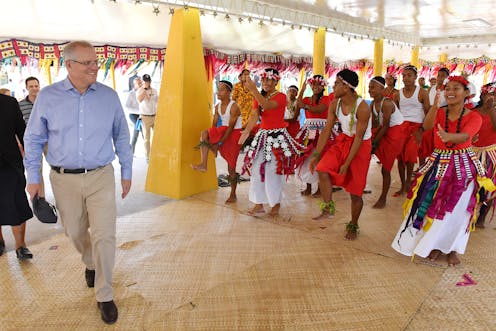
I was once asked “why should Australians care about what happens in the Pacific? and my response was (or started with) "This is where you live”.
Being in the neighbourhood is a fact of geography. Being a good neighbour requires thought, care, activity, and participation. When it comes to being a good neighbour in the region, how has Australia’s statecraft rated in the past and how can it be improved for the future?
Two years ago I led a research team that spent a good while listening to Pacific islanders (from Fiji, Solomon Islands, and Vanuatu). I have distilled some of what we heard into what I describe as the “Australia paradox”. Essentially this means that for people in these countries, the relationship with Australia is far and away the most important one, the one they care the most about. And because they care so much about it, they want it to be better.
The importance of ‘how’, not just ‘what’
So how do we do it better? Is it more aid, better labour mobility, economic integration, more support for Pacific regionalism, all of the above? Everyone is looking for or putting forward an answer. But first, we need to look at the questions and what underpins them.
In the Pacific, the number one currency is relationships. Relationships need to be nurtured and built on solid foundations. The “how” of what Australia does has been given insufficient attention. The narrative of the Pacific step-up has been too much about the “what”. This has led to it being something that is perceived as being done “to” or “for” the Pacific. It is only by addressing the “how” that it can be elevated to something Australia does “with” the Pacific.
There are four components to establishing the solid foundation that is needed to sustain and enrich Pacific relationships: listening, talking, Pacific literacy, and capacity building.
Read more: Labor’s Pacific plan is underdone and risks further politicising foreign policy
When it comes to listening, there needs to be more of it, and it needs to be done better. Australian policymakers need to listen to a wider range of voices, and they need to be open to listening to things that may be uncomfortable to hear.
Most importantly, Pacific voices need to be the ones doing the talking. In particular, Pacific diaspora communities in Australia are key sources of knowledge and expertise who often feel that they are overlooked when it comes to critical conversations.
As for talking, a lot of what we have seen during this election campaign, particularly in regard to the pact between China and the Solomon Islands, indicates that there needs to be less bluster and more self-awareness and respect. The words that political leaders, commentators and journalists use matter. They can be offensive or even inflammatory. Solomon Islands is not a “fly-speck country” or a “little Cuba” and neither is it in anyone’s “back yard”.
Even without the hyped up political rhetoric of an election campaign, too often how the Pacific is discussed or reported on reveals some rusted on tropes and prejudices. It doesn’t require much scratching to see they are based on a toxic mix of racism and neo-colonialism. Not only is this unattractive, it is also counter-productive.
Australians need to improve their Pacific literacy
Pacific islanders know a lot about Australia, but the reverse is far from true. The Australian policy community and the wider society need to make a meaningful and sustained investment in building Pacific literacy. Too little is taught in schools and universities about the diversity and dynamism of the Pacific neighbourhood.
The mainstream media has paid too little attention to the Pacific, other than in a reactive, knee-jerk way. A major gap in the Australian consciousness relates to historical links. Fortunes were made by plantation owners in Queensland and New South Wales on the back of labour that was blackbirded from Vanuatu, New Caledonia, and Solomon Islands. This is part of a shared history, and it needs to be acknowledged and understood if there is to be shared prosperity in the region.
“Capacity building” is possibly the most commonly and over-used phrase associated with Australian policy in the Pacific. But Australia’s leaders and officials have their own serious capacity deficits in the development and implementation of policies in our region.
Particular areas of focus are linguistic and cultural capacity. An unwillingness or refusal to engage with the cultural underpinnings of Pacific ways of thinking and being is more than just bad manners – it is intellectually lazy and strategically inept.
Other partners, including New Zealand and China, are able to develop stores of social and political capital by investing in cultural capacity, and Australian recalcitrance does not go unnoticed by Pacific counterparts.
These are the building blocks that can create a foundation for whatever strategy, policy, programme or project Australia seeks to develop with Pacific partners. They can form the basis of reinvigorated relationships that will be nurtured by trust, reciprocity, and respect.


