

Feral horses in Australia’s high country are damaging peatlands, decreasing carbon stores
- Written by The Conversation
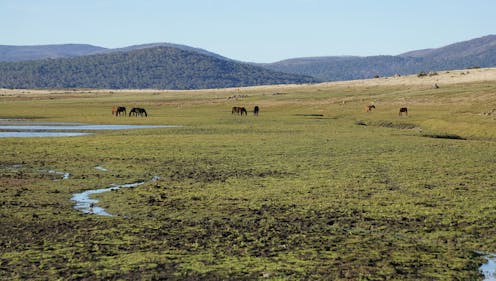
Peatlands store more carbon per square metre than any other ecosystem on Earth. These waterlogged, mossy bogs beat even dense rainforests for their ability to act as carbon reservoirs.
Under the right conditions, peat soils accumulate from carbon-rich, semi-decomposed plants. But if things go wrong, the carbon balance can be tipped in the other direction, releasing carbon into the atmosphere.
We wanted to know if feral horse grazing and trampling is reducing the amount of carbon Australia’s alpine peatlands can store. These peatlands are found in alpine and mountainous regions of Tasmania, Victoria, New South Wales and the Australian Capital Territory. But they’re quite rare on the mainland, restricted to areas such as those frequented by feral horses in the Snowy Mountains.
In our new research, we sampled peat soils from areas with and without feral horses in Kosciuszko National Park, NSW. We found peatlands untouched by feral horses store almost 50% more carbon. In degraded peatlands, where horses had trampled all of the plants leaving bare soils at the surface, carbon storage was even lower.
Brumby numbers are booming
Australia has more feral horses than any other country and their numbers have been growing.
A 2020 survey estimated the alpine horse population was increasing at 23% a year. A more recent survey published in December 2022 estimated there were more than 18,000 horses in Kosciuszko National Park alone.
Unfortunately, these large, hard-hooved animals are causing soil erosion and compaction.
In peatlands, where soils are soft and wet, the damage from grazing and trampling is even more pronounced.
Horses travel through peatlands to access drinking water in creeks and pools. This has degraded peatlands in the Australian Alps.
In March 2022, we sampled soils from 12 alpine and subalpine peatlands in Kosciuszko National Park. Seven of these sites had been degraded by feral horses and five hadn’t.
Where there was no evidence of horse activity, the peatlands were storing 45% more carbon in their soils than peatlands with evidence of horses. In heavily trampled areas, where all vegetation had been removed by horses, carbon storage was 16% lower than where vegetation remained.

Why are brumbies bad for carbon storage?
When peatlands are intact, healthy sphagnum moss and other plants capture atmospheric carbon dioxide (CO₂) through photosynthesis. Over time, carbon-rich plant material including decaying plant matter builds up as the peat soil.
But if the plants are grazed or trampled, they can no longer capture CO₂.
We also found degraded peatlands also had higher soil nitrogen concentrations, likely due to inputs (fertilisation) from horse waste.
In agricultural systems, having more nitrogen in the soil is generally a good thing. Unfortunately the opposite is true for peatlands, which are naturally low in nitrogen. Even small increases in nitrogen can reduce moss growth and survival and allow other types of plants to displace them, while also promoting the growth of microbes that break down carbon-rich plant matter and release yet more CO₂.
Increased peat nitrogen can also lead to higher emissions of nitrous oxide (N₂O), a very potent greenhouse gas. This means the global warming potential of degraded peatlands might be even higher than previously thought.
We know from our previous research that much of the peat carbon lost from horse-impacted peatlands is emitted as CO₂. Peatlands degraded by horses are losing CO₂ to the atmosphere, while intact peatlands are taking up CO₂.
Peatlands can recover but they need our help
Our findings support land managers’ efforts to protect and restore these peatlands, which are recognised as a threatened ecosystem under national environmental law. Facilitating long-term peatland carbon storage is a nature-based climate solution – we need to ensure our peatlands can perform at their best now, more than ever before.
Australia’s alpine peatlands deserve our protection. They are important for many reasons. These include controlling freshwater flows at the source of our most valuable water catchments. Peatlands also provide vital habitat for rare and endangered species such as the corroboree frog, alpine water skink and broad-toothed rat.
The good news is we know, through this study and our previous research, that grazed and degraded peatlands can recover over time. The peatlands we sampled that didn’t have evidence of feral horses had historically been grazed by sheep and cattle, which were widespread throughout the Australian Alps last century.
In the decades since domestic livestock grazing ended in the NSW Alps, a thick healthy layer of moss and other peatland plants has regenerated. High concentrations of peat soil carbon are building up again.
Recovering soil carbon, however, is not quick. In the midst of the climate crisis, we don’t have 50 years to wait for our peatlands to regain their carbon storage function while they recover from degradation by feral horses.
We have already lost about half of our peatlands, mainly through grazing and fire. Many may never recover.
The best way to ensure the health of Australia’s remaining peatlands is to protect them from harm to begin with. We need to keep horses and other large feral animals out of our peatlands.
 We sampled soil from peatlands close to where this photo was taken on the Cascade Hut Trail, near Dead Horse Gap and Thredbo ski resort in Kosciuszko National Park.
FiledIMAGE, Shutterstock
We sampled soil from peatlands close to where this photo was taken on the Cascade Hut Trail, near Dead Horse Gap and Thredbo ski resort in Kosciuszko National Park.
FiledIMAGE, Shutterstock
Protect and restore Australia’s alpine peatlands
Under the Kosciuszko National Park Wild Horse Heritage Management Plan, adopted in 2021 and amended in 2023, the NSW government is taking steps to protect the alpine environment. However, horses will remain in defined in “retention areas” (albeit in lower numbers). This will require extensive fencing of peatlands within the National Park to protect them from horses.
In most situations, other interventions are needed to restore peatlands such as slowing drainage to keep water within the peatlands. This will encourage peatland plants to regrow.
Where surface vegetation has been removed, mosses can be transplanted from healthy peatlands. Shading may help speed their recovery.
By protecting Australia’s alpine peatlands from feral animals, we can help them fight climate change, while looking after our water catchments and threatened species.


