

Cameras reveal wombat burrows can be safe havens after fire and waterholes after rain
- Written by The Conversation

Australia’s unprecedented Black Summer bushfires in 2019–20 created ideal conditions for misinformation to spread, from the insidious to the absurd.
It was within this context that a bizarre story went viral on social media.
This was a tale of heroic wombats herding other animals into their fireproof burrows to save them from the flames. At the time, we explained this story was largely inaccurate. But now we’ve investigated in more detail, and confirmed it may contain a kernel of truth.
The burrows of common wombats are deep and complex. They can be over 15 metres long with multiple entrances and chambers. So, even if wombats don’t shepherd wildlife into their homes, their burrows might act as “fire refuges” – providing vital shelter, food, and even drinking water during and after a bushfire.
Cameras reveal wombat burrows can be safe havens after fire (Charles Sturt University)Wombat burrows are not just for wombats
We set up 56 cameras in forests north of Albury, New South Wales, which burned during the Black Summer bushfires. Some areas suffered more than others, so we were careful to select sites that varied in how severely they burned.
Half of the cameras were pointed at wombat burrows and the other half were set up nearby – in areas with the same types of plants, but no burrows. Then we monitored the burrows from June 2021 to April 2022 to see which animals used them, and how.
We found 56 animal species at wombat burrow sites (19 mammal species, 33 bird and four reptile).
Native species such as bush rats, agile antechinus, lace monitors and birds such as the painted button-quail, were more abundant in and around burrows than nearby control sites. Even a threatened species, the heath monitor, was seen emerging from a burrow.
Wombat expert Barbara Triggs, who literally wrote the book on wombats, had seen several of these species “scurrying away from burrow entrances” and emerging “from small crevices in the the walls” of wombat burrows. So our results are supported by her, and others’, observations.
Overall, burrows were hotspots of mammal activity, with more mammal species recorded at burrows than control sites. These tended to be smaller mammals, presumably because they can use the burrows without bothering the wombats.
Bigger animals such as kangaroos and wallabies tended to avoid the burrows. They may have been wary of a encountering a cantankerous wombat. Wombats are known to defend their territories.
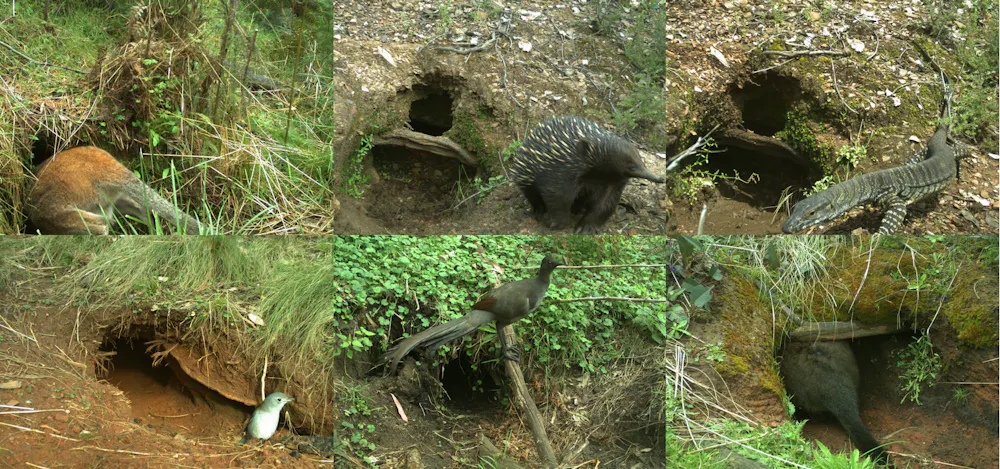
We observed some fascinating behaviour at wombat burrows. In total, 31 species were found interacting with the burrows. This included 30 species inspecting the entrance, 11 foraging (feeding in or directly around the lip of the burrow), and ten entering or emerging from burrows.
We also saw animals drinking and even bathing in pools at burrow entrances that temporarily filled with water after rain.
While water was not scarce during our study period, this suggests wombat burrows are providing a valuable ecosystem function that might help other wildlife. It’s an interesting observation that warrants further investigation.
Burrow use by several native wildlife species was highest in areas that burned most severely. This supports the idea that wombat burrows act as a kind of refuge for native wildlife after fire.
Underground networks
Our results are just the tip of the iceberg. Globally, many burrowing species provide habitat for others. From the American badger to the giant armadillo, burrows provide shelter and resources for species across many ecosystems.
Closer to home, sand goanna burrows provide shelter for at least 28 animal species. And bilby burrows have been described as an “outback oasis” for their role in supporting birds, reptiles and mammals.
We’re not the first to find animal burrows offer refuge after fire. A US study published in 2018 found gopher tortoise burrows in burned areas had 8.5 times more wildlife species than burrows in nearby unburned areas.
 Wombats are the largest burrowing marsupials in the world.
Grant Linley
Help wombats help others
The star of our research is the bare-nosed wombat. While not listed as threatened with extinction, their numbers have declined markedly since European colonisation.
Our research adds to a growing body of evidence that suggests protecting wombats will benefit various species across many Australian ecosystems.
As large and severe fires become more common in forests across southeastern Australia, our wildlife will need all the help they can get – including the humble wombat burrow.


