

‘When I’m 80, I want to remember how f***ing hot I looked’: why Bridgerton’s steamy carriage scene breaks new ground
- Written by The Conversation
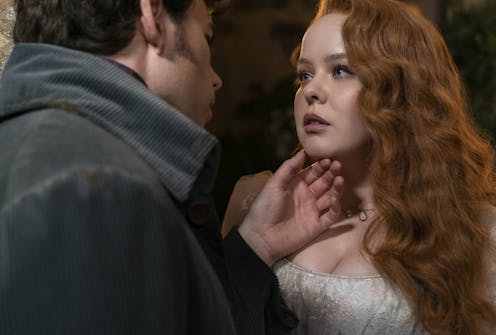
There has been much excitement in the lead up to the first four episodes of Bridgerton’s season three, featuring leading couple Penelope Featherington (Nicola Coughlan) and Colin Bridgerton (Luke Newton).
For anyone who tuned-in to previous seasons, you’ll know Penelope is none other than the famed gossiper Lady Whistledown. With this intriguing backstory, and two seasons’ worth of investment into her character, it’s no wonder she is being described as Bridgerton’s “most compelling protagonist to date”.
But this season is also important for another reason: it provides a rare example of a larger woman as being sexually desirable, wanted and erotic.
The premise
In season three (the rest of which is due on June 13) Penelope is heartbroken in overhearing Colin – someone she loves – tell other men he would never court her.
She sets off to find herself a husband. A makeover sparks some interest from potential suitors, but her confidence falters in social settings. Since Colin feels guilty about what Penelope overheard, he decides to give her “lessons” to develop her confidence. Soon enough, her charm shines through and Penelope finds herself a match in the wealthy and aloof naturalist Lord Debling (Sam Phillips).
Importantly, Penelope’s “makeover” does not involve weight loss, nor is her weight framed as an obstacle to her finding a suitor in the show (as it is in the book series).

Fat stigma in the media
Fat stigma refers to hatred, bias and prejudice targeted at someone on the basis of their body-weight and size.
Research has found it significantly impacts people whose bodies don’t fit a certain size or norm. In fact, it’s so common many people think it’s okay to engage in discrimination against those with larger bodies on the premise of being “concerned for their health” (a phenomenon known as “healthism”). This so-called concern is often cited as the reason for a lack of representation of larger bodies in media.
Fat discrimination is particularly challenging when it comes to sex. In Western culture, desiring a larger person is often regarded as a fetish rather than a legitimate interest, which can result in shame for those feeling the attraction.
Larger women can experience a variety of challenges in sex and dating, such as men refusing to date them in public, or introduce them to loved ones. They may be treated poorly in sexual encounters, or told to settle for abusive or unfulfilling relationships on the premise that they can’t have high expectations for love, sex and romance.
In mainstream media, larger women tend to serve as tropes for humour – even when they have sexual interests. One example is Rhonda (Cynthia LaMontagne) from That 70’s Show (1998–2006), who was regarded as too big and too boyish for her boyfriend, Fez (Wilmer Valderrama).
Eddie Murphy’s Norbit (2007), in which Murphy dons a fat suit to play his character’s wife, Rasputia, is another problematic example. Rasputia is characterised as being tyrannical and sadistic, and her large body is consistently used as a site of horror for comedic purposes.
More contemporary examples have pushed back against these mean-spirited representations. Side characters such as Fat Amy (Rebel Wilson) in Pitch Perfect (2012), Donna Meagle (Retta) in Parks and Recreation (2009-2015) and Detective Shannon Mullins (Melissa McCarthy) in The Heat (2013) are loud, funny, sexual, witty, confident and crass.
This is a step forward from previous media, in which larger women are either non-existent, or are used as a humorous plot device. But at the same time, these characters aren’t romantic leads. Even in Netflix’s Sex Education (2019-2023) – a show praised for its diversity in representing sex and sexuality – doesn’t feature larger people as romantic interests.
On the rare occasion a larger woman is cast as a romantic lead, we don’t see much sexual activity. She may be kissed, but anything further is usually absent.
A celebration of sex and romance
Bridgerton is, at its heart, a story about love, sex and romance. And season three is so far remarkable in its depiction of all of these.
Despite her feelings, Penelope is trying to move on from Colin and wants to find herself a sensible and practical match. Colin, however, grows more despondent as Penelope becomes close to Lord Debling – a handsome, kind and solid match for her.
Colin has erotic dreams about Penelope. He continously seeks her out at social events. He even interrupts an almost-proposal from Lord Debling. All of this is in stark contrast with the common trope of larger girls only experiencing unrequited love.
Penelope and Colin’s NSFW carriage scene is transgressive as a depiction of sex in which the larger woman receives (rather than gives) pleasure and is framed as the subject of love and desire. Not only does Colin desire Penelope, he does so in a way that centres her pleasure and consent. The resulting moment is highly intimate.
The carriage pulls over, interrupting the pair as they arrive at Colin’s house. Colin helps Penelope fix herself up and extends a hand to help her out, but she is worried his family will see her. In response, he simply asks Penelope to marry him.
This detail also goes against the portrayal of larger women as not being suitable to desire in public.
Empowerment for one and all
Actress Nicola Coughlan told interviewers she specifically wanted to film one particular nude scene (to come in later episodes):
It just felt like the biggest ‘fuck you’ to all the conversation surrounding my body; it was amazingly empowering. I felt beautiful in the moment, and I thought: ‘When I’m 80, I want to look back on this and remember how fucking hot I looked!’
Indeed, Bridgeton’s focus on an erotic romance with a larger heroine is an important push-back against society’s dislike of “big” bodies. It challenges a harmful narrative that seeks to dictate who is and is not worthy of love, sex and desire.
Spoiler alert: we all are.


