

Buried kelp: seaweed carried to the deep sea stores more carbon than we thought
- Written by The Conversation
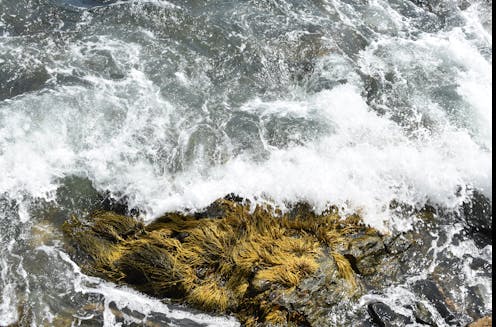
Deep in the ocean lies the world’s largest active carbon reservoir, which plays a pivotal role in buffering our planet’s climate. Of the roughly 10 billion tonnes carbon dioxide we emit each year, about 3 billion tonnes are taken up and stored in the oceans – and largely by plants.
When we consider natural carbon storage in the deep oceans, we generally focus on phytoplankton. Trillions of these microscopic plants live in the surface waters all across the oceans. When they die, they sink to the ocean floor, transporting carbon to the depths.
But there’s a missing piece of the puzzle. Our two new studies show coastal vegetation such as seaweed forests are more important to natural carbon storage than we thought. Around 56 million tonnes of carbon in the form of seaweed is carried into the deep ocean each year.
For carbon to be stored for hundreds of years, it has to enter slow cycling pools of carbon in the deep ocean. But most seaweeds only grow in shallow coastal seas. How can they get there?

Rivers in the sea
For decades, deep sea explorers have reported surprising findings. Pieces of seaweed and other coastal plants appear where they shouldn’t be.
Fragments of seaweed are often caught in deep-sea trawls, or recorded by submarines and underwater robots during surveys of the ocean floor. Seaweed DNA has been detected in deep sea water and sediments in all of the world’s oceans, as deep as 4 kilometres down and up to 5,000 km from the closest seaweed forest.
But how can seaweeds travel that distance?
 A piece of seaweed on the deep ocean floor.
Karen Filbee-Dexter/KELPEX, Author provided (no reuse)
A piece of seaweed on the deep ocean floor.
Karen Filbee-Dexter/KELPEX, Author provided (no reuse)
Our team discovered part of the answer. Seaweed can be carried by large “underwater rivers”, which flow from coastal waters along the seafloor across the continental shelf and into the deep.
These currents form when localised cooling causes cold dense coastal water to rapidly sink below warmer offshore surface waters. The dense water slides down the slope of the seafloor, following the topography like a river, and carrying with it large quantities of seaweed to deeper areas.
In Western Australia, these flows of seaweed and coastal vegetation towards the deep ocean happen most during colder months, when conditions allow these underwater rivers to form. During these months, storms often hit coastal waters, ripping up seaweed and filling the water with seaweed fragments.
These underwater rivers are a well-documented phenomenon in Australia. But are these ocean currents transporting seaweed and their carbon elsewhere?
We worked with an international team of scientists to find out. To do so, we tracked seaweed from coastal waters to the deep ocean using advanced ocean models.
The hidden role of seaweed forests in oceanic carbon export
Our findings were clear. Seaweed forests do, in fact, transfer substantial amounts of carbon to the deep ocean in many parts of the world.
This phenomenon is particularly high in the kelp forests of Australia’s Great Southern Reef, which stretches 8,000 km from Kalbarri in Western Australia to Coolangatta in Queensland.
The seaweed forests of the United States, New Zealand, Indonesia and Chile are also carbon transport hotspots.
While phytoplankton still sink vast amounts of carbon, our discovery suggests the plants of the coastal ocean transfer more carbon than we thought.
Mangroves, salt marshes and seagrass all contribute to these flows of carbon, but seaweed forests are really big contributor. These forests are made up of large brown algae such as kelp and rockweed species, which form extensive hidden forests. Seaweed forests – such as Tasmania’s disappearing giant kelp forests – are the largest and most productive coastal ecosystems on the planet.
Globally, these forests cover an area twice the size of India, and fix as much carbon during their growth as the northern forests of Canada – nearly 1 billion tonnes a year.
Of this carbon, our research suggests between 10 and 170 million tonnes makes it to the deep ocean every year.
 After storms or big swells, seaweeds such as kelp are battered into fragments. Some of this is carried to the deep.
Thomas Wernberg/UWA, Author provided (no reuse)
After storms or big swells, seaweeds such as kelp are battered into fragments. Some of this is carried to the deep.
Thomas Wernberg/UWA, Author provided (no reuse)
A threatened ecosystem
Many of us don’t give seaweed much thought. But underwater seaweed forests play a vital role. These forests give shelter and home to huge numbers of fish and other marine species. They improve water quality and boost biodiversity. And now we know they help store carbon for hundreds of years.
Like many other ecosystems, underwater forests are at risk. Hotter seas from climate change, coastal development, pollution and overfishing have pushed seaweed forests to die off faster than most other coastal ecosystems.
Their fate has worsened in recent decades. The ocean is getting hotter, faster, bringing with it longer lasting and more frequent marine heatwaves.
 Kelp forests offer homes, shelter and food to many species.
lego 19861111/Shutterstock
Kelp forests offer homes, shelter and food to many species.
lego 19861111/Shutterstock
In Tasmania, the heating ocean has brought new species to seaweed forests, which now have subtropical fish species and voracious sea urchins. These urchins are chewing through the state’s kelp forests.
In Western Australia, a severe marine heatwave struck in 2011, wiping out kelp forests along 100 km of coastline. These forests have not recovered.
When we lose seaweed forests, we lose their natural ability to transfer carbon to the deep ocean. But their loss also threatens the other species who rely on them, and the half a trillion dollars of value they provide to us.
We should think of conserving seaweed forests in the same way we do forests on land. Scaling up restoration where forests have been lost is vital to ensure these unsung plants can keep supporting us – and help store carbon.


