

How long should everyday appliances last? Why NZ needs a minimum product lifespan law
- Written by The Conversation
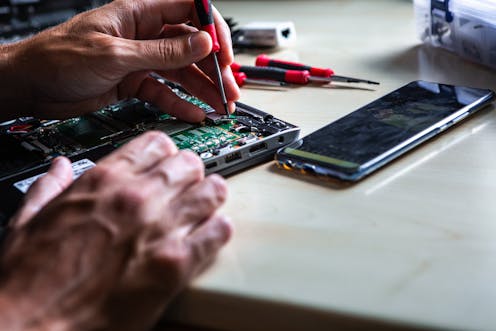
When a product or appliance fails, how often have you asked yourself whether it’s even worth fixing? Chances are, even if the item is repairable, the cost and inconvenience mean buying a new replacement can make more sense.
The fact is, modern products often fail to meet expectations for longevity. A 2023 Consumer NZ survey of mobile phone owners, for example, revealed 89% of faulty devices were no older than four years. Half were less than two years old.
According to a 2020 briefing from the European Environment Agency, smartphones, TVs, washing machines and vacuum cleaners were all “used on average for shorter periods than both their designed and desired lifetimes”.
The availability of parts or the technical demands of fixing complex products also often limit repair options. New Zealand consumers are often frustrated by how difficult and pricey repairs have become.
The Consumer Guarantees (Right to Repair) Amendment Bill now before parliament offers some hope. It builds on the Ministry for the Environment’s 2021 consultation document, “Taking responsibility for our waste”.
The bill seeks to force manufacturers to provide spare parts, repair information, software and tools to consumers for a reasonable period after the sale of goods. But there is still too much doubt about how long those goods and parts should last in the first place.
Fighting planned obsolescence
To give manufacturers and consumers more certainty, establishing minimum product lifespans is essential. This would be defined as the period for which a product can perform its intended function effectively.
Repairs can extend this functional lifespan. So it is also important to factor in a “repairability period” when products can be repaired at the consumer’s expense, beyond the manufacturer’s implied or expressed guarantee. Spare parts, repair information and necessary tools must be made available.
By mandating minimum product lifespans, we would begin to tackle the fundamental problem of planned obsolescence. This refers to the deliberate strategy of some manufacturers to design and engineer products that become outdated within a specific timeframe.
Planned obsolescence can involve integrating components that are likely to fail sooner than the product itself, withholding spare parts, or requiring prohibitive information and proprietary tools for repairs.
Ultimately, it is about maximising profitability, and extends from smartphones and appliances to automobiles and farm machinery. It fosters a throwaway culture, adding to the strain on waste systems and landfills.
In New Zealand, e-waste is the fastest-growing waste stream. Around 99,000 tonnes a year is generated, only 2% of which is recycled.
Making manufacturers comply
Establishing a right to repair is therefore essential for tackling planned obsolescence and encouraging sustainable consumption. But New Zealand can go further and look to other countries where minimum lifespans for certain products have been introduced.
In Europe, for example, manufacturers are required to provide spare parts for refrigeration devices for seven years after purchase. For washing machines, dryers and dishwashers the requirement is ten years.
France is recognised as the leading European jurisdiction for minimum lifespan requirements, with manufacturers having to provide clear information about product durability. Spare parts for certain electronic and electrical products must be available for at least five years from when they hit the market.
The United Kingdom also requires manufacturers to provide spare parts for electronics and appliances for up to ten years.
Reducing waste
New Zealand could emulate these examples and start requiring minimum lifespans for common products such as household appliances (washing machines, dryers, dishwashers, refrigerators) and electronics (televisions, laptops and smartphones).
Consumer NZ has already developed estimated life expectancies for washing machines (ten years), dryers (ten to 11 years), dishwashers (nine to ten years), fridges and freezers (ten to 11 years), ovens and stoves (13-15 years), televisions (seven to eight years), microwaves (eight years) and laptops (five years).
There would need to be penalties for non-compliance. French law, for example, imposes fines of between €3,000 and €15,000 (roughly NZ$5,000 to $25,000) for failure to meet the mandated standards.
These policies and laws are about more than consumer protection. They are part of a wider movement to reduce unnecessary waste and encourage a circular economy.
New Zealand has big environmental challenges of its own, and introducing minimum product lifespans and the right to repair would be one way to make a practical difference.


