

A fierce battle is being fought in the soil beneath our feet – and the implications for global warming are huge
- Written by The Conversation
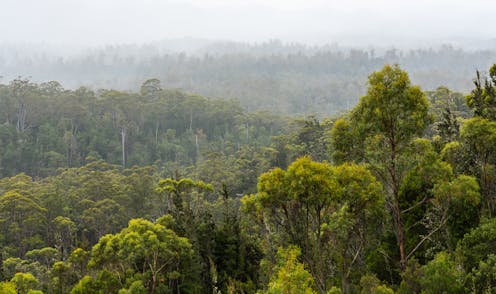
As humanity continues to burn fossil fuels, the delicate balance of life on Earth is changing. That’s true of trees, many of which are growing faster as a result of increased carbon dioxide (CO₂) concentrations in our atmosphere.
But not all trees are responding in this way. In particular, eucalypts – Australia’s iconic forest trees – haven’t benefited from the increase in CO₂ as they were expected to.
Why not? Our new research, published today in Nature, shows it comes down to a below-ground battle for phosphorus, a mineral nutrient in soils that is essential for tree growth. The results suggest in some parts of the world, increased CO₂ means tiny bugs in the soil “hold onto” their phosphorus, making less available for trees.
This is alarming news, because according to current projections, global forest growth is meant to limit damage from global warming.
What our study involved
Our study used data from a Western Sydney University experiment known as “Eucalyptus Free Air CO₂ Enrichment”, or EucFACE. The experiment is located in a century-old Cumberland plain woodland in Sydney’s Hawkesbury district.
CO₂ is released into the woodland through a computer‐controlled system. Scientists then monitor the effects on trees, soils and the broader ecosystem. Over six years, CO₂ was raised to the levels expected around the year 2050 (according to the current business-as-usual emissions trajectory).
Our previous studies found the woodland trees did not show any extra growth at high CO₂ levels. We suspected the low availability of soil phosphorus was the cause, and set out to test this.
Phosphorus is crucial to the process of photosynthesis that makes trees grow. Phosphorus in soil is provided by bugs known as microbes. These micro-organisms break down dead and decaying matter, and in the process change phosphorus into a form that plants can take up with their roots.
Most Australian soils are naturally low in phosphorus, because they are derived from ancient, nutrient-depleted rocks. The same is true for most soils in tropical and subtropical regions. That makes the phosphorus service provided by microbes even more important.
We sampled phosphorus in all parts of the ecosystem, tracing its journey from the soil to the trees. We found under high-CO₂ conditions the microbes keep more of the phosphorus they produce, to aid their own metabolism. This left less available for trees to take up.
This occurred despite the trees trying to “bargain” for phosphorus by releasing extra carbon into the soil to feed the microbes.
What’s more, trees are big “recyclers” of phosphorus – they remove half of the phosphorus from any leaf before it falls. But this was still not enough to support extra tree growth.
EucFACE is designed to predict the effects of rapidly rising atmospheric carbon dioxide on Australia’s unique native forests.Why this matters
Our study is the first to show how the phosphorus cycle is affected by high CO₂ – and in particular, the role of soil microbes.
The results are important to predicting soil phosphorus availability, and plant productivity, in woodlands and forests as CO₂ levels increase in the atmosphere.
Current climate projections assume increasing CO₂ will lead to more forest growth globally. Forests are a vital carbon “sink” – that is, they draw down carbon from the atmosphere. So the increased forest growth was projected to go some way to limiting the effects of climate change.
If our results are taken into account, future warming would be higher than current projections. However, it’s important to verify our results in other locations, with other tree species. New experiments are being formed by overseas teams, including in the Amazon rainforest, to test the findings.
Importantly, our results don’t mean that forests are not a crucial sink for carbon. Forests hold a vast quantity of carbon. Avoiding deforestation and planting new forests are both valuable means of maintaining and adding to carbon stores.
Our research demonstrates the importance of considering soils when growing trees. We also hope our research stimulates further efforts to find phosphorus in ecosystems, especially in tropical rainforests where phosphorus is often greatly limited.


