

We dated a sacred Aboriginal women’s site used for birthing ceremonies and discovered 7,000 years of tool making
- Written by The Conversation
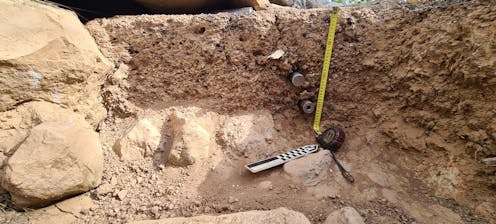
Investigation of a sacred area at Avon Downs in Jangga Country, Central Queensland, has uncovered evidence of stone tool production in a place that was traditionally restricted to women.
We detail our findings in newly published research in collaboration with archaeological expert Liz Hatte and Jangga Elders Colin McLennan and Marie Wallace.
Our excavation of the layered sediments at Avon Downs reveals a long history of raw stone extraction and tool making. In the short period of our study, we recorded about 1,500 stone artefacts on the surface and under the ground.
And this is just the tip of the iceberg, as we expect more detailed evidence of tool production to be found beneath the site’s surface and in neighbouring areas.
By dating these artefacts, we have traced a 7,000-year history of continuous stone tool production by Aboriginal women – including objects traditionally associated with men. We are also the first team to ever date a sacred Aboriginal women’s area.

Hundreds of generations of tool making
Using a technique called optically stimulated luminescence, we measured the age of individual sand grains within the artefact-rich layers of the hill slope. We were then able to date the artefacts by association.
The uncovered artefacts varied in age from about 430 years ago (before the first Europeans arrived) to some 7,000 years ago. This implies the site was used for stone tool production and possibly as a sacred women’s area for hundreds of generations.
Jangga Elders Colin McLennan and Marie Wallace have a shared memory extending as far back as at least six generations. They understand the site has always been forbidden to men, as it continues to be today.
While some of the relevant sacred knowledge remains restricted, we can report Jangga women came to Gaio Nanhi Bura (women’s sacred place) to give birth and perform associated ceremonies until the turn of the 20th century.
Some of the stone tools were used in sacred ways, such as for cutting the umbilical cord of newborn babies, says Wallace. Drill points, ochre and a grinding stone and muller are further evidence of everyday tool making and decoration.
The rare discovery of an unfinished axe, ready to be ground and polished, is also somewhat surprising, as axe making is typically associated with male crafters.
 The axe blank found at the Thirteen Mile Creek site.
Irina Ponomareva
The axe blank found at the Thirteen Mile Creek site.
Irina Ponomareva
The site remains a direct link between modern Jangga women and their ancestors. Today’s Jangga women who have visited and worked on the site describe feeling a strong sense of peace and belonging, as well as the presence of their ancestors.
Railway project disruptions
Like many other Aboriginal sites in Australia, the Avon Downs Women’s Area has faced threats. It sits in the way of the North Galilee Basin Rail Project, which stretches from the Carmichael coal mine to the port at Abbot Point.
Planning for this project started in 2012, prompting cultural heritage surveys, assessments and negotiations with Traditional Owners.
In 2014, the sacred area at Avon Downs was revealed following a survey and consultations with Jangga Elders. The artefacts themselves, which had been partially hidden by thick spinifex grass, were discovered in 2020 during cultural heritage monitoring before the clearance of native forest.
After extended negotiations with the Carmichael project representatives, and some news coverage of the archaeological discoveries, a solution was found.
For the benefit of future study, the site was conserved as a protected portion inside the rail corridor – but not without any loss. This portion is a fragmented piece of a much larger complex of camp sites and knapping floors (areas where stone tools were shaped) – but there is no longer free access between these individual sites.
So while the railway project will not run directly through, it has still compromised the integrity of the area.
 A map with the location of the site.
Irina Ponomareva
A map with the location of the site.
Irina Ponomareva
Protecting sacred area
Sacred Aborignal women’s sites are often difficult to protect in their entirety. It can be challenging to demonstrate their cultural value when the associated knowledge is restricted to a few members of the Aboriginal community.
The protection of these sites has been hampered by past misunderstandings of Aboriginal cultures, as well as racism, sexism and misogyny.
Throughout Australia, there are only a handful of examples where Aboriginal women have chosen to disclose secret information to protect sacred women’s sites for future generations.
 Jangga Elder Marie Wallace and her granddaughter Sharnai McLennan taking a break at the site, which is named Thirteen Mile Creek.
Irina Ponomareva, Author provided (no reuse)
Jangga Elder Marie Wallace and her granddaughter Sharnai McLennan taking a break at the site, which is named Thirteen Mile Creek.
Irina Ponomareva, Author provided (no reuse)
When explaining the importance of protecting and recording Jangga traditional knowledge and culture, Wallace emphasised the Jangga people’s belief that such sacred places can even be dangerous:
You are not supposed to touch anything, or take away something. They can make you sick.
Jangga people maintain the sanctity of these areas in their collective memory, providing a seamless connection between living memory and the dated sequence of sediments and artefacts.
And while their current cultural traditions in the Avon Downs Women’s Area can be traced back to several hundred years, we may be able to extend this to several thousand as more archaeological evidence becomes available.


