

Across Southeast Asia, people paying respect to Spirits living on their Land is a normal part of life
- Written by The Conversation

Travelling through Southeast Asia, many tourists might notice small roadside shrines and Spirit Houses. Adorning shopfronts and homes, this practice ranges from makeshift shrines to ornate architectural buildings. Depending on regional differences, Spirit Houses might be filled with votive offerings such as talismans, flowers, fresh fruit, alcoholic beverages and incense.
Part of the overlooked every day, I didn’t know much about the function – let alone the social frameworks – for the Spirit House. Growing up in Vietnam in a Catholic family among our Buddhist and Daoist neighbours, I was aware that shrines, with their many variations, were incorporated across all different religions, classes of people and ethnic communities.
Spirit Houses and shrines were simply a part of daily life.
It was not until my family resettled to Australia that I noticed the distinct lack of Spirit Houses in this new environment. Although memorials for traffic accidents can be spotted along roads and highways, it would be unusual to encounter small roadside shrines and altars.
I had not given this much thought until one of my Uncles came to visit us from Vietnam. He remarked on how the roadside memorials in Australia seemed to honour victims of accidents, rather than be a preventative way to protect people from the traffic. His passing comment was completely at odds with my own spiritual logic. How can a shrine or Spirit House possibly offer protection for passersby?

Memories of loss
Throughout Vietnam’s terrifying and turbulent history, my Uncle explained, most places where people travel through are burdened with memories of loss and violence. Forgotten massacres and personal tragedy are embedded into the landscape.
No matter how beautiful the scenery, there was always the chance any place could have once been a place of unspeakable horror.
According to Vietnamese folklore, these tragedies and sins can turn common people (with our human capacity to perpetrate horrific crimes) into powerful and dangerous resident Spirits. Haunting almost every corner, these Spirits can cause retribution and make chaos in the world of the living.
 Appeasing local Spirits is a widespread practice throughout East and Southeast Asia.
Margarita Young/Shutterstock
The cult of appeasing these local Spirits continues to be widespread throughout Vietnam and many parts of East and Southeast Asia.
In Thailand, ornately decorated Spirit Houses are common fixtures outside government buildings, hotels, cafes and beauty parlours. They work by attracting beneficial Spirits who fend off more troublesome ones. Strawberry Fanta is the modern offering of choice, symbolising the blood offering rituals and animal sacrifices of the past.
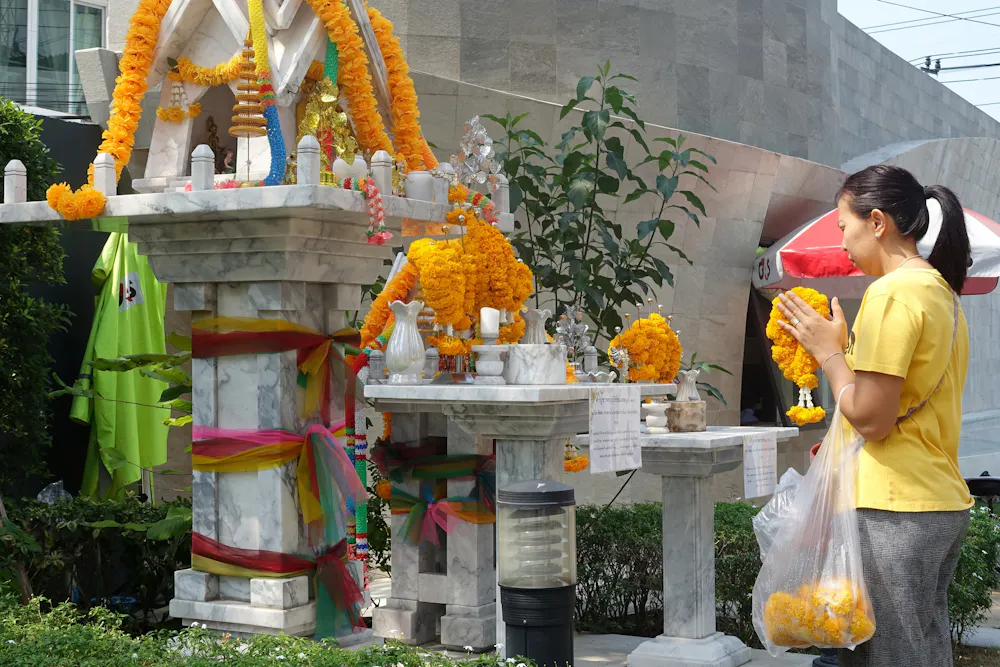 A woman prays at a Spirit House in Bangkok, Thailand.
1000 Words/Shutterstock
In eastern Sumba, an Indonesian island situated between Bali and northern Australia, the Spirit House takes the form of a Katoda, an elevated altar on top of a forked timber post. Whenever land is cleared for farming, the boundary between undisturbed and broken ground is mediated by this spiritual marker.
Richly decorated with raw and cooked food parcels, alongside raw and processed cotton and handmade trinkets, these posts represent a fruit-laden tree to compensate Spirits exiled from their cleared lands. In exchange, they are provided with a more elevated and delicious resting place. This practice confers local forest Spirits with the status of Guardian Spirits who watch over the property.
 There are countless altars across Singapore.
Justin Adam Lee/Shutterstock
Less noticeable, but just as customary, are the countless altars sheltering Spirits in Singapore’s alleyways, Hawker centres and underground car parks.
Established by the old traditions of Chinese Daoist merchants setting up their shops with an accompanying Spirit House for prosperity, these car park altars continue to offer shift workers and patrons at places like the Hilton Singapore with much needed spiritual respite and protection amongst the hustle and bustle of city life.
Respect and duty
The Spirit House as a cultural marker of respect and spiritual duty not only acts to appease and honour the disturbed Spirits on the Lands where new people have migrated to, built their homes, farms, and businesses on, but is an important expression of a traditional Land Acknowledgement.
Throughout East and Southeast Asia, there is a profound awareness that all sites are potentially loaded with unspeakable trauma and pain. To pay respects to those Spirits still living on their Lands becomes a normal part of life. This has resonance with First Nations communities in Australia and others around the world who share a familiar view of belonging and sharing collective duty to Land.
 Wooden carved altars for sale in Da Nang, Vietnam.
Ilona Bradacova/Shutterstock
My Uncle reminded me the daily offerings that Vietnamese people make at these Spirit Houses are not merely empty gestures like some bureaucratic Land Acknowledgement. Instead, the placement of food or the burning of incense at a Spirit House seals an unbreakable cosmological and spiritual contract.
Most relevant to rural areas lacking good access to state welfare and social security, these daily offerings signal to all passersby – and any passing Spirit – that the householder will offer reasonable sustenance, respite and safety for the night.
To reject or break this contract immediately rescinds the goodwill and protection of the Guardian Spirits. The householder will expect to face the full force of spiritual retribution and chaos from a traumatised Land.


