

Australia’s art industry is too white. A unique regional curatorial program provides a model to help change this
- Written by The Conversation
Non-white artists and curators are underrepresented in the Australian art industry.
The art industry has made active efforts to change this, for example by creating designated roles for First Nations arts workers. But more work needs to be done.
In 2018, Diversity Arts Australia’s Shifting the Balance Report looked at the cultural diversity of leadership in the arts. It found in the visual arts, craft and design sector, 89% of leadership positions were held by people who identify as Anglo-Celtic.
Across Australia’s institutions, positions held by leaders of colour are generally in major art institutions in urban centres. Despite diverse populations across the continent, First Nations and culturally diverse people are especially underrepresented in leadership positions in regional areas.
Leadership roles in Australian galleries often require a background in curation. This means creating opportunities for diverse emerging curators is essential for future leadership diversity in the art sector.
Regional galleries are uniquely positioned to lead the transformation of Australia’s art industry towards greater cultural diversity.
The potential of the regions
Emerging curators face many challenges, including lack of institutional resources and opportunities to work with established organisations.
Non-white curators encounter additional challenges. Too often, exhibitions aren’t staged with culturally appropriate methods.
These challenges are again increased for non-white curators in regional areas, who have fewer opportunities to work with galleries than their city-based counterparts.
Regional areas are witnessing a surge in cultural diversity due to factors like migration and cost-of-living pressures in bigger urban areas.

Yet, despite these ongoing demographic shifts, Indigenous and migrant communities in these regions still face institutional and social challenges.
We have both been involved in the HERE+NOW program at Wollongong Regional Art Gallery as artists and curators. With a focus on artists and curators under the age of 30 with a connection to the Illawarra region, HERE+NOW is facilitating important change in the local community.
It is also a unique program in how it embraces key principles of decolonial and Indigenist practice.
Decolonial practice is the process of creating opportunities for restorative justice.
This could involve offering generous commissions to young First Nations artists without a significant history of showing in galleries. This challenges the gallery as a space for established artists, and redirects funding to First Nations communities.
Indigenist practice prioritises Indigenous leadership, and Indigenous ways of knowing, being and doing.
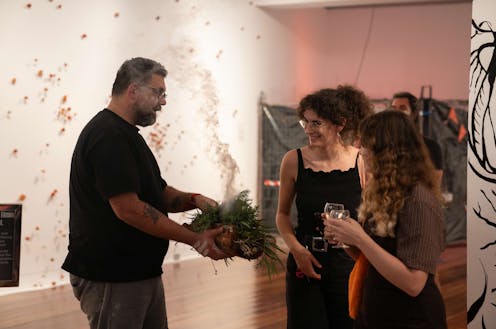
For example, building policies often forbid the use of smoke inside. But allowing a smoking ceremony within a gallery takes a step toward cultural health and safety. This initiative comes from Indigenous leadership through ongoing relationship-building between curators, galleries and local Indigenous community members.
New ways of working
Through the HERE+NOW program, emerging curators and artists can access institutional resources, get experience in working in established arts organisations and be paid for their work.
As curators, we experienced firsthand how this kind of initiative can address diversity in the arts.
In particular, we noticed three forms of institutional support that could be applied to other galleries throughout Australia to nurture emerging curators of colour.
1. Alternative recruitment strategies
To recruit artists to show in the exhibitions, we used community callouts and asked communities to share the callouts with people in their own networks.
This snowballing form of recruitment enabled opportunities for individuals beyond art industry social circles.
It also reached more non-white artists who had never considered being involved with a regional gallery.
 Recruitment enabled opportunities for individuals beyond art industry social circles.
Stephanie Beaupark
Recruitment enabled opportunities for individuals beyond art industry social circles.
Stephanie Beaupark
If this approach was embraced by the broader arts world we could see more diverse voices displayed in galleries.
By removing recruitment barriers we can create a more equitable cultural landscape that better reflects the diversity of regional communities.
2. Autonomy and flexibility
A high degree of autonomy for artists and curators was reflected in the curatorial and artist contracts.
Instead of measuring success through visitor numbers, it was defined by the diversity of audience demographics. Artists and curators were given free rein both physically in the gallery space, and conceptually through the messages communicated in the exhibitions.
With these in place, we were able to take calculated risks as curators to benefit our communities.
 Curators were able to take calculated risks to benefit our communities.
Abril Felman
Curators were able to take calculated risks to benefit our communities.
Abril Felman
While large institutions often plan exhibitions up to two years in advance, HEAR+NOW exhibitions are curated within six to 12 months. The shorter timeline enabled us to invite artists who couldn’t commit to a long-term project.
Increased curatorial autonomy and flexibility in the arts could lead to more experimental work, fostering innovation. It also allows for deeper, ongoing community connections.
3. Equal treatment of exhibition production and design
Unlike working in many emerging art spaces, HERE+NOW curators were given the same support in exhibition development as other exhibitions in the gallery.
This allowed for expanded possibilities for both curatorial and artistic visions.
This approach of not segregating “emerging” programs from the broader gallery calendar results in conventionally successful outcomes for the galleries.
At the same time, we were able to produce work that is authentic to diverse artists, curators and their communities.
A quietly radical opportunity
Our curatorial projects aimed to work with Indigenist and decolonial practice. The groundwork offered by the gallery ensured we were supported in our projects.
Institutional support is essential in supporting diverse artists and curators who often bring with them different methods and communities.
If more regional galleries embraced these ways of working we could create a very different future for Australian art.
Opportunities like this can nurture a quietly radical opportunity for shifting Australia’s cultural understanding of itself – all while creating pathways for future cultural leaders.


