

Idiotfruit and tree kangaroos: here’s why the ancient rainforests of Queensland’s Wet Tropics are so distinctive
- Written by The Conversation
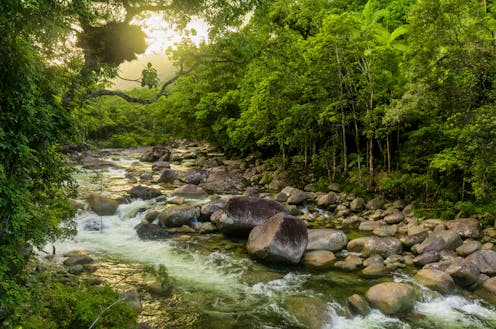
In Queensland’s northern reaches lie the Wet Tropics, spanning about 450 kilometres between Townsville and Cooktown. These mountainous rainforests are a relic of the ancient continent of Gondwana, dating back million of years when Australia and parts of Antarctica were covered in rainforest.
While much of the rest of Australia has dried out, the Wet Tropics have stayed wet. It’s here you find green-eyed treefrogs, wompoo fruit-doves and striped possums with elongated fourth digits, for digging out grubs. It’s a particular hotspot of endemic and unique plant species too, including the colourfully named idiotfruit tree.
Why is the region so distinctive? It has many different niches for species, from cool mountaintops down to hot and humid lowland rainforest. As a result of its unique evolutionary history, the Wet Tropics are a biodiversity hotspot, hosting an array of species found nowhere else on Earth.
Like many ecosystems, it is under serious threat from land clearing, invasive species and climate change. And these threats could be worse than we think due to the indirect, and often hidden ways they can affect the whole environment.
My research explores how species in these rainforests interact to forecast how rising temperatures and other environmental changes can lead not just to extinctions of individual species, but to the possibility of cascading extinctions as the loss of important species ripples through the web of life.
How does this ecosystem function?
These rainforests cover just 0.1 per cent of Australia’s landmass but harbour an exceptionally large share of the country’s biodiversity, where you can find about 45 per cent of the nation’s vertebrate species. It’s not just the largest tropical rainforest in Australia, but also one of the oldest in the world, holding immense indigenous cultural value.
Australia’s heaviest bird, the southern cassowary, plays an essential role in Queensland’s ancient tropical rainforests. It gobbles down the large, bright blue and toxic fruit of the cassowary plum tree, whose seeds can only start to grow when they have passed through the bird’s digestive system.
This symbiotic relationship is essential for the regeneration of these trees, which in turn support countless other lifeforms. Without the cassowary, the cassowary plum would struggle to survive, and the forest structure would change.

This region is also home to the giant petaltail, one of the world’s largest dragonflies, flourishing along the pristine streams of the rainforest. It also boasts Boyd’s Forest Dragon, a tree-climbing master of camouflage, and the Victoria’s Riflebird from the Bird of Paradise family, whose dazzling courtship dances captivate onlookers. The white-lipped tree frog also contributes to the rainforest’s nocturnal chorus. The Lumholtz tree kangaroo, an elusive arboreal marsupial, navigates the high canopies.
Read more: Forests of eastern Australia are the world’s newest biodiversity hotspot
 The Victoria’s riflebird only lives in the Wet Tropics. Here, the male begins to display, curving his rounded wings above his body and tilting his head back to expose his chin and throat to the light.
kosala000000/Shutterstock
These tropical rainforests form a complex web. When one species suffers, it can affect other species. This can start a chain reaction that might harm more species or even lead to their extinction. This phenomenon is known as co-extinction, a domino effect that can decimate entire communities of species.
For smaller scale ecosystems on land such as the Wet Tropics, co-extinction is a largely overlooked threat. As a result, we’ve probably underestimated how vulnerable these communities are to threats such as climate change in the future.
Tackling threats
The Wet Tropics is World Heritage Listed. It’s one of the most effectively regulated and managed protected areas in the world, ranking in the top 0.1% of the most important protected areas globally. Even so, it still faces many threats, including habitat loss and fragmentation as well as ongoing residential development, invasive species, and even changes in fire and water regimes, to name a few.
Only in the last few years, introduced virulent pathogens have been implicated in the extinction of the sharp snouted day frog and the mountain mist frog in this region.
Climate change is the region’s biggest threat. Extinction rates are forecast to soar if temperatures rise above 2°C.
 Lumholtz’s tree-kangaroo is a long-tailed marsupial endemic to the rainforests of north-east Queensland.
Frank Fichtmueller/Shutterstock
Read more: Climate change could empty wildlife from Australia's rainforests
Recent research suggests co-extinctions will cause up to 34 per cent more biodiversity loss by 2100 than that predicted from the direct effects of threats such as climate change.
The Wet Tropics are a landscape of ancient beauty, threatened by contemporary dangers. Protecting this primeval region is about maintaining the ecological processes sustaining life itself.
Queensland’s Wet Tropics are recognised as one of the most irreplaceable natural World Heritage Areas] in the world, considered by the UN as a region of ‘Outstanding Universal Value’ – the same status given to other iconic biodiversity hotspots such as Ecuador’s Galápagos Islands and India’s Western Ghats.
To safeguard the future of the Wet Tropics and other regions like it, we must deepen our understanding of the ecological challenges it faces and develop strategies to address them.


