

AIDS, trauma – and joy: how artist Brent Harris captures the intensity of emotion beneath humour
- Written by The Conversation
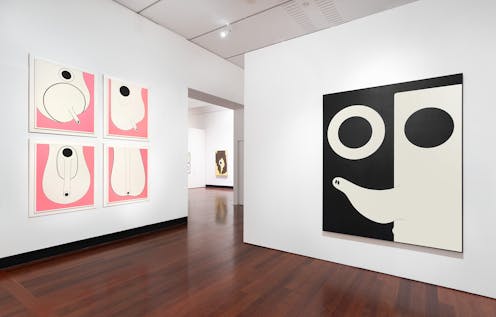
Brent Harris’ retrospective exhibition Surrender and Catch traces his art over four decades. It is a visual and linguistic treat.
The paintings, some immaculately rendered, others delightfully loose, along with the prints and drawings, are presented chronologically to chart his career, its shifts and importantly personal insights gained through art making.
The title of the exhibition, Surrender and Catch, is based on American sociologist Kurt Wolff’s 1970s theory of being open to what reveals itself in art making, surrendering to the process of self-discovery, and catching the knowledge it generates. It has an affinity with the surrealist approach of allowing the unconscious to inform imagery.
Harris was born in 1956 in Palmerston North, Aotearoa New Zealand. He relocated to Melbourne in 1982 in order to distance himself from a difficult childhood and to embark on a career as an artist.
Death and pandemics
The exhibition begins with expressionist paintings of the later 1980s where there are traces of influence from his teacher at the Victorian College of Arts, Peter Booth.
The pace and tenor changes radically with the series of 14 abstract and geometric paintings, the Stations (1989), produced in response to the death of fellow members of the gay community from the AIDS pandemic. The title references the biblical narrative of Christ walking to his death in the Stations of the Cross.
The Crucifixion, in a reduced palette of black, white and cream, shows the close influences of fellow New Zealander, Colin McCahon and his Fourteen Stations of the Cross (1966).
Harris revisited the theme during the COVID pandemic as a mature and less derivative artist in his Stations of the Cross (2021).

Playing with the surreal
Harris works in series to pursue a feeling/idea/sensation through to a completion of sorts.
The next series of work show another shift away from the precision of his abstract canvases, to his responding to images coming from the unconscious in a surrealist fashion.
 Brent Harris born Palmerston North, New Zealand 4 October 1956. Appalling Moment E 1994, Melbourne oil on linen 71.0 x 55.0 cm.
Private Collection, Melbourne © Brent Harris
Dots become eyes, another set of marks become an elephant’s trunk as in Appalling moment E (1994). He named this move to absurd figuration in which he allowed himself to turn to the body and memories stored within, “an appalling moment”. This is a lovely play on words that characterises his often-humorous approach to naming his deadly serious work, indicative of the intensity of emotion beneath the humour.
Another series of drawings playing with body parts, legs and trunk, developed into distended multi-branch drooping organic forms. The title, Swamp, refers to marshy land – not quite land, not quite water – symbolic of the artist’s memories of his transitional teenage years of loneliness and isolation.
 installation view: Brent Harris: Surrender & Catch, Art Gallery of South Australia, Adelaide, photo: Saul Steed.
The paintings lure the viewer into looking for meaning due to the spatial ambiguity created between abstract and figurative shapes of intriguing white forms on black. Viewers need to spend time, ponder and look again – as you should for good art.
To the Forest, blue (1998), with its uncluttered simplicity – perfection even – of it alluring free-ranging shapes of white on blue guide the viewer to contemplate the path to the forest, beyond the canvas.
Revisiting traumatic pasts
Harris’s turning within, drawing on stored memories, led to a series of portraits referencing his traumatic childhood dominated by a cruel and bullying father including the startling painting, I weep my mother’s breasts (1996).
This mirror image, depicted in cartoon style, recalls an incident Harris experienced as an eight-year old when he was denied his mother’s embrace by his father, that led in turn to breaking the mother/child bond.
 Brent Harris born Palmerston North, New Zealand 4 October 1956. I weep my mother’s breasts 1996, Melbourne oil on linen 57.0 x 96.7 cm; Courtesy of the artist and Robert Heald Gallery, Wellington © Brent Harris.
In his surreal doubled painting, drawing on notions of the unexpected, Harris shows himself weeping, but his tears are his mother’s breasts.
Some years later he lays bare the pain of his dysfunctional family in drawings, prints and paintings. The most disturbing is the diptych, Grotesquerie (2008), in which he portrays his mother in profile as sightless, unseeing, whereas his father is a horned monster. He has placed a red dummy in his father’s mouth to silence him. The two figures painted in white, apart from his mother’s yellow hair, are placed on a haunting, domineering black ground.
 Installation view: Brent Harris: Surrender & Catch, featuring Grotesquerie and Grotesquerie (no. 20) by Brent Harris, Art Gallery of South Australia, Adelaide, photo: Saul Steed.
The mood changes completely and most magnificently in colourful semi-abstract and abstract oil paintings, some large, others small, such as The reassembled self, no. 28 (2010).
There is peace, joy and acceptance at what giving into the unconscious, surrendering and catching, has yielded.
 Brent Harris born Palmerston North, New Zealand 4 October 1956. The reassembled self no. 28 2010, Melbourne charcoal and gouache on board 42.0 x 31.0 cm.
Private collection, Melbourne © Brent Harris photo:Andrew Curtis
A beautifully curated exhibition
Some of the most interesting and unassuming work in the exhibition lies in the monotypes in The Fall when the artist works rapidly on a black base applied to glass. Employing the surrealist method of automatic drawing, he produces images such as Untitled no 33 (2012), of inhabitants of a frightening underworld.
The exhibition closes with paintings completed on a return to New Zealand. The death of his father in 2016 led to a re-engagement with his country of birth. His joyous painting Peaks (Vision over Taranaki) (2019), is at one level revisiting a vista frequently seen during his childhood. At another level his mother, signified by her yellow hair, can at last see. From the foggy mass over the mountain, a hand reaches out.
 Brent Harris born Palmerston North, New Zealand 4 October 1956. peaks (vision over Taranaki) 2019, Melbourne oil on linen 220.0 x 160.0 cm.
Collection of David Cleary, Sydney © Brent Harris photo:Russell Kleyn
This is a large exhibition, supported by an excellent catalogue, with the work in each gallery introduced by wall text to assist viewers reading the pared back, distilled and cropped imagery in which its rigour is astonishing. The work of key artists who have influenced Harris, such as Louise Bourgeois, Edvard Munch and McCahon, is also woven into the display.
Harris’ art is held in major public and private collections; his discrete suites of work have been the subject of smaller exhibitions and critical commentary. This retrospective curated beautifully by Maria Zagala pulls these strands together.
While Harris’s work is in part a psychological journey, it should not be reduced to that reading. In an accompanying film on show in the exhibition space, the artist perceptively observes his art goes beyond the personal in its wider search for meaning.
Brent Harris: Surrender and Catch is at the Art Gallery of South Australian until October 20.


