

The CFMEU overhaul won’t do much to end the blokey culture that dominates Australian job sites
- Written by The Conversation
The Construction, Forestry and Maritime Employees Union (CFMEU) is in crisis. Amid the headlines and allegations of standover tactics, thuggery and kickbacks, the construction division of the union has been placed in administration.
The peak body for unions, the Australian Council of Trade Unions, has also resolved to suspend the construction arm of the CFMEU.
Some have welcomed the union’s overhaul, and the resignation of Victorian Branch Secretary John Setka, as a good thing for women in the sector.
But in an industry notorious for its blokey culture, administrators are unlikely to be able to get big improvements for women in construction. Gender discrimination is baked into the sector’s practices and norms. It is perpetuated by a culture of denial and resistance from business, government and unions.
Women sent packing
The construction sector is a valuable economic sector in the Australian economy and is highly political. It is also the most male-dominated employment sector in the country.
The drivers behind gender inequality in construction are multifaceted and structural. How we work in construction, what stories are told, and what behaviours are valued and revered all work to maintain gender inequality. It’s the product of a historical gender legacy.
Take work practices, for example. Construction contractors are incentivised by their public and private sector clients to deliver projects quickly. As a result, construction workers are financially incentivised to work long work hours, often over a six- or seven-day work week. On average, tradespeople and construction workers work more than 60 hours per week, exceeding the national employment standards of 38 hours per week and International Labour Organisation recommended maximum threshold of 48 hours per week.
On top of the work hours on site, my research finds workers travel long distances, in some cases three hours a day, to get to construction sites. Workers who adhere to these practices are valued. This is despite abundant evidence that these work practices harm men’s health. Construction workers experience higher-than-average levels of suicide and report poor physical and mental health and greater substance abuse.
For women, who undertake the bulk of society’s care work, fitting in care responsibilities with construction’s existing work practices is almost impossible. It sends women packing. It was one of the reasons I left the sector 12 years ago. I worked as a construction project manager for almost two decades in Australia and the Middle East.
In terms of behaviour, it’s not unusual to see aggressive behaviour on site, where swearing is the norm and punctuates sentences. When I shadowed construction workers for my research, I experienced this behaviour and pushback first-hand, not from CFMEU representatives, but from construction professions (such as project managers and supervisors).

When I politely asked to interview him, one manager raised his fist and screamed “what the fuck” at me across the open-plan office. I found in our research, he wasn’t the only man or group of men to make me feel like a stranger spoiling a good time.
When my male colleague, with whom I conducted the research, and I compared notes, we were treated differently. He was made to feel like one of the boys. He was given a nickname and men swore freely in front of him without filter. He wasn’t subjected to any pushback.
Yet both of us were exposed to the sexualisation of women. This included sexualised commentary, sexist and pornographic graffiti. Our 2018 research found a widespread tolerance of sexism and sexist behaviour in construction. The Australian Human Rights Commission’s Respect@Work report also found there is a high prevalence of sexual harassment and discrimination towards women in both trade and professional roles.
Yet despite this, the sector has moved at a glacial pace to prevent and respond to sexual harassment on construction sites.
A bigger problem than the CFMEU
There is much work to do in making the construction sector a safer and more inclusive place for all workers. For example, it’s essential that government and construction clients recognise how they procure and build projects has unintended consequences on gender equality and worker wellbeing in construction.
The construction sector needs to move to a five-day working week. Research found it resulted in better wellbeing for workers and their families.
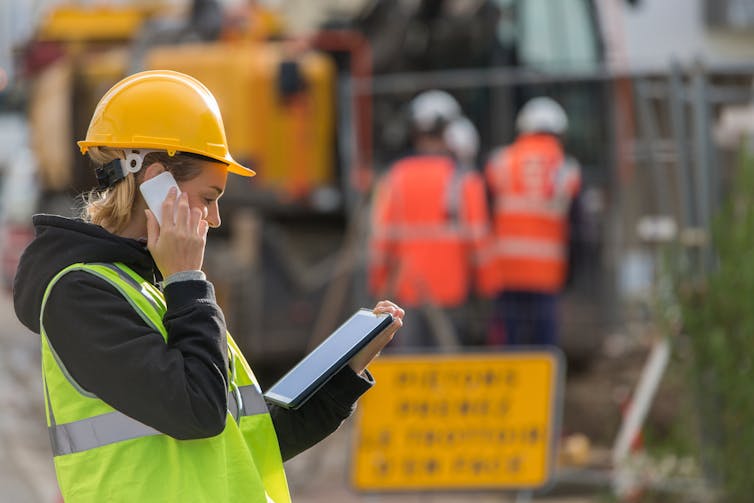
 Working conditions in the construction industry don’t offer women enough support.
Shutterstock
Working conditions in the construction industry don’t offer women enough support.
Shutterstock
Sounds like a simple suggestion, but there remains resistance from business groups, government and trade unions including the CFMEU. The sector needs to adopt and enforce the evidence-based Culture Standard that is focused on improving diversity, wellbeing and time for life.
There also needs to be a greater focus by the trade unions, business and government on the needs of women in construction, especially those working within small to medium size companies.
For example, moves to support tradespeople and construction workers – men and women – taking parental leave, are important. A 2024 Victorian CFMEU survey found more than 70% of members supported parental leave allowances and levies. The sector should consider a “long-service leave” type levy that supports workers on parental leave.
However, these provisions must be extended to tradeswomen navigating pregnancy too. Construction work during a time when the body is undergoing dramatic change requires more support.
For too long the trade union and business groups have shaped policy and practice around the perceived needs of their members, who are, for the most part, men. To shift gender equality in construction and make it a place where parents will encourage their daughters to pursue a career, and where women want to work and will thrive, we must focus on the needs of a future workforce: women.


