

Hospitals worldwide are short of saline. We can’t just switch to other IV fluids – here’s why
- Written by The Conversation
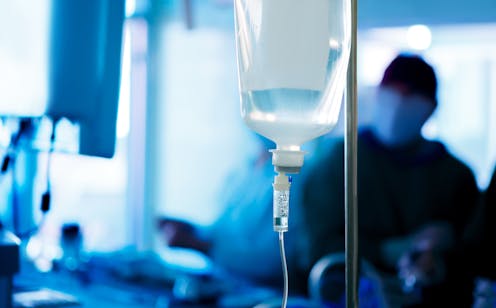
Last week, the Australian Therapeutic Goods Administration added intravenous (IV) fluids to the growing list of medicines in short supply. The shortage is due to higher-than-expected demand and manufacturing issues.
Two particular IV fluids are affected: saline and compound sodium lactate (also called Hartmann’s solution). Both fluids are made with salts.
There are IV fluids that use other components, such as sugar, rather than salt. But instead of switching patients to those fluids, the government has chosen to approve salt-based solutions by other overseas brands.
So why do IV fluids contain different chemicals? And why can’t they just be interchanged when one runs low?
We can’t just inject water into a vein
Drugs are always injected into veins in a water-based solution. But we can’t do this with pure water, we need to add other chemicals. That’s because of a scientific principle called osmosis.
Osmosis occurs when water moves rapidly in and out of the cells in the blood stream, in response to changes to the concentration of chemicals dissolved in the blood plasma. Think salts, sugars, nutrients, drugs and proteins.
Too high a concentration of chemicals and protein in your blood stream leads it to being in a “hypertonic” state, which causes your blood cells to shrink. Not enough chemicals and proteins in your blood stream causes your blood cells to expand. Just the right amount is called “isotonic”.
Mixing the drug with the right amount of chemicals, via an injection or infusion, ensures the concentration inside the syringe or IV bag remains close to isotonic.
What are the different types of IV fluids?
There are a range of IV fluids available to administer drugs. The two most popular are:
0.9% saline, which is an isotonic solution of table salt. This is one of the IV fluids in short supply
a 5% solution of the sugar glucose/dextrose. This fluid is not in short supply.
There are also IV fluids that combine both saline and glucose, and IV fluids that have other salts:
Ringer’s solution is an IV fluid which has sodium, potassium and calcium salts
Plasma-Lyte has different sodium salts, as well as magnesium
Hartmann’s solution (compound sodium lactate) contains a range of different salts. It is generally used to treat a condition called metabolic acidosis, where patients have increased acid in their blood stream. This is in short supply.
What if you use the wrong solution?
Some drugs are only stable in specific IV fluids, for instance, only in salt-based IV fluids or only in glucose.
Putting a drug into the wrong IV fluid can potentially cause the drug to “crash out” of the solution, meaning patients won’t get the full dose.
Or it could cause the drug to decompose: not only will it not work, but it could also cause serious side effects.
An example of where a drug can be transformed into something toxic is the cancer chemotherapy drug cisplatin. When administered in saline it is safe, but administration in pure glucose can cause life-threatening damage to a patients’ kidneys.
What can hospitals use instead?
The IV fluids in short supply are saline and Hartmann’s solution. They are provided by three approved Australian suppliers: Baxter Healthcare, B.Braun and Fresenius Kabi.
The government’s solution to this is to approve multiple overseas-registered alternative saline brands, which they are allowed to do under current legislation without it going through the normal Australian quality checks and approval process. They will have received approval in their country of manufacture.
The government is taking this approach because it may not be effective or safe to formulate medicines that are meant to be in saline into different IV fluids. And we don’t have sufficient capacity to manufacture saline IV fluids here in Australia.
The Australian Society of Hospital Pharmacists provides guidance to other health staff about what drugs have to go with which IV fluids in their Australian Injectable Drugs Handbook. If there is a shortage of saline or Hartmann’s solution, and shipments of other overseas brands have not arrived, this guidance can be used to select another appropriate IV fluid.
Why don’t we make it locally?
The current shortage of IV fluids is just another example of the problems Australia faces when it is almost completely reliant on its critical medicines from overseas manufacturers.
Fortunately, we have workarounds to address the current shortage. But Australia is likely to face ongoing shortages, not only for IV fluids but for any medicines that we rely on overseas manufacturers to produce. Shortages like this put Australian lives at risk.
In the past both myself, and others, have called for the federal government to develop or back the development of medicines manufacturing in Australia. This could involve manufacturing off-patent medicines with an emphasis on those medicines most used in Australia.
Not only would this create stable, high technology jobs in Australia, it would also contribute to our economy and make us less susceptible to future global drug supply problems.


