

An ambiguous foreign policy on Gaza risks undermining NZ’s global reputation
- Written by The Conversation
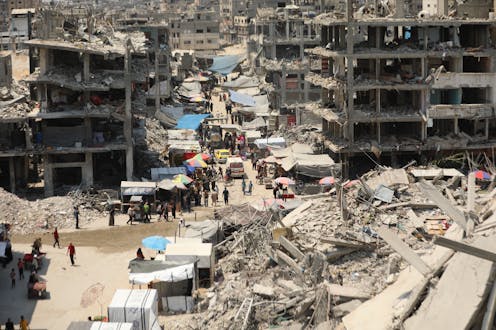
New Zealand may be a long way geographically from Gaza, and the government’s ability to influence the course of events there may be limited, but the nation’s inconsistent position on the appalling conflict is diminishing its vital interests.
Since the October 7 terrorist attacks by Hamas on Israel, and the devastating results of Israel’s policy (unconditionally supported by the US) of “mighty vengeance”, New Zealand’s response has been erratic and disjointed.
In particular, New Zealand’s traditionally bipartisan approach to foreign policy – based on rules and principles rather than sheer power – has been strained.
When the then foreign affairs minister, Nanaia Mahuta, condemned the October 7 attacks and urged Hamas and Israel to uphold “international humanitarian law”, she was criticised domestically for being weak and failing to recognise “Israel’s right to defend itself”.
Soon after the October 14 general election last year, Chris Hipkins called for an immediate ceasefire in Gaza. He said he made the statement as Labour leader, not caretaker prime minister.
The National Party accused Hipkins of “playing politics”. Then the new National-led coalition government stated it “supported the goal of a ceasefire, but acknowledges the conditions have not existed for one so far”.
Since then, New Zealand’s stance toward the Gaza disaster has remained ambiguous. On the one hand, it has pushed for a ceasefire and criticised the US veto in the Security Council. On the other, it has joined the US-led Red Sea operation against Houthi attacks on commercial shipping.
There is a clear tension within the government’s Gaza response, between its efforts at the UN and its relationship with the US. The result is a muddled foreign policy stance on the Gaza crisis.
Action at the UN
New Zealand was the only member of the Five Eyes intelligence partnership to vote for the October 27 United Nations General Assembly resolution calling for an immediate humanitarian truce in Gaza. More than 120 member states backed the resolution.
Then, on December 13, New Zealand co-sponsored a UN General Assembly resolution demanding an “immediate humanitarian ceasefire”, which was backed by 153 member states.
In mid-February 2024, New Zealand, Australia and Canada issued a joint statement calling for an immediate humanitarian ceasefire. They repeated the same message in late July.
Six weeks later, Deputy Prime Minister and Foreign Minister Winston Peters told the UN General Assembly the use of the veto in the Security Council – which New Zealand had always opposed – meant the council had failed in its responsibility “to maintain international peace and security”.
Peters was alluding to the US exercising its veto on October 18, December 8 and February 2024 to block Security Council resolutions calling for humanitarian pauses or immediate ceasefires.
On June 10 – eight months into the Gaza conflict – the US finally tabled a ceasefire proposal, which the Security Council adopted. But Washington has done little to enforce this, other than exhort the Israeli government to comply with the resolution.
Selective concern for international law
When the New Zealand government accepted Washington’s request in late January for a small defence force deployment in the Red Sea to counter Houthi attacks, the US was still resolutely opposed to a Gaza ceasefire.
The government insisted its support for Red Sea maritime security has no linkage to Israel’s unrelenting military assault in Gaza, but this is simply not credible.
The Houthi attacks on commercial shipping are clearly illegal, but they are essentially part of the fallout from the continuing international failure to stop the Gaza conflict.
Meanwhile, the International Court of Justice has called for Israel to take steps to prevent genocide. And the International Criminal Court has applied for arrest warrants for the leaders of Israel and Hamas.
By reaffirming support for a NZ Defence Force team in the Red Sea without publicly calling on the US administration to end its support for Israel’s military offensive in Gaza, the government has shown a selective concern about maintaining international law.
Compartmentalised policy
In the process, New Zealand also seems to have retreated from an independent foreign policy based on firm principles and values – and also on the concept of partnership and co-operation embodied in the Treaty of Waitangi.
While the founding document’s aspirations have yet to be fully realised, the credibility of its vision of reconciliation at home depends on New Zealand’s willingness to robustly uphold respect for human rights and the rule of law in the international arena.
While 146 states have formally recognised the state of Palestine, New Zealand remains in a relatively small group of former colonial powers yet to do so.
It seems clear the coalition government’s approach to the Gaza crisis has been compartmentalised between its UN diplomacy and its desire for a closer alignment with the US.
The overall impact of this ambiguous stance erodes New Zealand’s standing as a good international citizen. The government should have been making it clear in Washington and elsewhere that the absence of a lasting ceasefire in Gaza is inexcusable and unacceptable.


