

A rare aid success story has brought riches to a hardscrabble corner of the Pacific. Will it last?
- Written by The Conversation
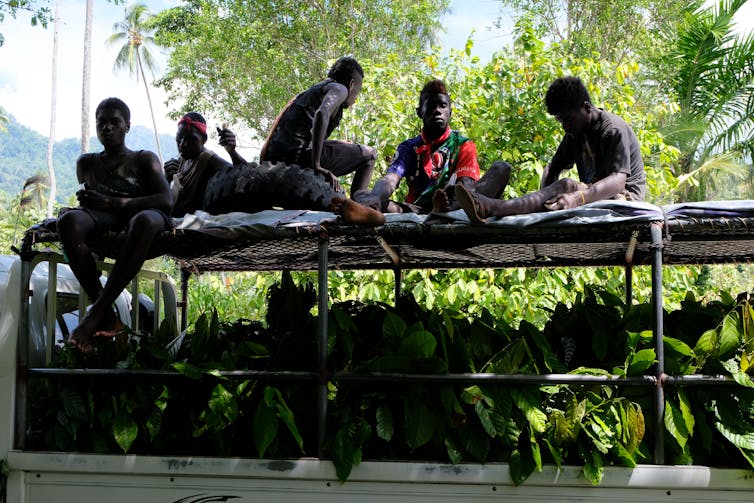
There is so much money sloshing around these days in Bougainville, an autonomous region of Papua New Guinea, the stores are running short of goods and some locals are partying until dawn.
The region’s economy is buoyant thanks in part to good fortune – record high prices for cocoa – and a largely unknown Australian and New Zealand aid success story.
Nearly a decade ago, the two governments helped Bougainville’s cocoa farmers rehabilitate their plantations, some of which had gone to seed since the region was embroiled in a civil war in the 1990s.
The aim of the initiative, called the Commodity Support Facility, was to plant quality seeds, improve the financial literacy of farming collectives and help farmers get their product to market.
More than 20 million kina (A$8 million, NZ$8.7 million) was spent to help more than 2,500 smallholder farmers. And this year, these farmers are reaping the rewards. Weather-related diseases caused the West African cocoa crop to collapse, quintupling world prices and precipitating Bougainville’s unexpected economic boom.
Success for farmers
Bougainville’s cocoa story is more than 100 years old. The Germans planted cocoa trees during their 30-year colonial rule, and today, the industry is the lifeblood of the archipelago.
The most recent chapter began in 2016 when the Commodity Support Facility was launched. Officially, it was a partnership between the governments of Australia, New Zealand, PNG and Bougainville, though Australia contributed a large portion of the funding.
It was hardly a propitious time to launch such an endeavour like this, as world cocoa prices were falling rapidly. Like elsewhere in PNG, the cocoa industry in Bougainville had been laid low by a pestilent worm called the cocoa borer, which had wrought devastation on production.
Australia also supported a complementary project managed by the nonprofit organisation CARE that included a focus on supporting women in cocoa production. The program organised an annual chocolate festival that helped put Bougainville’s products back on the map and recently funded a new laboratory to test the quality of cocoa beans.
And nearly a decade after seedlings resistant to the borer were distributed to farmers, the rewards are being reaped. According to initial findings from a survey by the Department of Foreign Affairs and Trade, 87% of grantees have benefited from increased income. Cocoa output has also improved, with more beans being grown and produced through the new trees.
This, combined with the price boom, has left Bougainville’s cocoa farmers flush. It has the potential to be a real boon in this hardscrabble island chain still bearing the scars of a violent conflict from 1988–98, which had been sparked in part by opposition to mining development.
Today, tensions remain between Bougainville and the PNG government over a 2019 independence referendum that showed residents overwhelmingly supported secession. Talks on progressing the results of the referendum are proceeding at a languid pace.
Why this program matters
Given how hard it is to deliver aid effectively in Papua New Guinea, as well as the geopolitical imperatives around aid these days, you would think more people outside of Bougainville would know about the project’s success.
It’s true there are chirpy stories posted about the Bougainville cocoa initiative on the Australian High Commission’s social media channels. But given so much government aid content feels boosterish, it is hard to distinguish a genuine, silver-plated aid success story when it comes around.
The question now is how Bougainville can double down on its success. If the late night din in the regional capital of Buka is anything to go by, at least some the newfound wealth is being spent on consumption.
But one day cocoa prices will fall again. As a result, the long-lasting benefits of the cocoa boom will only materialise if the windfalls are saved and reinvested. There is little in the public domain about how many farmers are actually doing this.
It’s also a challenge for Bougainville’s autonomous government, which has struggled to generate revenue, aside from the indirect rise in GST revenue from increased spending. Additional money is coming into the coffers through an adjusted cocoa export levy, but we couldn’t ascertain how much. Our inquiries to the Bougainville government went unanswered.
Whatever the amount, the increased money coming to the government must be invested productively in things like education and health.
Lessons for Canberra and Wellington
There is also a lesson here for officials in Canberra and Wellington. Development is often acknowledged as a long-term endeavour, yet the attention span of the aid world is stubbornly short.
The cocoa project in Bougainville is – to its credit – still running, combining the existing grants to farmers with a new focus on building buyer confidence.
Reports on the project, as with all development projects, however, are rarely publicly released. This is a shame because there is much that could be learned:
how, for example, has the project managed to succeed when many similar projects have failed?
how is the current revenue from cocoa exports being spent? Countries are notoriously bad at managing windfall gains, so what is Bougainville’s government doing with its cut?
and how are relations between the region’s independence-focused politicians and PNG’s independence-averse government being affected?
Long after the fanfare of the project launch, sweet success has materialised, seemingly out of the blue, in Bougainville. If it is to bring real long-term gains, though, people need to be paying attention.


