

News Daily


Men's Weekly

Australia

  • Written by The Conversation

The death of one of Australia’s most-loved thoroughbreds, Black Caviar, brought an outpouring of grief from the racing industry and fans across the world.

It also sparked some uncomfortable questions about what retirement actually means for a champion mare like her and what really goes into breeding a racehorse.

Some questioned the quality of care she was given and whether she was valued for more than just her ability to produce foals. Many were surprised at how thoroughbred breeding works in practice, even for champions like Black Caviar.

Does good care always mean good welfare?

The background

Black Caviar gave birth to her final foal on Saturday morning. Shortly afterwards she was euthanised after contracting laminitis (an extremely painful condition in which blood flow to the hoof is severely restricted).

“She had a milk infection about a week ago and we just treated it like you do with all broodmares. But, like a lot of treatments, it went straight to her feet,” trainer Peter Moody said.

“Basically, it killed her feet.”

Continuing the sad news, the unbeaten mare’s final foal, a colt, died shortly after.

Black Caviar was one day shy of her 18th birthday when she died. Retired racehorses often live between 25–30 years.

Black Caviar died after delivering her ninth foal in 11 years since her retirement from racing in 2013.

The average gestation period for a horse is 340 days.

Thoroughbred breeding basics

The Australian breeding season begins on September 1 each year.

Mating is achieved “naturally” (use of artificial insemination is banned for thoroughbreds worldwide) – although the process is dramatically different from what happens with horses in natural settings.

In the wild, the mare usually initiates mating by approaching the stallion and performing a range of courtship behaviours before allowing him to mate (or “cover”) her multiple times a day during her receptive period.

If she’s not ready to breed, she will refuse the stallion’s advances, which may including kicking and biting him or galloping away.

Black Caviar’s death has prompted uncomfortable questions about how champion mares spend their retirement In the wild, there is a courtship between a mare and a stallion before she allows him to cover her. Paul McGreevy/Wes Mountain/The Conversation

But at the stud, safety and efficiency is prioritised.

To prevent injury to the stallion and to facilitate an efficient covering, the mare will be fitted with equipment designed to ensure she can’t react during the procedure.

To minimise kicking, she may be fitted with breeding hobbles or boots that limit the movement of her hind legs. A breeding cape protects her neck from bites during copulation.

A device known as a twitch may be used as an additional form of restraint. This is a loop of string or rope that is twisted tightly around the upper lip, causing a temporary reduction in heart rate and the release of endorphins that induce calmness in the mare.

She may also have a foreleg held up while the stallion mounts to further restrict her ability to avoid the stallion.
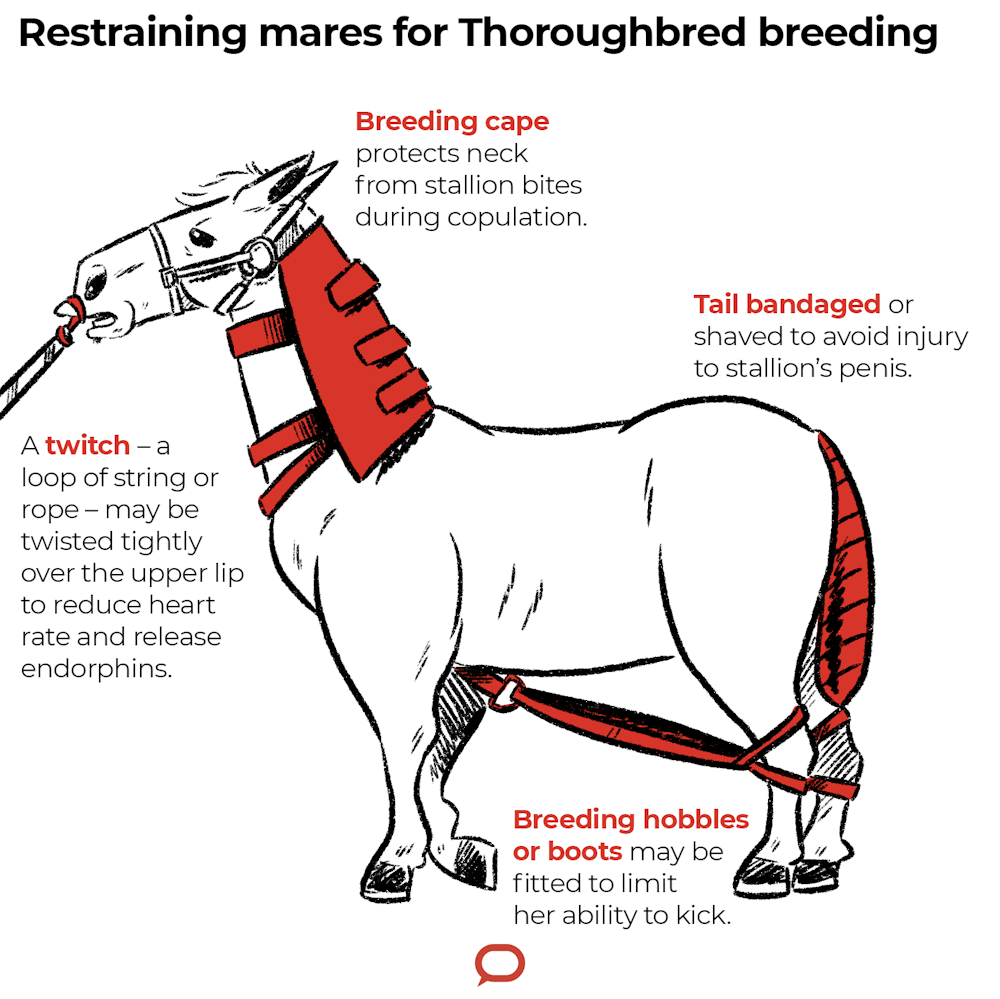
Wes Mountain/The Conversation, CC BY-ND The stallion’s natural mating behaviour is also restricted during mating. Instead of a courtship between two animals, the stallion is taught to mount the mare on command under the control of the handler. What about animal welfare? Throughbred breeding has a long history, but recently community concerns about the ethics of the industry have emerged. One is the welfare of the animal during mating – not just the mare but the stallion and foal, and the care they receive after birth. In Black Caviar’s case, it’s safe to assume she was given the very best care, considering her importance and value to her owners. But even so, during covering, she would have been restrained like any other mare, having no agency in regards to who she was mated to or what happened to her. Stallions are also affected by standard industry practices. Once a stallion retires to stud, it will most likely be socially isolated from horses other than during covering for the rest of their lives. Stallions living in the wild not only have the company of their mares, they also regularly play with their foals. It’s also important to consider the quantity of horses being bred. The racing industry relies on a continual supply of young horses, especially two and three-year-olds. In Australia, most of the biggest prizes in racing are age restricted, so owners and trainers need a continuous supply of young horses that are eligible for those races. This creates a huge incentive to keep breeding, which adds more pressure on horses like Black Caviar to produce offspring, even as the mare ages and the risks of poor outcomes increases. Black Caviar had nine foals, but such a number isn’t uncommon in the thoroughbred industry where access to the latest veterinary interventions is available. In the wild, mares may only give birth to five to seven foals in their lives depending on the availability of food and protection from predators. What does getting pregnant almost every year do to a mare? More pregnancies mean there’s generally more opportunities for things to go wrong. As horses get older, the muscles, ligaments and tendons around their abdomen often get laxer and they are more prone to infections, so they are more at risk of difficulties during and after pregnancy. Every pregnancy accumulates the risk for mares once they are in their mid-to-late teens. The economic realities of breeding Finally, in analysing the reaction to Black Caviar’s death, it’s apparent there’s a sizeable disconnect between people within the industry and those outside it. Some outside “the bubble” queried the treatment of the champion racer. But many in the industry – including Thoroughbred Breeders NSW president Hamish Esplin – quickly jumped to the defence of Black Caviar’s owners. Every person who starts working in the racing or breeding industries does so because they have a true connection and love for horses. But there’s no denying the economic truths – it’s a business in which the primary assets are the horses, and mares generate income by producing foals. Ultimately, all that care and concern for a horse is to ensure it can keep having foals for as long as possible. Although Black Caviar’s owners kept her foals rather than selling them as yearlings, which is the usual practice, those animals still entered the racing and breeding industries. Undoubtedly, Black Caviar was much loved and received the best of care. But even after winning 25 races, she still had a job to do – produce as many foals as possible that might one day generate a similar return on investment as she did.

Read more https://theconversation.com/black-caviars-death-has-prompted-uncomfortable-questions-about-how-champion-mares-spend-their-retirement-237039

Lighting Stores Perth: Expert Guidance for Inspired and Functional Spaces

Choosing the right lighting can completely change how a space feels, functions, and flows. Trusted lighting stores Perth play a crucial role in helping homeowners and businesses make confident lighting decisions that go beyond appearance alone. Lighting influences mood, productivity, comfort... Read more

Why Retail Cleaning Plays a Key Role in Customer Experience

In retail environments, cleanliness directly shapes how customers perceive a brand. Retail cleaning is not just about appearance but about creating a space where shoppers feel comfortable, confident, and welcome. From small boutiques to large shopping centres, a clean retail environment... Read more

Cleaner Floors, Healthier Homes: Lefant M3L Arrives as Australians Prioritise Pet-Friendly Hygiene

As pet ownership continues to rise, Australians are placing greater emphasis on maintaining a hygienic indoor environment for both family members and their animals. Issues such as dander, loose fur, and tracked-in dirt require consistent cleaning to support better home... Read more

How Home Removalists Save Time, Money, and Energy During Your Move

Moving to a new home is an exciting chapter in life, but the process of getting there can be overwhelming. From packing and organizing to transportation and unpacking, relocation involves a long list of tasks that can consume both your... Read more

Fulfilment Australia: Streamlining ECommerce Operations for Business Growth

As eCommerce continues to thrive, efficient order fulfilment has become one of the most critical components of customer satisfaction and business success. Companies across the nation are turning to professional fulfilment Australia providers to manage inventory, packaging, and shipping operations... Read more

Evaporative Cooling Cleaning Melbourne: Keeping Your System Fresh, Efficient, and Healthy

As Melbourne’s summers grow hotter, many homes rely on evaporative cooling systems to stay comfortable. While these systems are energy-efficient and environmentally friendly, they require regular maintenance to perform at their best. Professional Evaporative Cooling Cleaning Melbourne services are essential... Read more