

From Aussie politics to Henry Lawson: the story of how ‘Australian studies’ spread across China
- Written by The Conversation
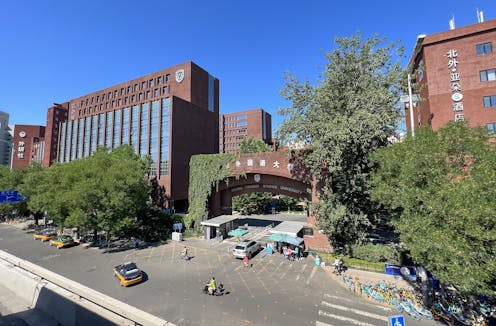
There are nearly 40 Australian studies centres in China’s universities and institutes. This is a greater number than anywhere else in the world, including in Australia itself.
We estimate about 250 scholars are involved in the teaching, research and debate of Australian affairs in China. A suite of Australian courses, both compulsory and elective, are offered to undergraduate and postgraduate students. Several programs also offer Master’s and PhD degrees.
The presence of this intellectual community in China is exceptional. And as we explore in our new book, How Australia is Studied in China, its emergence is both accidental and purposeful.
Early pioneers
In early 1979, nine Chinese students came to study at the University of Sydney under a student exchange program that formed part of the first cultural agreement between the two countries.
These “students” were English education scholars in their 30s and 40s. They were among the first Chinese students/scholars to study in Australia (and the West) at a time when China had just started opening up to the world.

The students were well received by their host university and country. They studied Australian literature, culture and linguistics under legendary academics such as Dame Leonie Kramer and Michael A. K. Halliday.
After completing their two-year-long study, these nine “Australianists” returned home and started teaching about and researching Australia. And although Australian and Oceanic studies had been available in China prior to this (such as at Nankai University and Anhui University), these scholars became the pioneers of Australian studies in China as we know it today.
Nicknamed the “gang of nine”, their contributions have extended far beyond Australian studies. They have all become flagship figures in English education, linguistics and English and Western literature in China. Several have taken up high-profile roles in universities or in the national education apparatus.
The gang of nine’s two-year stay in Australia opened a new chapter of intellectual pursuit. More importantly, it opened the door for an ongoing educational and intellectual exchange between China and Australia.
 This 1979 photo shows the Chinese First Vice-Minister Of Education, Liu Yangqiao, presenting University of Sydney chancellor Sir Hermann Black with a scroll painting.
Courtesy of the University of Sydney Archives, CC BY
This 1979 photo shows the Chinese First Vice-Minister Of Education, Liu Yangqiao, presenting University of Sydney chancellor Sir Hermann Black with a scroll painting.
Courtesy of the University of Sydney Archives, CC BY
Language, literature and more
The Australian studies centres in Chinese universities are mostly affiliated with English or foreign language schools. Australian courses are offered in English and are usually integral to English language and literature degrees.
Ever since China established its reform and opening-up policy in 1978, English has been very important in the nation’s education system. The rise of Australian studies has met a growing demand for English proficiency and a desire to understand the developed world.
Bespoke courses on various subjects have been taught at many universities. One examples is an elective course on Australian children’s literature that was offered at the Inner Mongolia Normal University, with positive learning outcomes.
The main focus of Australian studies in China has been on literature, with a series of monographs published and numerous Australian novels translated.
As such, Chinese readers can access works by Australian writers such as Patrick White, Henry Lawson, Alex Miller, Helen Garner, Peter Carey, Alexis Wright and Thomas Keneally. One prolific translator, Li Yao, has translated more than 50 Australian titles.
Other fields of Australian studies in China include history, economics, trade, tourism, education and Indigenous studies. The scholars of these disciplines actively contribute to academic and policy debates relating to Australia in areas of politics, international relations, technology, innovation and the environment.
Support from both sides
While the efforts of the Australianists have led to remarkable growth and achievements in Australian studies, there has also been long-term support from Australian agencies and individuals.
Founded in 2011, the Foundation for Australian Studies in China (the creation of which was led by the Australia-China Council) has played a strategic role in supporting Australian studies in China.
The foundation’s Australian Studies in China program has delivered books and library resources, translation prizes (and various other output prizes), and project awards for Chinese students and scholars to visit Australia.
It has also organised conferences, sponsored students from both countries and enabled the recruitment of the BHP Chair of Australian Studies at Peking University.
It is thanks to both sides’ efforts and understanding that we have seen the emergence of such an intellectual community in China – a positive outcome of both cultural literacy and cultural diplomacy.


