

We found one in six Australian reptile species traded as pets overseas, despite the export ban
- Written by The Conversation
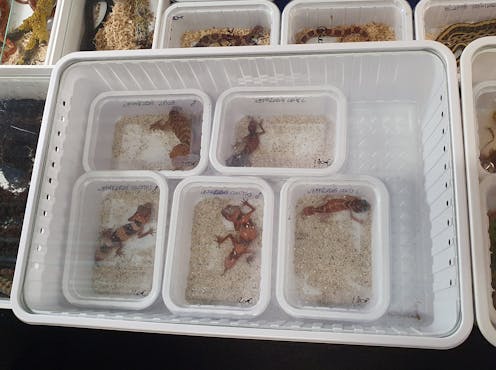
Trade in “exotic” pets from foreign countries is a global multibillion-dollar industry. Australian species are highly sought after.
Australia banned the commercial export of all live native animals in 1982. But once wildlife is taken out of the country, these laws no longer apply. Many species can be legally traded without restrictions once they are beyond our borders.
In our new research, we found 163 Australian reptile species and seven frogs traded as pets overseas. That’s more than one in six (16%) of all Australian reptile species – and around 3% of Australian frogs.
While many species may be bred in captivity to supply the pet trade, seizure records show some are still illegally taken from the wild. We need to deploy more sophisticated methods to monitor the booming online trade. Australia must also enlist the support of other countries to monitor the wildlife trade and identify those species most at risk for greater protection.
What we did and what we found
We scoured the web for evidence of online trade in Australian reptiles and amphibians worldwide. This included monitoring online stores and forums, including classified advertisements. We probed both the surface web – the pages readily available to the general public such as pet stores, public forums and public social media – and the deep web, which can’t be searched by standard search engines. It includes private forums and password-protected or special-access social media sites.
Web scrapers automated our data collection and machine learning helped sift through the data for relevant information.
We also extracted data from published papers, trade databases and seizure records.
We found Australian species being sold on 152 websites and 27 social media pages, particularly in the United States and Europe.
The most commonly traded species were bearded dragons, goannas such as the ridgetail monitor, and a range of geckos including barking and knob-tail geckos.

Wildlife smugglers
As species become rarer, their value to smugglers goes up. A species with only a few hundred individuals left in the wild can command very high prices. Unscrupulous traders often attempt to get around the law and smuggle rare and unique reptiles out of Australia.
A police bust in New South Wales this year found more than 250 lizards destined for illegal export, worth up to A$1.2 million.
But this is not the first time, and it won’t be the last. Years of seizure records show ongoing smuggling of Australian wildlife. Some species, such as the shingleback skink, are routinely targeted by poachers and smugglers, while others may be victims of opportunity.
Our research found smugglers have tried to take 58 reptile and three frog species out of Australia since the export ban was introduced. It’s likely many more have never been caught.
Nearly 260 native Australian reptiles bound for Hong Kong discovered by police | ABC News.Regulating global trade
The main international approach to regulating trade in wildlife is the Convention on International Trade in Endangered Species of Wild Fauna and Flora, known as CITES.
This is an agreement between 184 governments to ensure international trade in wild animals and plants does not threaten species’ survival.
For a species to be covered under this agreement, it has to be added to one of three lists (known as Appendix I, II, and III), according to the degree of protection needed. Appendix I species have the highest level of protection.
In 2022, Australia added 127 lizard species to Appendix III.
It was the first big listing of Australian reptiles in the convention’s history. But at the time of the listing, there had been no comprehensive study of Australian reptiles and frogs in global trade. It is unclear how those species were selected.
Appendix III is used for monitoring trade rather than restricting it. Australian authorities can watch to see if trade is threatening any of these species and upgrade the listing if so.
Just over half of the Australian species we identified in our study are now covered by the convention. Most (64%) of these were added in 2022.
That means a large portion of Australian reptiles (and all Australian frogs) remain unregulated and unmonitored in the international market. We recommend the Australian government consider listing these remaining species in Appendix III. We specifically recommend listing gecko species in the Diplodactylidae family, which make up the largest group of species in trade. We also recommend listing any species classified as threatened or endangered.
Improving surveillance
Our study also showcases emerging online trade surveillance methods through the use of web scrapers.
As the online pet trade grows, these methods will improve and become more effective for capturing trade, including trade that has circumvented the convention and other regulations. We found almost 90% of traded Australian reptiles and frogs have been advertised online at some point.
 Knob-tail geckos are one of the most popular Australian reptiles traded overseas.
Sebastian Chekunov
Knob-tail geckos are one of the most popular Australian reptiles traded overseas.
Sebastian Chekunov
Protect Australian reptiles and frogs
Australia banned native wildlife from commercial export to protect species from exploitation. Yet seizure records show some are still being illegally harvested from the wild.
Given the covert nature of this illegal trade, there is no way of determining exactly how many animals are poached or which species are targeted. But by monitoring trade beyond Australian borders, we can uncover patterns and determine if trade poses a threat to any native Australian species.
Our study provides the first comprehensive overview of trade in Australian reptiles and frogs worldwide. Ongoing monitoring is needed to ensure this trade poses no threat to survival of these species.
We encourage the Australian government to list more species under the convention and deploy more sophisticated online surveillance methods. Now we know which species are traded overseas, we need to ensure the trade is sustainable.


