

Buried treasures: how seeds help us learn about fire in the Australian landscape
- Written by The Conversation
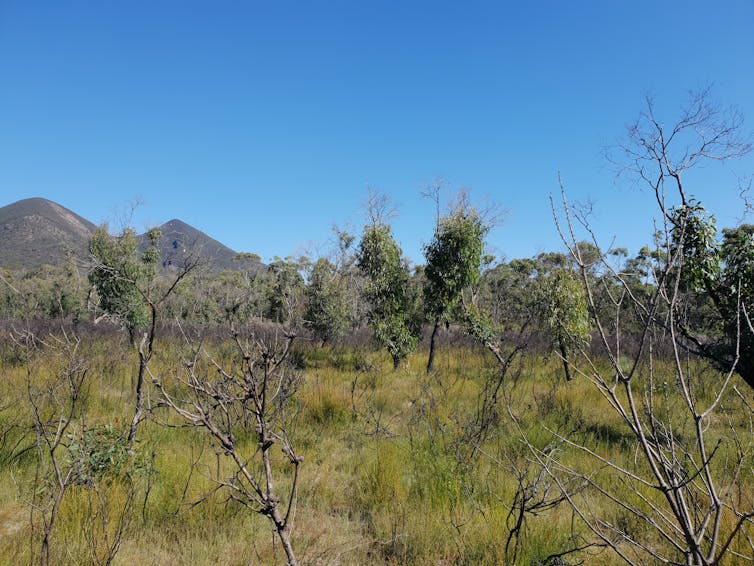
Fire is a natural part of Australian ecosystems. Many plants have developed ways to adapt and even thrive after fire. They may store their seeds in the soil, ready to sprout after fire. Or they may flower after fire, which helps them to produce the next generation of seeds.
Most of what scientists know about plants and fire comes from studying what happens above ground. In my new research, my colleagues and I examined what happens below ground.
I studied plants in the eucalypt woodlands of Gariwerd, including the species-rich Grampians National Park of Victoria. I wanted to find out which seeds were waiting in the soil, and whether their presence or absence had anything to do with past fires. But first I had to grow them.
Through a series of glasshouse experiments, I discovered the seedbank in each soil sample reflected its past experience of fire. More frequent fire depleted stores of annual plants, such as purple-leaved groundsel (Senecio picridioides) and pimpernel sundew (Drosera glanduligera). But perennial plants that live for many years were more resilient.
It was also clear that landscapes benefit from a patchwork or a “mosaic” pattern of fire, where some areas have burnt more recently than others. Managing landscapes to create a mosaic pattern of fire history will ensure that landscapes can support the requirements of a diverse range of species.

Studying soil transplants
I sampled soil from 57 sites in Gariwerd/Grampians that had experienced different patterns of fire over the past 80 years. Some had burned just once, and others up to nine times.
I then exposed the soil samples to various heat and smoke treatments, to mimic the variety of environmental cues different seeds need to germinate and grow into plants. For example, smooth parrot pea, a yellow-flowered shrub from the study area, is known to prefer hot heat to germinate. This species has a hard seed coat which cracks open under high heat, allowing them to grow. In contrast, some herbs and grasses prefer no heat at all.
 Twisted beard heath (Leucopogon glacialis)
Ella Plumanns Pouton
Twisted beard heath (Leucopogon glacialis)
Ella Plumanns Pouton
Once treated, I took each soil sample to a greenhouse where I watered them and waited for the seeds to grow into plants.
Over 15 months, I watched an incredible 39,701 plants grow from 245 different plant species. Some of the amazing species that came up included twisted beard heath, which has pretty tufted white flowers and twisted leaves, and the endangered Grampians trigger plant, found only in Gariwerd, which uses a trigger system to spurt pollen at insects when they visit its flower.
What I found by looking underground
The species growing in the greenhouses told a story of the fires that occurred where they were collected.
The frequency of fire was important. But how fire frequency influenced species presence in the soil depended on whether a species lived for one year (annuals) or many years (perennials). Or how long a species was able to store seeds.
Frequent fire (at least once every 15 years) reduced the occurrence of seeds of annual species which can store their seeds in the soil for many years. This is probably because every fire stimulated the sprouting of seeds, depleting the seed store.
Yet the seeds of other species, including perennials who store their seed in the soil for a short time only, appeared to be able to withstand the frequency of fires experienced to date. This is probably because these kinds of species rely less on storing their seeds in the soil to persist after fire than other measures, such as the resprouting of mature individuals from their trunk or base.
Interestingly, more than half (53%) of the species found in the soil seedbank were not growing as plants above ground. And for species with both seeds in the soil and plants above the ground, their response to fire above and below ground was not always the same. This highlights that the complex relationship between fire and plant life cycles is more than that meets the eye (above ground)!
Our findings point to the importance of researching plants at all stages of their life cycles, including their largely invisible time as seeds below ground.
 Over 15 months, I watched 39,701 plants grow in the greenhouse.
Ella Plumanns Pouton
Over 15 months, I watched 39,701 plants grow in the greenhouse.
Ella Plumanns Pouton
Healthy mosaic patchwork of fire
When it comes to fire in the landscape, my research suggests Victorian eucalypt woodlands benefit from variety. This means ensuring some areas remain unburnt for many years, while others are burnt more recently. Such a mosaic of fire patterns would enable a diverse range of plants to survive and thrive.
This new knowledge helps us act to protect plants, both locally and globally.
At the local scale, I was pleased to donate several thousand germinating plants to the Nature Glenelg Trust. They used them to help restore a native wetland, bringing the seeds back to Gariwerd.
 Seedlings raised in the greenhouse were later planted at Walker Swamp Nature Reserve by Nature Glenelg Trust volunteers.
Nature Glenelg Trust, Author provided (no reuse)
Seedlings raised in the greenhouse were later planted at Walker Swamp Nature Reserve by Nature Glenelg Trust volunteers.
Nature Glenelg Trust, Author provided (no reuse)
On a national and global scale, this research can help us make sense of changing fire patterns to help protect biodiversity. This year, California experienced the fourth largest fire in the state’s history, burning an area bigger than Los Angeles in under a week. And during the 2019-20 Australian Black Summer bushfires, more than 100 plant species had their entire above ground populations burnt.
Studies of seeds in the soil can help us find out how plant populations can recover after fire. Finding out which plants are affected by fire, in what ways, and why, will help us protect them into the future.
I would like to acknowledge my colleagues listed as coauthors on the research paper that formed the basis of this article: forest ecologist Sabine Kasel, fire scientist Trent Penman, fire ecologist Matthew Swan, and Luke Kelly, researcher in biodiversity dynamics.


