

Understanding risks for Australia of China’s slowing economy is Chalmers’ top priority at upcoming Beijing talks
- Written by The Conversation
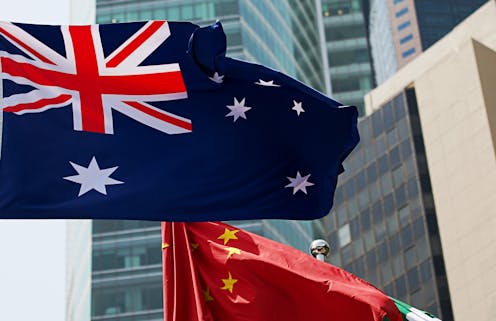
When Treasurer Jim Chalmers travels to Beijing later this month, he and his counterpart at China’s peak economic agency, the National Development and Reform Commission, won’t be short on important topics to discuss.
Chalmers will be attending the Australia-China Strategic Economic Dialogue, one part of a tripartite agreement secured by the Gillard government in 2013.
The purpose was to hold annual talks at the highest level. The agreement also includes a Leaders’ Dialogue and a Foreign and Strategic Dialogue involving the two countries’ foreign ministers.
Troubled times
The dialogue was last held in September 2017 as the state of official ties began turning south.
It was then formally suspended by Beijing in May 2021 after the Morrison government cancelled the Victorian state government’s Memorandum of Understanding to participate in China’s “belt and road initiative”.
Its resurrection has been slow in coming. The stabilisation in the bilateral relationship under the Albanese government has already seen reciprocal visits involving leaders and foreign ministers. But it was not until June the two sides signed a new memorandum to bring back the dialogue.
The fact Chalmers was able to confirm the trip last Sunday is another sign Canberra and Beijing remain committed to talking. This is despite there being numerous issues over which they are at odds.
Chalmers’ concerns
For the Treasurer, the priority will be getting a first-hand read on China’s struggling economy and the risks this presents to Australia’s own outlook.
When announcing the visit he alluded to one scenario his department was tracking that could see Commonwealth budget revenue take a $4.5 billion hit due to falling prices for key commodity exports, including iron ore and lithium.
Slowing Chinese growth and falling commodity prices are clearly not positives for Australian income, but Chalmers is unlikely to return in a state of panic.
The latest trade figures show China continuing to import Australian iron ore and lithium at record or near record volumes.

This points to increasing supply and a lack of demand from other countries being at least as relevant in explaining recent price falls. And both are coming off extraordinary price spikes to now be approaching levels more in line with historical averages.
The impact of Chinese growth on its demand for Australian goods and services has also never been a simple, one-to-one relationship. That remains true today.
A complex relationship
Australian wine exports, for example, are booming after Beijing removed tariffs earlier this year.
China’s customs agencies put the value of imported Australian wine over the past three months at US$252 million, or around A$400 million. This topped the $A357 million sold over the past year to the US, Australia’s second largest customer.
Students from China are also commencing at Australian universities in record numbers, albeit this is likely to fall next year due to restrictions imposed by Canberra, not Beijing.
That China remains a stand-out market is reflected in the large numbers of businesses and politicians attending the Australia-China Business Council’s Canberra Networking Day on Thursday. Trade Minister Don Farrell, Foreign Minister Penny Wong, Shadow Trade Minister Kevin Hogan and Shadow Foreign Minister Simon Birmingham are all slated to give speeches.
Chalmers will also be keen to raise the lingering import ban Beijing imposed in 2020 affecting Australian lobsters. Trade Minister Don Farrell said in June he was “very confident that in the near future” the ban would be lifted. Chalmers’ visit might provide the occasion to announce a final resolution.
China’s concerns
For China, top of the list of concerns will be Australia’s treatment of Chinese investors, particularly in sectors like critical minerals. In the past they have been welcomed but since 2020 there’s been an apparent de-facto ban on further involvement.
A recent survey of Chinese businesses in Australia pointed to generally positive sentiment. Almost 80% said they were optimistic about the outlook of the local business environment. Still, while 72.5% did not consider they had experienced discriminatory treatment, 42.4% felt the enforcement of Australia’s laws and regulations lacked transparency.
It’s not hard to see why. When Chalmers was asked in an interview last Sunday whether or not he wanted “China’s investment in critical minerals processing in Australia”, he did not reply with a “no”. Nor did he provide even a qualified “yes”.
China will likely also be seeking reassurance Canberra will not join Washington and some other capitals usually regarded as geopolitically “like-minded” in putting up tariff barriers on Chinese imports.
This reassurance shouldn’t be difficult for Chalmers to provide. Unlike the US, Australia’s economic relationship with China remains overwhelmingly complementary. Last year, Australia’s exports to China exceeded imports by $110.7 billion.
And low-cost, high-quality imports from China, such as electric vehicles, would be welcomed by the government amid a cost-of-living crisis and the net zero transition.
Late last month, Chris Bowen, Australia’s Minister for Climate and Energy, hosted his Chinese counterpart for the 8th Australia-China Ministerial Dialogue on Climate Change in Sydney.
A bipartisan approach
Trade with China also enjoys bipartisan support. In March, Minister Farrell touted the potential for two-way trade to increase from $300 billion to $400 billion.
Not to be outdone, opposition leader Peter Dutton said in June he’d “love to see the trading relationship [with China] increase two-fold”.
Chalmers was on the money this week in stating Australia’s relationship with China is now “full of complexity and full of opportunity”. His upcoming trip can only help in managing the former and realising the latter.


