

India is in the midst of an electric vehicle revolution – and Australia should tap in
- Written by The Conversation
You don’t have to be in India long to appreciate just how dramatic its electric vehicle revolution is. Whether it’s electric two-wheelers or trucks, buses or bicycles, they are hard to miss.
The Indian government’s financial incentives include waiving registration fees on electric vehicles. Allocated distinctive green numberplates under the national registration system, these vehicles stand out from the rest.
India’s cumulative sales of electric vehicles (of all types, including cars, buses, two-wheelers and three-wheelers) exceeded 4.1 million by March 2024. About 1.7 million were sold in the year to March alone. That was an 80% increase in a year.
Australians import about 80% of our electric vehicles from China. But we largely ignore India and the potential it offers us. It would be prudent to engage with India more and avoid over-reliance on China.
A fast-growing and increasingly diverse market
Indian industrial giant Tata has a roughly two-thirds share of the market for electric passenger vehicles. It produces four models, each with multiple versions, targeting different market segments. These range from the Tiago (selling for about A$16,125) to the Nexon (A$27,400).

Emerging from Delhi’s international airport, a visitor is greeted by dozens of vehicles from the four-year-old electric taxi start‑up BluSmart, a local ride-hail rival to Uber. This year, it announced plans to expand its current fleet of 6,000 vehicles to 10,000.
BluSmart is already South Asia’s largest all-electric ride-hailing service. In its first international foray, BluSmart has just launched in the United Arab Emerates.
All-electric vans, belonging to delivery companies such as DHL, cut and weave through the dense city traffic.
 Electric delivery vans are an increasingly common sight.
David T. Hill
Big blue electric buses in cities like Delhi and the IT hub of Bengaluru (formerly Bangalore) brandish their pollution-free status. Airport apron passenger buses in Bengaluru are also electric.
With Tesla absent from India, the luxury market remains small – under 3,000 units in 2023. A Volvo C40 Recharge starts at around A$112,000 – way beyond the budget of most of India’s people. Yet the swing away to electric vehicles is more pronounced in this segment than in the lower and mid-income brackets.
There’s something electric for everyone
Those on lower incomes have many other options. In the laid-back coastal tourist haven of Goa, I spied the green numberplate on the back of a family’s electric motor scooter when it silently passed me as I strolled through the historic quarter.
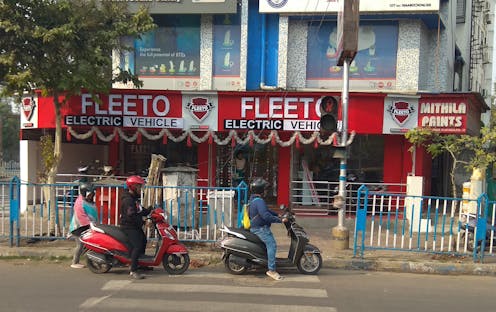
Local electric scooter manufacturer Fleeto sells an entry-level model, with a lead-acid battery, for about A$1,130. With a range of 50‑60km, a charging time of 6‑7 hours and a top speed of 45km/h, it won’t suit everyone.
But in a densely packed city like Kolkata, where many commuters could only dream of maintaining 45m/h in the daily traffic snarls, Fleeto sees a market. A lithium-battery model, with a range of 100‑120km, would add about 50% to the entry-level price.
Fleeto is just one of more than a dozen manufacturers of electric two-wheelers in India. Their sales grew by about 28% in the last financial year to around 780,000 units.
Hero, with about 46% share of India’s motorcycle market, offers a variety of scooters. The Vida V1 Pro sells for about A$2,660 and has a seven-inch full-colour touchscreen, over-the-air software updates, a top speed of 80km/h and a 165km range. A huge national network of Hero dealers give it considerable appeal.
Alternatively, for less than A$1 an hour, people can hire an electric scooter from firms like Dabadigo using a phone app. Their low speeds (up to 25km/h) and range of 60km are not a disincentive in densely crowded Kolkata.
 Old trishaws are being replaced by electric three-wheelers.
David T. Hill
In central Old Delhi, even the battered three-wheelers that in recent decades replaced human-drawn rickshaws now have to be powered by battery, not petrol, if they want to operate in certain zones. The number of electric three-wheelers grew by 55% in the last financial year.
India is an incredibly responsive and innovative market. A start-up funded by Hero recently launched a unique combination vehicle. The Surge S32 is a two-wheel scooter that converts into a three-wheeler cargo vehicle. It’s aimed at consumers who want both an economical personal scooter and a cargo vehicle that transports goods for a small business.
There are e-bicycles, too, from lighter bikes that are mainly pedal-powered to more scooter-style. The Motovolt Urbn sells for around A$900. It has pedals and a removable lithium-ion battery, with a range of up to 105km on a four-hour charge and a top speed of 25km/h.
What’s driving these changes – and where do we fit in?
India has huge pollution problems and urgently needs to shift to clean power.
Every day, Delhi locals check the deteriorating air quality index like Australians check the weather report. This January Delhi’s average index was 354. Anything above 200 is considered hazardous. By comparison, the index in Australian cities like Sydney, Melbourne and Brisbane generally averages around 30.
In all market sectors, India is both a maker and a consumer of electric vehicles. It’s set to play a major role in the global electric vehicle market. Yet, like China, India has a huge domestic market. It has little need to export – unless a lucrative market presents itself, as Australia did for China.
Australia now needs to avoid over-reliance on China and attendant strategic risks. The onus is on Australia to engage with Indian producers, across all types of vehicles.


