

At 2.7%, Australian inflation is back within the RBA zone. Here’s why that matters
- Written by The Conversation
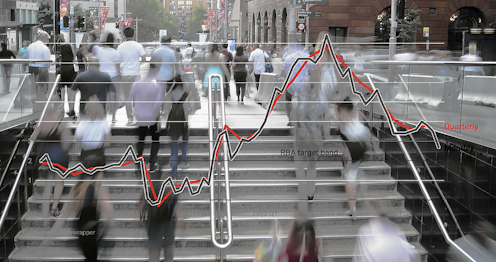
A closely watched measure of Australian inflation dived in the month of August, plunging from 3.5% in July to just 2.7%.
The dip below 3% puts the monthly measure of annual inflation back within the Reserve Bank’s target band of 2-3% for the first time since August 2021.
The longer-running quarterly measure of annual inflation is also likely to be back within the 2-3% band when the September-quarter figure is released next month.
The dramatically lower inflation rate puts Australia in the same league as the United States, whose inflation rate is 2.5%, and the United Kingdom, whose inflation rate is 2.2%.
The US and the UK have inflation targets of 2%, meaning their inflation rates are still somewhat above target. Australia’s monthly measure of inflation is on target, close to the middle of the band.
Electricity prices down 17.9%
Inflation has been trending down since late 2022, as shown on the graphs, but the sharp drops in the past two months are largely due to electricity rebates offered by the federal and state governments.
The rebates will be applied automatically to electricity bills in this and each of the next three quarters. A staged rollout means they hit bills in only Queensland and Western Australia in July and hit other states in August.
The Bureau of Statistics says these rebates took 6.4% off the average national power price in July and a further 14.6% off in August.
Household electricity prices were down 17.9% over the year to August. The Bureau of Statistics describes this as the largest annual fall on record.
Also helping bring down inflation were lower petrol prices and cheaper public transport, aided by Brisbane’s pre-election six-month trial of 50 cent fares.
The jump in the monthly measure to 4% in May, which had excited some commentators, now looks like a misleading blip.
A takeaway is to be cautious in interpreting the less-comprehensive monthly indicator, as is the Reserve Bank, which puts it in small print at the top of its website under the quarterly index, which it headlines in big print.
For what it’s worth, I am expecting the quarterly index to show annual inflation of 2.8% in the year to September, down from 3.8% for the June quarter.
Governor Bullock isn’t impressed
Reserve Bank Governor Michele Bullock says that at the moment she is paying more attention to the “underlying” rate of inflation, which looks through temporary measures such as subsidies.
But the Reserve Bank’s preferred measure of underlying inflation, the so-called trimmed mean, also fell in August, to 3.4%, down from 3.8% in July.
Australia’s weak economy – right now it’s the weakest outside of a recession – means the underlying measure of inflation is likely to continue to fall, unless the tax cuts that started in July have a big effect.
Why do we target 2-3% anyway?
Reserve Bank set its target of 2-3% inflation in the early 1990s without a lot of science. It was about where inflation was, close to the targets adopted by other countries, and was a range rather than a specific number in order to give the authorities some flexibility.
But it happens to be a sensible target, as last year’s independent review of the Reserve Bank confirmed.
The bank wants to target an inflation rate low enough to not be noticed much and to not much distort decisions.
Evidence from Google searches suggests that when inflation is around the 2-3% range, people don’t much notice it, but when it climbs up to 4% or 5%, they notice it a lot and search for the word a lot.
Although zero is (literally) a round number, zero inflation would be too low a target. It would mean deflation (prices falling) as often as not to balance out the prices that were climbing. Deflation is associated with recessions and poor economic performance.
An inflation rate of 2-3% also allows some real wages to fall (because they can increase by less than the inflation rate), which can be useful in encouraging workers out of declining industries into ones that are expanding.
In particularly bad times, the Reserve Bank might want to push interest rates down below the inflation rate. This is hard to do if the inflation rate is zero.
In theory, there is a case for increasing Australia’s inflation target to about where inflation is at the moment, but if that happened, Australia’s inflation target and future inflation targets would have less credibility.
And in any event, we are moving quickly back towards the target, and on Wednesday’s measure have already hit it.
Read more: No RBA rate cut yet, but Governor Bullock is about to find the pressure overwhelming


