

Jimmy Carter at 100: how his life outside the White House proves he’s long been ahead of his time
- Written by The Conversation
On October 1, Jimmy Carter, the United States’ 39th president, turns 100.
Carter’s longevity is notable. In 2024, centenarians make up just 0.003% of the US population, and 78% of them are women.
Carter is the first US president to reach the landmark age and the longest-living former US president by some margin. His 77-year marriage to Rosalynn Carter, who died last year, was also longer than most presidents’ lives.
It has now been almost 44 years since Carter lost office, easily defeated by a Republican, Ronald Reagan, who first promised to “make America great again”.
As a one-term president, a fate that Joe Biden will also share, Carter does not rank highly in polls of great presidents. One former speechwriter, perhaps harshly, even labelled it the “passionless presidency”.
But presidents are defined by more than their presidency – a lesson that may comfort Biden as he heads into enforced retirement. As Carter turns 100, it’s an apt time to reflect on a unique life after the oval office: one with relevance to key global issues of our time.
A tough presidency
As president from 1976 to 1980, Carter struggled to deal with congress, a sign of his political inexperience.
His presidency was marked by stagflation: a toxic mix of high inflation, stagnant growth and persistent unemployment.
His poll numbers were low and his social reform efforts fell short.
Tensions in the Middle East further eroded his support. The 1979 Iranian Revolution led to sharp increases in energy costs and the infamous hostage crisis. The Soviet invasion of Afghanistan contributed to the atmosphere of chaos in Carter’s final year in office.

Carter’s defeat in a landslide in 1980 was humiliating. A post-political life in obscurity might have been expected.
The opposite occurred. Carter’s long post-presidency arguably achieved more than his presidency, which became bogged down in economic malaise and foreign policy reversals.
Success overseas
As president, Carter’s greatest achievements came in his efforts to implement a human rights-based foreign policy. He continually put his own political wellbeing on the line to pressure US allies to improve their human rights records, as well as returning the Panama Canal from US control.
Arguably his greatest achievement was the Camp David peace accords, which established “normal and friendly relations” between Israel and Egypt after 31 years of warfare and hostility. Historian Richard Perlstein described Carter’s efforts:
he knew just when to risk a scathing remark and when to say nothing at all; when to horse-trade and when to hold fast, ever reassessing the balance between the visionary and the pragmatic.
Once free from the pressures of being president, Carter’s skills in foreign affairs flourished, working assiduously for human rights and peace, especially in the Middle East.
In 2002, he won the Nobel Peace Prize for his “decades of untiring efforts” to find peaceful solutions to international conflict. Carter is one of only four US presidents to win the prize and the only one to win it after leaving office.
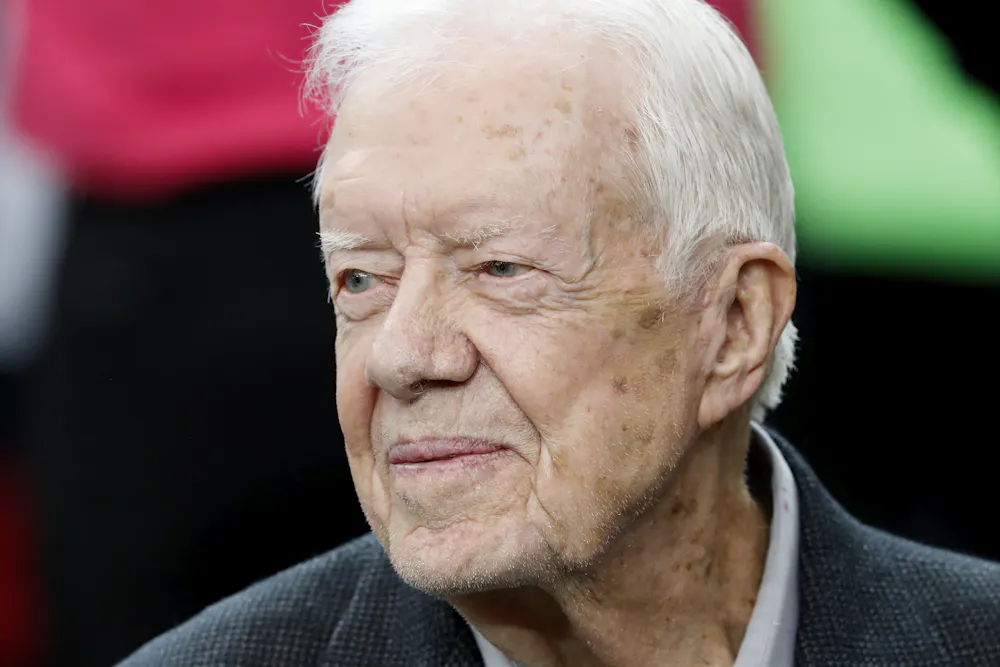 Carter in 2016.
John Bazemore/AP
Recently, the Carter Center in Atlanta, another of his legacies, called for a ceasefire in Gaza and noted that Carter would be on the plane to try and secure one if his health permitted it.
Today, Carter’s Middle Eastern efforts – while certainly not perfect, given the intractability of the challenges – stand the test of time and remain especially relevant.
Ahead of the curve
Post-White House, the Carters (they were very much a partnership) were ahead of their time on many issues.
Building on important environmental work as president, Carter installed the first solar panels at the White House and saved millions of acres in Alaska from development. This was long before climate change was widely recognised.
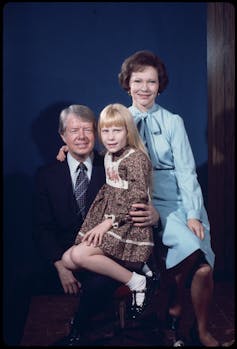
 Carter, his wife Rosalynn, and daughter Amy in the late 1970s.
The Library of Congress
For more than 40 years, Carter was also a stalwart of Habitat for Humanity, a charity that builds free houses for needy working families. In the early 1980s, he gave the group “national visibility”, an outcome that helped it expand internationally. This was well before housing affordability became a major political issue.
Carter also strove to remove the stigma associated with mental illness, again long before such efforts were common.
A former peanut farmer from Georgia, Carter’s post-presidency is distinctive in other ways.
Most former presidents retire to live in luxury in Washington DC, New York or on private estates in the country. Carter, however, went back to Plains, Georgia, the small town (population 776) where he and Rosalynn had grown up.
Carter has decreed that upon his death, the “modest” ranch house that he built there in 1961 will be gifted to the US National Park Service. The planned museum will showcase the house’s ordinariness; it is a typical example of the brick homes built by millions of Americans after World War II.
 The Carters lived in the same house in Plains, Georgia since it was built in 1961.
The Library of Congress
Strong Christians, the Carters lived for decades among the citizens of Plains, going to church and mingling with the community. When Rosalynn died in 2023, the funeral was held at the local Baptist church, not in Washington DC. The entire town turned out to watch the procession. Presidents, first ladies, governors and senators were in the congregation, but only pastors, family and friends spoke.
Carter’s survival is also notable. He has been in “end-of-life” hospice care at home for almost two years. In the US, the average stay in such care is 70 days.
Carter’s family have publicised his condition partly to break taboos about death and provide support for the millions around the world whose loved ones are in hospice care. Although frail, the former president has no underlying conditions and his family report that he is looking forward to voting for Kamala Harris on November 5.
A man who lived the first 40 years of his life in a racially segregated southern state, with most adult black people unable even to vote, has witnessed tremendous social change.
Carter may not have been the best politician, but there is a fundamental decency about him that stands as an important legacy. Even his opponents could agree on that.
According to James Fallow, a former aide who wrote an important account of the Carter administration, the 39th president had admirable personal qualities. Fallow described Carter as “disciplined, funny, enormously intelligent and deeply spiritual”.
At a time of fake news and record low levels of trust in politicians, this “politician with principles” is worth remembering.


