

Curious Kids: What does the edge of the universe look like?
- Written by The Conversation
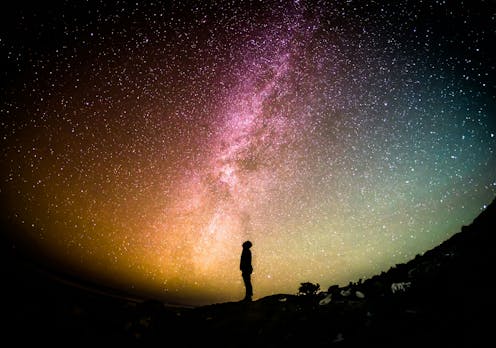
What does the edge of the universe look like?
Lily, age 7, Harcourt
What a great question! In fact, this is one of those questions humans will continue to ask until the end of time. That’s because we don’t actually know for sure.
But we can try and imagine what the edge of the universe might be, if there is one.
Looking back in time
Before we begin, we do need to go back in time. Our night sky has looked the same for all of human history. It’s been so reliable, humans from all around the world came up with patterns they saw in the stars as a way to navigate and explore.
To our eyes, the sky looks endless. With the invention of telescopes about 400 years ago, humans were able to see farther – more than just our eyes ever could. They continued to discover new things in the sky. They found more stars, and then eventually started to notice that there were a lot of strange-looking cosmic clouds.
Astronomers gave them the name “nebula” from the Latin word for “mist” or “cloud”.
It was less than 100 years ago that we first confirmed these cosmic clouds or nebulas were actually galaxies. They are just like Milky Way, the galaxy our own planet is in, but very far away.
What is amazing is that in every direction we look in the universe, we see more and more galaxies. In this James Webb Space Telescope image, which is looking at a part of the sky no bigger than a grain of sand, you can see thousands of galaxies.
It’s hard to imagine there is an edge where all of this stops.
The edge of the universe
However, there is technically an edge to our universe. We call it our “observable” universe.
This is because we don’t actually know if our universe is infinite – meaning it continues forever and ever.
Unfortunately, we might never know because of one pesky thing: the speed of light.
We can only ever see light that’s had enough time to travel to us. Light travels at exactly 299,792,458 metres per second. Even at those speeds, it still takes a long time to cross our universe. Scientists estimate the size of the universe is at least 96 billion light years across, and likely even bigger.
You can learn a little more about that and our universe as a whole in this video below.
What would we see if there was an edge?
If we were to travel to the very, very edge of the universe we think exists, what would there actually be?
Many other scientists and I theorise that there would just be … more universe!
As I said, there is a theory that our universe doesn’t actually have an edge, and might continue on indefinitely.
But there are other theories, too. If our universe does have an edge, and you cross it, you might just end up in a completely different universe altogether. (That is best saved for science fiction for now.)
Even though there isn’t a straightforward answer to your question, it is precisely questions like these that help us continue to explore and discover the universe, and allow us to understand our place within it. You’re thinking like a true scientist.
Read more https://theconversation.com/curious-kids-what-does-the-edge-of-the-universe-look-like-233111


