

People don’t like a ‘white saviour’, but does it affect how they donate to charity?
- Written by The Conversation
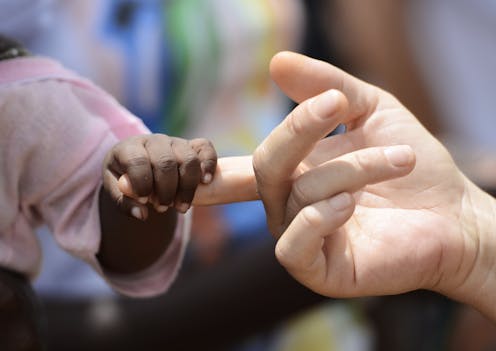
Efforts to redress global inequality are facing an unexpected adversary: the white saviour. It’s the idea that people of colour, whether in the Global South or North, need “saving” by a white Western person or aid worker.
An eclectic mix of white activists have been publicly accused of being white saviours for trying to help different causes in the Global South. They include celebrities who adopted orphaned children, organised benefit concerts such as Live Aid, or called out rights abuses.
Others include professional and volunteer charity workers and journalists reporting on poverty in Africa. Even activism at home can earn the white saviour label, like efforts to refine the proposal for the Indigenous Voice to Parliament in Australia.
We conducted a series of studies with 1,991 representative Australians to find out what people thought made a white saviour, how charity appeal photographs create this impression, and how it affected donations.
White saviourism and charities
The concern is that white people’s overseas charity, even when well-meaning, can inadvertently hurt rather than help the cause. It could perpetuate harmful stereotypes of white superiority, disempower local people, or misdirect resources to make helpers feel good rather than alleviating genuine need.
The fear of being labelled a white saviour could make people think twice about giving time or money to worthy causes. It might stop aid organisations using proven appeals to raise donations they need.
Médecins Sans Frontières (MSF), for instance, released a video apologising for using photos depicting white people in aid settings and which aren’t representative of the majority local staff they employ.
Therein lies the dilemma: white donors can relate to photos of white helpers, but this is easily interpreted as white savourism.
What makes someone a white saviour?
Very little research exists into exactly what white saviourism means. Broadly, it seems to describe people in the Global North who support international causes for selfish reasons, to satisfy their own sentimentality and need for a positive image. We wanted to go deeper.
In the first of our studies, we showed our participants 26 photographs depicting different Global South aid settings with a white helper.
The helpers that participants thought of as highly “white saviour” typically had these characteristics:
they appeared to be privileged and superior
they gave help sentimentally and tokenistically
they conformed to the colonial stereotype of the helpless local and powerful foreigner.
Further analysis showed these characteristics boil down to two essential features: ineffectiveness of the help and entitlement of the helpers.
These two perceptions of the white saviour explain the problem for charity. Behavioural economics research has identified two main reasons for donating, and these perceptions undermine both.
Why do people donate at all?
So to see how much white saviourism affects charities, we need to know why people donate in the first place.
One reason for giving is pure altruism, the desire to help others with no direct benefit to oneself. The effective altruism movement encourages people to make every donated dollar count – getting the maximum bang for the buck in terms of measurable outcomes for those in need.
The difficulty for effective altruists is in assessing the impact of different charities vying for their donations. There are now websites that list charities by lives saved per dollar donated.
Read more: How white saviourism harms international development
Alternatively, donors might look at a charity’s appeal images for clues of how effectively it will use their dollars.
Depicting white people as saviours can create the impression of tokenistic aid that only serves the helper’s sentimental needs. Evidence shows people resent impure motives in others (including organisations) and might try to penalise them.
Behavioural economics research also shows, as you might expect, that some people are more concerned about themselves than others when giving. This is known as “warm glow” giving.
Warm glow givers have several self-serving motivations. They include giving to gain self-respect or social status.
People also have a desire to meet their social obligations. For richer folks this could include charitable giving. And giving can reduce guilt they might feel about their privilege.
Just like the effective altruist, the warm glow giver could be put off by any sign of white saviourism. They don’t want to be seen to be endorsing it.
Do people still donate?
All this suggests that seeing a white saviour depiction in a charitable appeal will make people donate less.
We examined this in another study, in which participants were shown each of the previous photos. This time they were asked, for every photo, if they were willing to donate to a charity that uses it.
And as we thought, the photos previously rated as high in white saviourism had low intentions to donate.

But intentions do not always equal actions, as psychologist have demonstrated for many years.
To overcome this, we measured real donations in another study. Again participants saw the same photos, but this time they had the chance to donate part of their participation fee to a real charity when seeing them.
What we found surprised us: the white saviour effect disappeared. How high a photo was on the white saviour scale had no impact on how much participants donated when seeing it.
Does the end justify the motivation?
Our results summarise the dilemma. Donors might object to white saviourism by charities, but in the end feel that it’s the help that counts, not the motivation behind it.
We found some evidence for this when we asked participants about their general views of white saviourism.
Almost 70% agreed that white saviour motives are common in Western help and that this was problematic for recipients. But interestingly, only 42% thought helpers with these motives deserved criticism.
Together, this might suggest that people feel white saviour help is better than no help. There are voices in the charity community who echo this sentiment: imposing conditions on charitable giving will serve to reduce it.
In an interview with the Wall Street Journal, Elise Westhoff, president of the Philanthropy Roundtable in the United States, said “by imposing those ‘musts’ and ‘shoulds’, you really limit human generosity”.
But this doesn’t mean there are no legitimate concerns. There are, but it’s not hard for charities to address them.
Our results show that white saviour perceptions do not affect actual donations, so read another way, suggests charities can safely replace highly white saviour images without losing donations for their causes.


