From mass deportations to huge tariff hikes, here’s what Trump’s economic program would do to the US and Australia
- Written by The Conversation
It’s time to take Donald Trump seriously. Betting markets say it’s as likely as not he will be elected US president four weeks from today.
And unlike in 2016 when his program wasn’t clearly defined, he has set out plainly what he intends to do. Which means it’s possible to model the consequences.
The three Trump promises with the greatest economic impact are
the deportation of millions of US residents
steep restrictions on imports, especially from China
presidential influence over interest rates.
The best way to model the consequences is with an established model of the kind used by the International Monetary Fund and central banks around the world rather than one set up for the purpose that could be seen as designed to favour or not favour Trump.
The Washington-based Peterson Institute for International Economics has just done that, noting that during Trump’s first term as president he “by and large” did what he said he would do.
It finds
ironically, despite his ‘make the foreigners pay rhetoric’, Trump’s package of policies does more damage to the US economy than to any other in the world.
No other country in the world would be hurt by Trump’s program as much as the US – not even China – although several US allies would suffer, including Australia, which would be the fourth-worst hit by the most extreme version of what Trump is proposing.
Peterson Institute for International Economics.Mass deportations
Trump has repeatedly promised the “largest domestic deportation operation in American history,” targeting up to 20 million unauthorised immigrants, including about 8.3 million thought to be in the workforce.
He says his model is Operation Wetback – a 1956 Eisenhower administration program that used military-style tactics to deport 1.3 million Mexicans.
The institute says Eisenhower’s success makes it easy to believe Trump could remove 1.3 million immigrant workers. It has modelled two scenarios: removing 1.3 million and 8.3 million, both over two years in 2025 and 2026.
Both slash employment, including the employment of non-immigrants, both push up inflation, which eventually is brought under control, and both make the US a less attractive place to invest, which benefits much of the rest of the world.
The institute says the low and high scenarios differ “only by the degree of damage inflicted on people, households, firms, and the overall economy”.
Huge tariff hikes
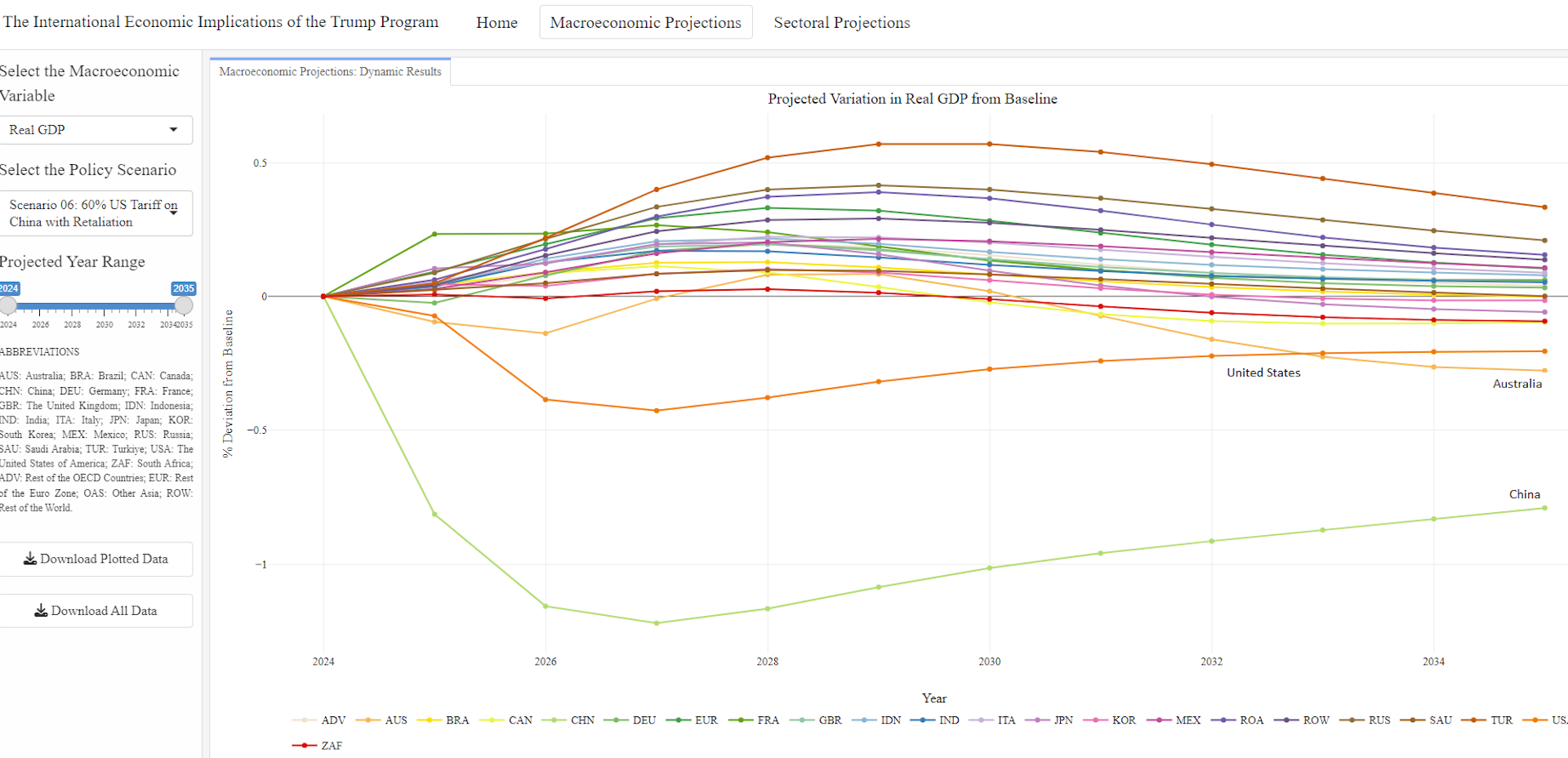
Trump wants to increase every tariff on goods imported to the US by 10 percentage points, including where there is at present no tariff. And he wants at least a 60% tariff on imports from China. The institute has modelled both, with and without retaliatory tariffs from China and the rest of the world.
It finds, unsurprisingly, that extra tariffs push up the price of US imports and the prices of US-produced goods that compete with imports. Many are used as inputs in manufacturing, which means US manufacturing suffers (which is probably not what Trump had in mind).
Fewer imports mean less demand for foreign exchange within the US, which means a higher US dollar which makes US exports less competitive. The US economy is weaker as a result, although China’s is weaker still and Australia’s is weakened as much as the US given its role in providing resources to China.
Nobbling the Fed
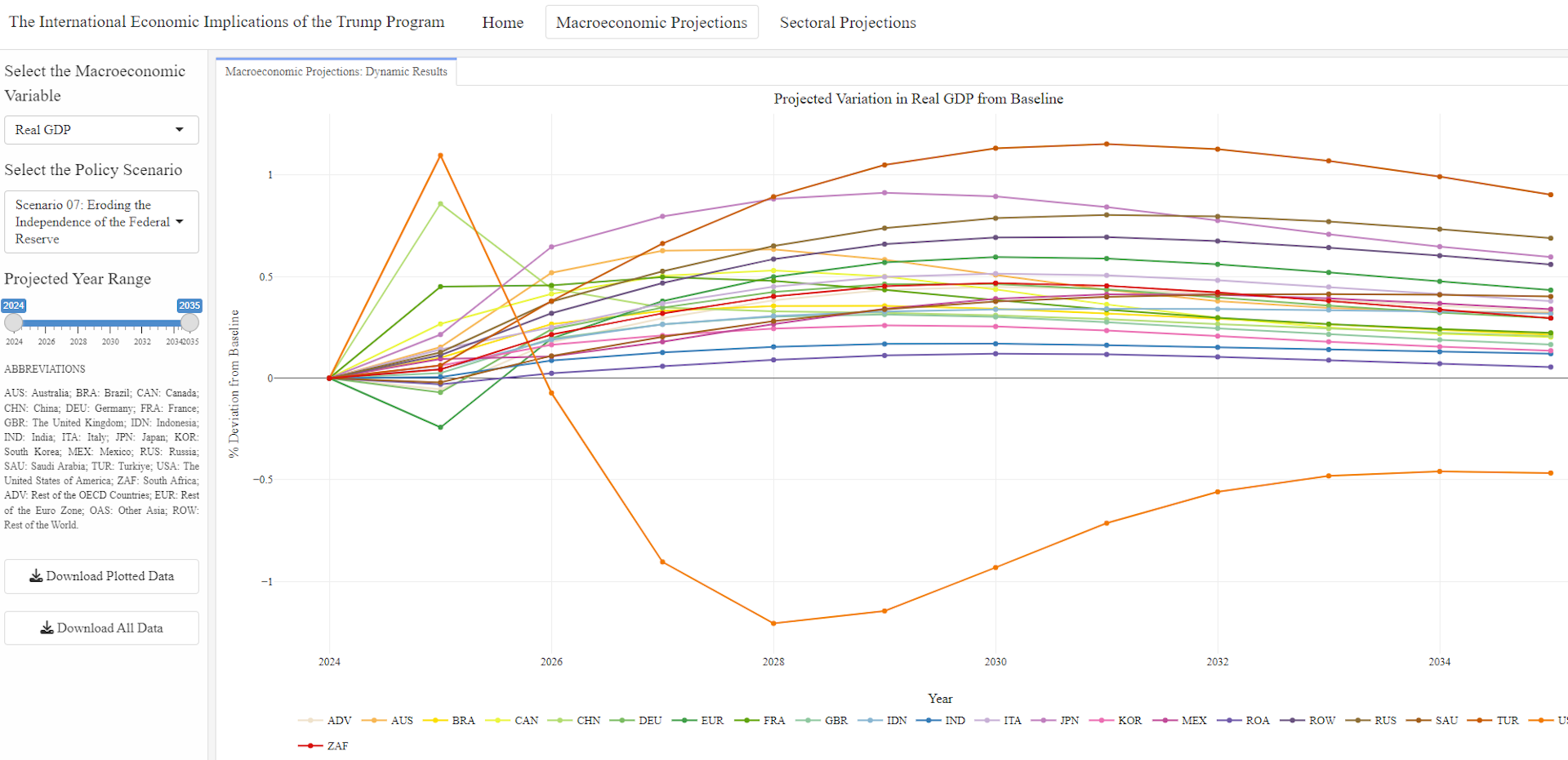
Trump has raised the prospect of more presidential influence over interest rates, saying he thinks he has “a better instinct than, in many cases” the board of US Federal Reserve. This could be achieved by requiring the president to be consulted on rate decisions or by appointing a compliant chair.
However it’s done, the institute’s “conservative” assumption based on what happens in developing countries with less central bank independence is that it will push inflation two percentage points higher.
The modelled result is capital flight. While the US economy is initially stronger than it would have been because of the Fed’s willingness to tolerate higher inflation, after a few years it is weaker and every other economy is stronger.
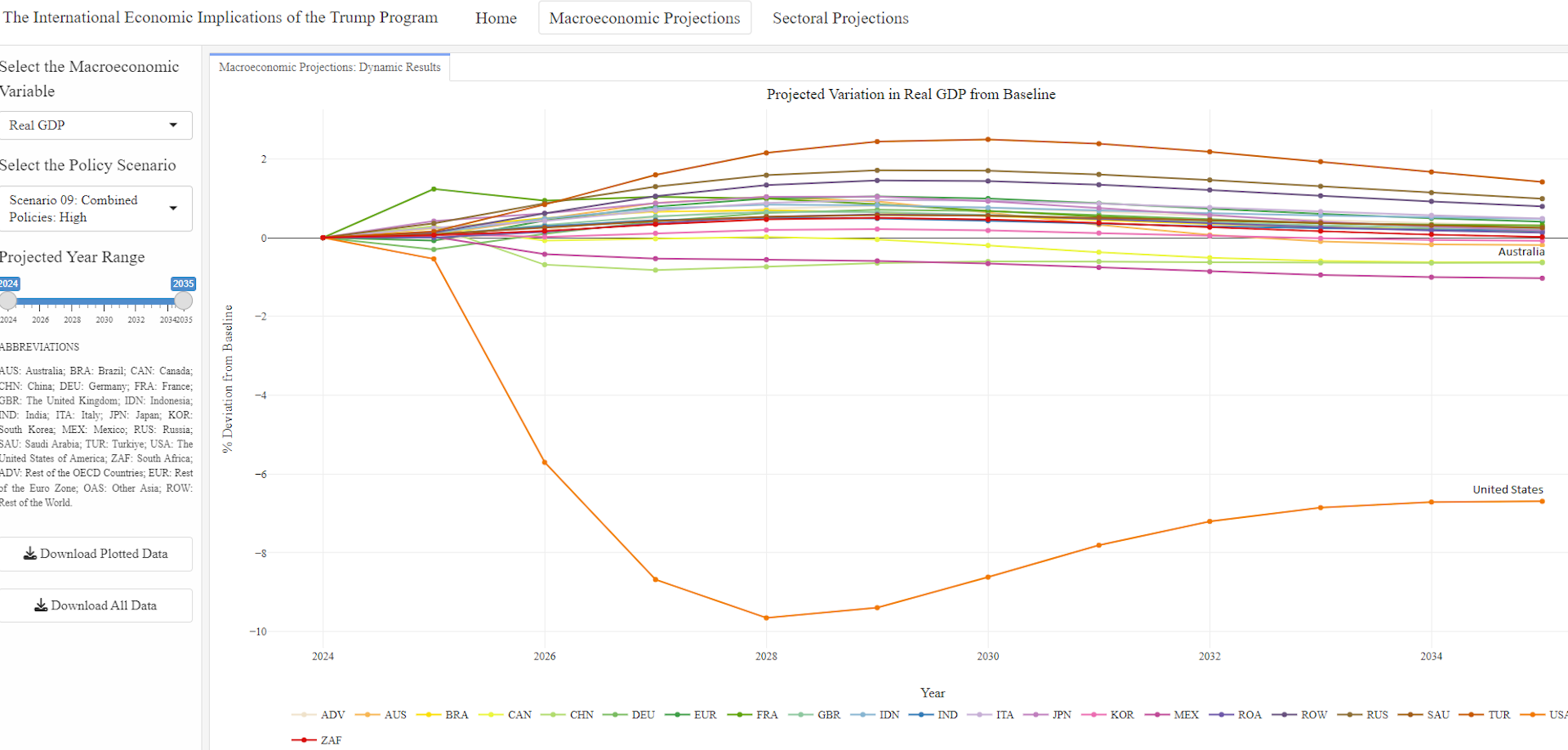
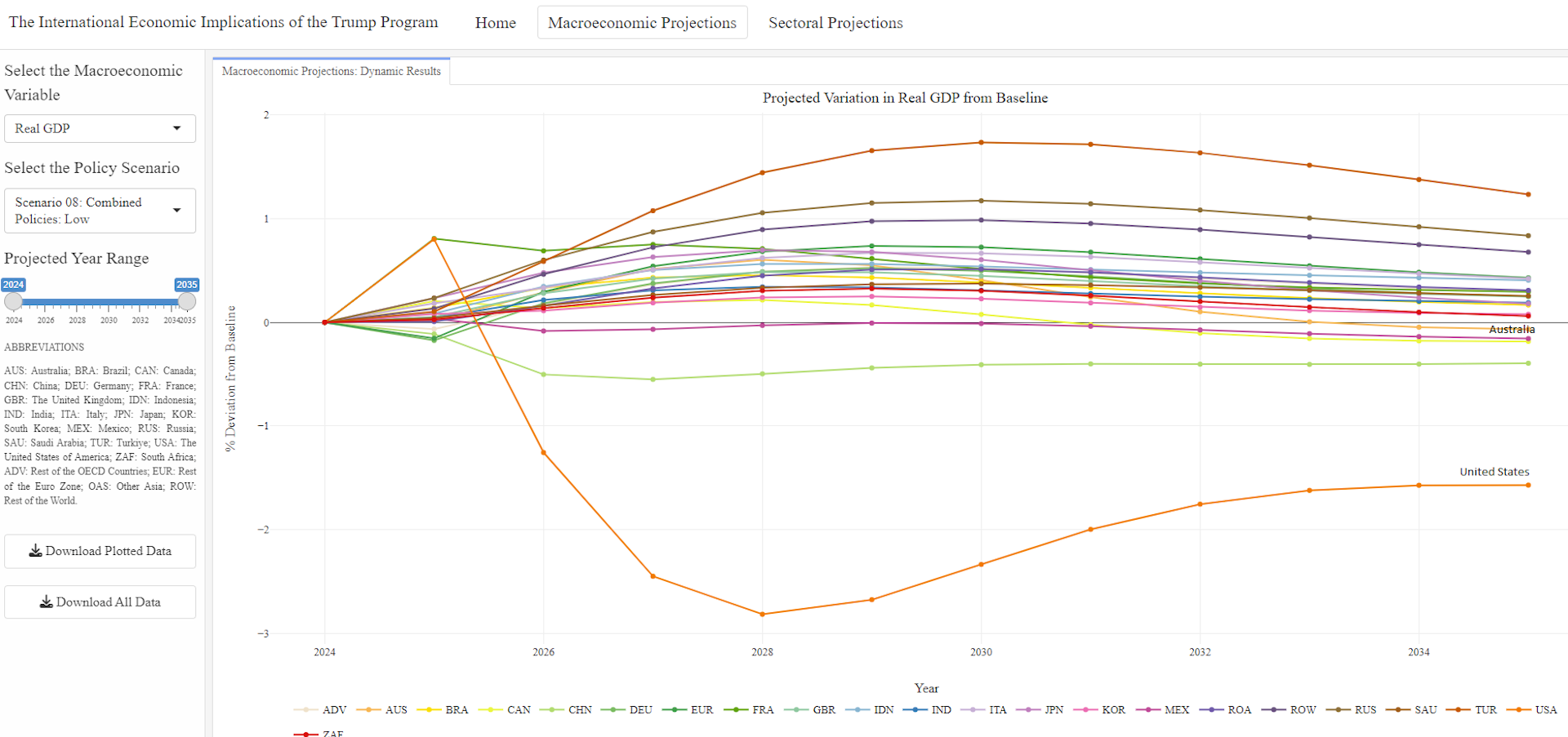
When all the measures are combined, under the extreme scenarios the US economy is 6.7% weaker than it would have been by 2035 and Australia’s is 0.2% weaker. Under the more modest scenarios, the US economy is 1.6% weaker and Australia’s is 0.06% weaker.
Why not examine Harris?

Despite a history of non-partisanship, the Peterson Institute is prepared for criticism. It points out that the economic model it used is regarded as the best in the world for scenario planning and is Australian, built by Warwick McKibbin of the Australian National University.
And it says it has modelled the Trump policies rather than the Harris policies because only Trump’s represent a departure from business as usual.
As the Institute’s president Adam Posen put it in Washington last month, the Harris campaign has said it will not impose across-the-board tariffs, will not engage in mass deportations and will not interfere with the independence of the US Federal Reserve.
The Trump campaign has indicated it will do all three.
It’s entirely possible that in office Trump wouldn’t do everything he proposed while campaigning, and it’s entirely possible that he would change course if what was doing damaged the US in the way the modelling suggests.
But there’s something to be said for taking people at their word, at least to get an idea of what we could be in store for after a knife-edge election.