

Rebates for buying e-bikes and e-scooters are good but unlikely to greatly boost sustainable transport on their own
- Written by The Conversation
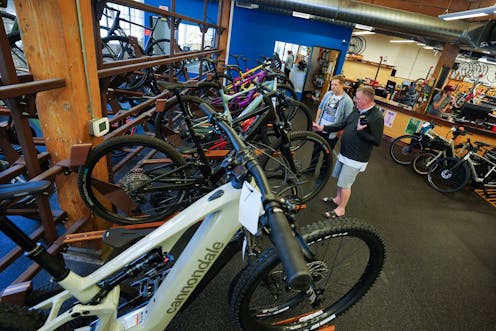
Queensland has joined Tasmania as the second Australian state or territory to offer a A$500 rebate for buyers of new e‑bikes. The pre-election announcement includes a smaller $200 rebate for e‑scooters.
The Queensland e‑mobility rebate scheme is first come, first served, until its $2 million budget ($1 million was added last week) is used up. The Tasmanian scheme has closed for this reason.
These schemes follow a trend of government incentives to buy e‑bikes in North America and Europe. The Australian schemes differ from most schemes overseas by including e‑scooters too.
It’s a welcome move to promote sustainable transport. These personal transport devices have smaller environmental footprints to produce and operate than electric cars. Owning e‑bikes or e‑scooters can enable people to drive less – reducing congestion and emissions – and avoid high fuel costs.
However, my research and other studies suggest ownership doesn’t guarantee much greater use. Additional measures will be needed to boost use of these sustainable transport modes.
Why own e-bikes or e-scooters when you can share?
The rebate is likely to boost retailers’ sales. More than 860 rebate applications were received within three days of the scheme starting on September 23.
And existing owners now have an incentive to upgrade or replace models. They might then sell their pre-loved e‑bikes or e‑scooters on the second-hand market. This means others could get them more cheaply.
Queensland was the first Australian state to legalise the use of e‑scooters in 2018, when Brisbane introduced shared e‑scooter operations. Regional cities such as Townsville and Cairns launched similar schemes. Dockless e‑bikes later replaced Brisbane’s initial CityCycle bike-sharing scheme.
I recently conducted research to understand why South-East Queensland residents want to own e‑scooters. The study methods were comparable to an earlier e‑bike user survey.
Both sets of owners cite replacing car use as their top reason for ownership. However, their motivations differ.
E‑scooter owners are mainly driven by the lower price and the fun factor of riding. E‑bike owners focus more on fitness and the health benefits of getting some exercise when riding. Australian regulations require e‑bikes to be pedal-assisted.
But does this mean people will ride more?
Since 2022, the Queensland government has offered a rebate of up to $6,000 for buying full-sized electric vehicles (that scheme closed last month). It now appears to have responded to calls to do the same for e‑bikes and e‑scooters.
Buyers certainly won’t mind freebies and rebates, but rebate-induced ownership might not increase overall use by much.
An Australia-wide survey in 2023 found 57% of respondents had access to at least one working bicycle at home and this proportion has been increasing. However, only 15% reported riding in the previous week. Only 36.7% had ridden in the past year.
Overall cycling participation has declined over the past decade, except during the COVID pandemic when work and travel patterns were more local. For all periods, men are significantly more likely to cycle than women.
The same 2023 survey revealed only about 2.1% own e‑bikes. The rebate will likely increase this rate in Queensland.
Some preliminary evidence suggests e‑bike users ride more often and further than those riding non-electric bikes. It also helps older people get into cycling. And it has the potential to replace car use even in rural areas.
Despite e‑bikes offering advantages over traditional bikes, riders of both face obstacles to greater use, such as road safety and poor cycling infrastructure.
What kinds of incentives do other countries offer?
Australian policymakers should consider offering incentives to ensure the new purchases are well used, not sitting idle most of the time.
The United Kingdom has a long-standing cycle-to-work scheme that offers commuters a tax exemption for buying bicycles or e‑bikes.
In the Netherlands, incentive schemes have used smartphone technology to track their mileage. For example, in the B-Riders scheme, riders earn €0.08–0.15 (A$0.13–0.21) per kilometre. There was a 68% increase in e‑bike use by former car commuters after one month and 73% increase after six months of participation.
Schemes in North America tend to be aimed at lower-income households. They are more likely to be involuntarily carless, so e‑bikes can improve their access to jobs, goods and services.
There are alternatives to rebates. North Vancouver, for example, is trialling e‑cargo bike lending to replace car shopping trips, as these bulky bikes are not practical for every household to own.
In France, residents can claim a bike or e‑bike subsidy of up to €2,000 (A$3,210). Second-hand devices sold by approved repairers are covered too, which is likely to help reduce e‑waste. Australian schemes so far only cover new purchases.
What more can be done?
For e‑bike and e‑scooter owners, the main barrier to riding more is the lack of safe and well-connected infrastructure. Numerous studies have connected rates of riding to the quality and quantity of infrastructure. Extensive, high-quality and safe cycling networks can deliver lasting shifts towards sustainable transport.
When the Spanish city of Seville built such networks, cycling rates surged 11-fold in a few years.
In the Netherlands, this infrastructure is so well-funded and extensive that it’s no surprise cycling is popular there.
Riders don’t just need bikeways. They also need end-of-trip facilities with secure parking (and maybe free charging too).
In Australia, cycling gets only around 2% of transport funding.
In Brisbane, despite not being anywhere close to the European level of cycling infrastructure, new “green bridges” and bikeways will be expanded to more areas of the city (and other Queensland venues). It’s part of preparations to host “climate-positive” Olympic and Paralympic Games in 2032. This year’s games host, Paris, successfully upgraded infrastructure and boosted cycling rates.
Another benefit of more riders on the streets is that it creates “safety in numbers”. Greater numbers would also help attract more funding for infrastructure that makes cycling and scooting safer and more attractive.
Both e‑bikes and e‑scooters are already worthwhile investments. Using them often would free yourself from car dependence – and that’s good for the planet and your wallet.


