

Election anniversary: a year into 3-party coalition government, can the centre hold?
- Written by The Conversation
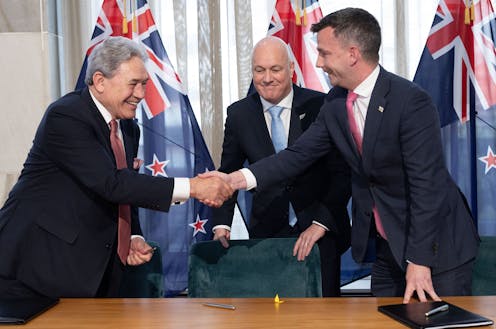
Nearly a year on from its formation, it’s clear a three-party coalition is not quite the same as the two-party versions New Zealand is accustomed to.
Normally, the primary dynamic has been clear: the major party sets the pace while the smaller governing partner receives a bauble or two for supporting the lead act. There may be occasional concerns about tails wagging dogs, but the dog is clearly in charge.
With the present National-ACT-NZ First coalition, however, things are more complex and less predictable. The dog has two tails, both of which are more than capable of vigorous wagging.
On the anniversary of the 2023 election, which produced the first three-party coalition government since the MMP system was adopted in 1996, we are perhaps beginning to get a picture of where dog ends and tails begin.
Speed wobbles
If that picture has been a little blurry until now it’s partly because of the speed with which the government has moved – not always to its own advantage.
In the process of ticking off the 49 items on its plan for the first 100 days, Prime Minister Christopher Luxon’s administration has kept some election promises but broken or fudged others, having to backtrack as a result.
It has delivered tax cuts, but been forced to trim and cap spending in areas (like health and infrastructure) crying out for extra investment.
It has given the impression of urgency and action with its Fast-track Approvals Bill. But it had to scrap the policy’s core element of granting three ministers unprecedented constitutional authority over which projects to fast-track.
Concerns about executive overreach and potential conflicts of interest have dogged other policy areas, too. These range from the repeal of ground-breaking smoke-free legislation to firearms control – both the responsibility of junior coalition party ministers.
This sense of a government somewhat at odds with itself extends to the swingeing cuts made to the public service workforce. Marketed as freeing up resources for front-line staff, the cuts are increasingly likely to be affecting actual service delivery in health, police, defence and elsewhere.
An ‘executive paradise’
Some of this can be put down to a new government’s distrust of a public service inherited from its predecessor, and a desire to make the most of its first year before the shadow election campaign kicks off mid-term.
But the coalition’s vigorous embrace of the executive authority baked into New Zealand’s constitutional arrangements has still been something to behold. As constitutional lawyer and former prime minister Geoffrey Palmer put it, the fast-track legislation risked turning New Zealand into “an executive paradise, not a democratic paradise”.
The government has used parliamentary urgency more frequently than any other contemporary administration. It has been rattling legislation through the House faster than the wheels of parliamentary democracy are meant to turn.
Submitters on the Māori wards legislation, for example, were given just three working days to prepare their arguments. Those wanting to comment on the Crown Minerals Amendment Bill had four days.
And the government has been making less use of parliament’s expert select committees than is standard practice. This has limited public participation and constrained scrutiny of proposed legislation.
Ministers have also been prepared to ignore public service advice while paying plenty of attention to operational matters in the departments that furnish that advice.
New Zealand’s system of public management distinguishes between ministers’ responsibility for policy outcomes and senior officials’ responsibility for the operational decisions required to deliver those outcomes.
Nonetheless, Cabinet has commandeered oversight of operational matters in Whaikaha/Ministry of Disabled People, following botched communications over changes in disability funding. And civil servants have recently been told to stop working from home and return to the office.
The government will be betting this tactical disposition bolsters its “getting stuff done” narrative. But no one wants a concern with short-term operational details to come at the expense of long-term policy thinking.
Treaty principles pantomime
Nowhere is the coalition’s internal tension more evident, however, than in its confrontational approach to Māori and te Tiriti o Waitangi/Treaty of Waitangi issues.
Having courted voters already sceptical or disgruntled about Māori cultural assertiveness, the coalition moved fast to disestablish Te Aka Whai Ora/Māori Health Authority, repeal legislation supporting Māori wards in local government, row back on official use of te reo Māori, and cut funding for Māori language revitalisation.
But its proposed Treaty Principles Bill – an ACT Party initiative – looks set to be especially constitutionally fraught and politically divisive.
National and NZ First have indicated they will not support the bill beyond its first reading, but have agreed it will receive a full six months in front of a select committee.
This only raises the question of why any parliamentary time and money should be spent on the proposal at all – especially given the government’s supposed “laser focus” on cost and efficiency elsewhere.
Can the centre hold?
The politics around the Treaty Principles Bill also reveal just how much the prime minister has had to cede to ACT, for whom the proposed legislation was a bottom line during the government formation process.
And it inevitably casts doubt on the extent and exercise of prime ministerial authority under three-way governing arrangements. ACT leader and soon-to-be deputy prime minister David Seymour has questioned Christopher Luxon’s authority more than once.
And Luxon’s apparent unwillingness to at least censure an under-performing minister from another party (NZ First’s Casey Costello, for example) contrasts starkly with his firmer treatment of those in his own National Party (Melissa Lee and Penny Simmons, both demoted).
One year into a three-year term, these issues can perhaps be dismissed as part of the process of bedding down a new government. But politics never rests. Winston Peters hands the deputy prime minister role to David Seymour at the end of next May. Both NZ First and ACT will want to distinguish themselves from National.
As the next election nears and the jockeying for attention begins, the prime minister’s authority over his administration, and the coalition’s coherence, will be tested further.


