

Social media footage reveals little-known ‘surfing’ whales in Australian waters
- Written by The Conversation
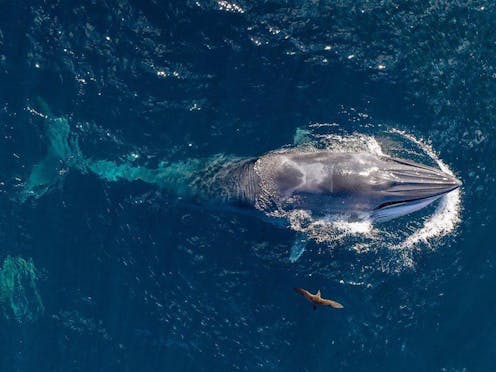
As humpback and southern right whales return to Antarctica at the tail end of their annual migration, east coast whale watchers may think the show will soon be over. But some whale species are still here, possibly year-round. And we need to find out more about them.
My team’s new research concerns one of these little-known species – the Bryde’s whale. You may have seen it feeding, breaching or surfing, without realising what it was.
My colleagues and I wanted to learn more about where Bryde’s whales can be found in Australian waters. So we tapped into observations shared on social media, including drone footage and photographs from whale-watching tours. We also gathered observations from scientists.
We discovered a wealth of information. It includes evidence of feeding and “surfing” behaviours possibly never documented before. Findings from this research will directly help inform conservation efforts to protect this species, which we still know so little about in Australian waters.

Observing whales through citizen science
Scientists can’t always be out in the field, or on the water. That’s why the data gathered by everyday people, known as “citizen scientists”, can be so useful. It captures valuable information about wildlife that can be used later by professional researchers.
Citizen science projects involving marine life have grown over recent years. They include people documenting humpback whale recovery by counting northward migrating humpback whales off Sydney, and people watching sharks off Bondi Beach via the @DroneSharkApp.
Hungry hungry whales
Like humpback whales, these giants are “baleen” whales, meaning they are toothless. But Bryde’s whales have a much pointier mouth and lack that famous hump.
A preference for warmer waters means Bryde’s whales are also known as tropical whales. They can be found in tropical or subtropical waters.
Around the world, Bryde’s whales have demonstrated interesting feeding behaviours, from high-speed seafloor chases to “pirouette feeding”.
 Bryde’s whale in shallow waters near baitfish.
Taylor Arnell and Austin Ihle @takethemap.
Hanging out in shallow and deep waters
Our study documented Bryde’s whales feeding in both deep and shallow waters off the east coast of Australia, alone or sometimes with other whales.
We tapped into more than an hour of drone vision and more than 200 photos of Bryde’s whales shared by citizen scientists on social media platforms such as Facebook, Instagram and YouTube.
In offshore environments, Bryde’s whales were typically seen “side lunging” – where they propel themselves forward and turn onto their side then open their mouth to engulf their food. They also swam from below and scooped up their prey, much like humpback whales.
 Lunging Bryde’s whale feeding on small baitfish in New South Wales waters.
Brett Dixon
In shallow waters, Bryde’s whales were observed feeding directly within or behind the surf break.
We believe this is a new feeding behaviour for this species. We call it “shallow water surf feeding”.
Whales may be using the surf to assist with their feeding efforts, or, perhaps they are there because that’s where the bait fish are hanging out.
Regardless, it’s impressive to see such a large whale in the surf and in shallow waters.
Spotted: mums with their calves
We also documented mothers with calves. This indicates some parts of the Australian east coast could possibly serve as an important area for nursing mothers with their young. They could also be using these waters for calving.
We don’t yet fully understand the species’ movements around Australia, and whether they swim in New Zealand waters. For example, the world-famous white humpback whale Migaloo has been known to swim across the Tasman Sea.
 Bryde’s whale mother with calf in NSW waters escorted by dolphins.
Brett Dixon
Could these Bryde’s whales we see here in Australian waters be the same ones seen in New Zealand waters? Are they calving in New Zealand or Australia and moving between the two? If so, what does this mean for their protection?
Whales don’t recognise international boundaries. They go where they want, when they want. This is why collaborative research like this is important for our growing knowledge of this species.
The more we know, the better we can protect
This is the first dedicated paper on both the occurrence and feeding behaviour of Bryde’s whale in Australian waters.
As humans continue to expand our footprint in the ocean through activities such as offshore wind energy, shipping, fishing and tourism, knowledge of this species and others can help inform future decisions in our blue backyard.
Findings of this study will directly contribute to Australia’s efforts to protect whales. One immediate action will be contributing information to the federal review of Biological Important Areas for protected marine species. The more we know, the better we can target conservation efforts to provide for a species we know relatively little about in Australian waters.
And even though the humpbacks and southern rights are headed back south to Antarctica for the summer, it’s still worth keeping your eyes on the water. You might be the next person to spot a Bryde’s whale in Australian waters. Let us know if you do!
 An example of shallow water surf feeding by a Bryde’s whale.
Taylor Arnell and Austin Ihle @takethemap


