

A technical fix to keep kids safe online? Here’s what happened last time Australia tried to make a ‘clean’ internet
- Written by The Conversation

For anyone who has been online in Australia longer than a decade or so, the discussion around current proposals to set a minimum age for social media use might trigger a touch of déjà vu.
Between 2007 and 2012, the Rudd–Gillard government’s efforts to implement a “Clean Feed” internet filter sparked very similar debates.
Beset by technical problems and facing fierce opposition, the Clean Feed was eventually abandoned in favour of laws that already existed. Will the proposed social media ban face a similar fate?
How to regulate cyberspace
The question of how to regulate a cyberspace occupied by both adults and children has puzzled governments for a long time. Traditional controls on physical media are difficult to apply to online spaces, particularly when so much online media comes from overseas.
As early as 1998, an Australian Broadcasting Authority report noted a key difficulty in online regulation. Namely, balancing adults’ access to legal online spaces and content with restrictions on childrens’ access to age-inappropriate material and bans on illegal content.
The Clean Feed proposal attempted to address parental concerns about age-inappropriate websites. First raised in 2006 by Labor in opposition, it became a campaign promise at the 2007 election.
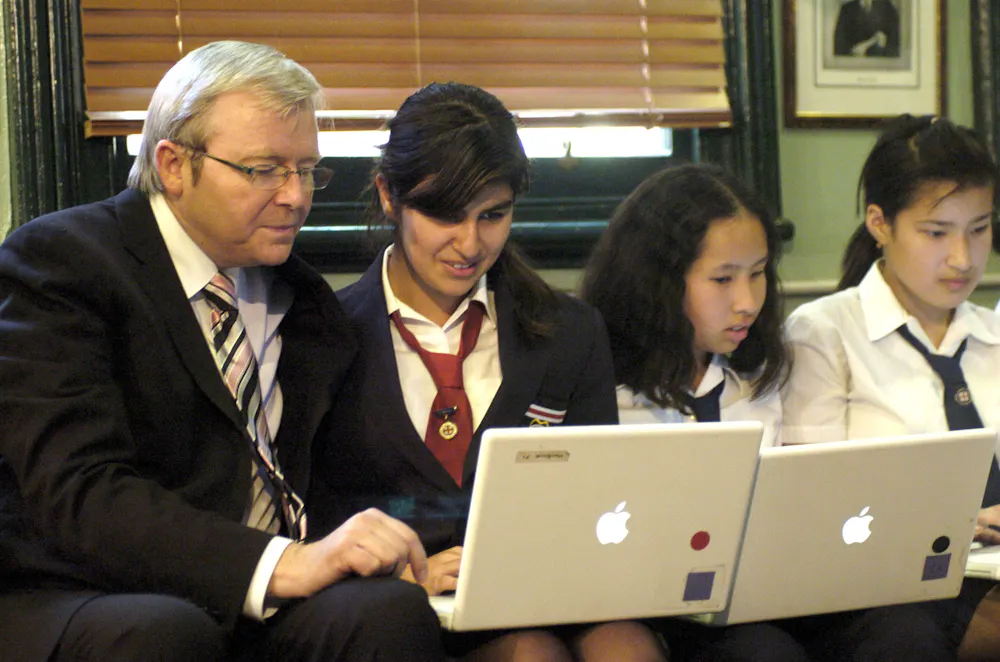
The proposal aimed to solve the issue of overseas content. Australian authorities could already require website owners in Australia to take down illegal content, but they had no power over international sites.
To address this, the Clean Feed would require internet service providers to run a government-created filter blocking all material given a “Refused” classification by the Australian Classification Board, which meant it was illegal. Labor argued the filter would protect children from “harmful and inappropriate” content, including child pornography and X-rated media. The Australian Communications and Media Authority created a “blacklist” of websites that the filter would block.
Technical trouble
The Clean Feed was plagued by technical issues. Trials in 2008 revealed it might slow internet speeds by up to 87%, block access to legal websites, and wouldn’t block all illegal content.
While the effect on speeds was improved, the 2008 trials and others in 2009 revealed another problem: determined users could bypass the filter.
There were also fears the blacklist would be used to block legal websites. While the government maintained the filter would only target illegal content, some questioned whether this was true.
Internet service providers were already required to prevent access to content that had been given a Refused classification. This, along with unclear government statements about removing age-inappropriate material, led many to believe the blacklist could be more far-reaching.
The government also planned to keep the list secret, on the grounds that a published list could become a guide for finding illegal material.
The blacklist
In 2009, the whistleblowing website Wikileaks published a list of sites blacklisted in Denmark. The government banned those pages of Wikileaks, and in response Wikileaks published what it said was the Australian government blacklist. (The government denied it was the actual blacklist.)
Newspapers noted that around half the websites on the published list were not related to child pornography.
 Wikileaks published what it claimed was the government’s planned ‘blacklist’ of websites, along with a rationale for publishing the list.
Wikileaks
The alleged blacklist also contained legal content, including Wikipedia pages, YouTube links, and even the website of a Queensland dentist. This lent weight to fears the filter would block more than just illegal websites.
More debates emerged surrounding how the Refused classification category was applied offline as well as on the internet.
In January 2010, the Australian Sex Party reported claims from pornography studios that customs officials had confiscated material featuring female ejaculation (as an “abhorrent depiction” or form of urination) and small-breasted adult women (who might appear to be minors). Many questioned whether these should be banned, and if such depictions would be added to the blacklist – including members of hacker-activist group Anonymous.
Operation Titstorm and the end of the Clean Feed
While Anonymous members had already protested the Clean Feed, this new information sparked a new protest action dubbed Operation Titstorm.
On February 10 2010, activists targeted several government websites. The Australian Parliament site was down for three days. Protesters also mass-emailed politicians and their staff the kinds of pornography set to be blocked by the filter.
While Operation Titstorm gained media attention, other digital activists (such as Electronic Frontiers Australia and other members of Anonymous) criticised its illegal tactics. Many dismissed the protest as juvenile.
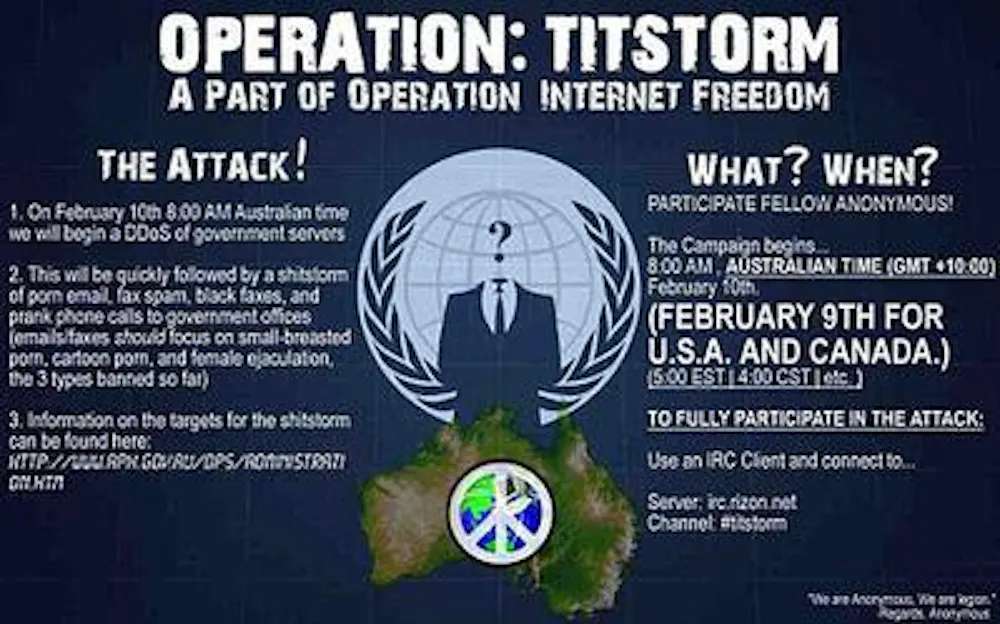 In February 2010, hacker-activists from Anonymous launched denial-of-service attacks and email campaigns in protest of proposed internet filters.
WIkipedia
However, one participant argued that many protesters were children, who had used these methods because “kids and teenagers don’t really get the chance to voice their opinions”. The protesters may have been the very people the Clean Feed was supposed to protect.
The government abandoned the Clean Feed in 2012 and used existing legislation to require internet service providers to block INTERPOL’s “worst of” child abuse list. It remains to be seen whether the social media minimum age will similarly crumble under the weight of controversy and be rendered redundant by existing legislation.
The same, but different
The Clean Feed tried to balance the rights of adults to access legal material with protecting children from age-inappropriate content and making cyberspace safer for them. In a sense, it did this by regulating adults.
The filter limited the material adults could access. Given it was government-created and mandatory, it also decided for parents what content was age-appropriate for their children.
The current proposal to set a minimum age for social media flips this solution by determining what online spaces children can occupy. Similar to the filter, it also makes this decision on parents’ behalf.
The Clean Feed saga reveals some of the difficulties of policing the internet. It also reminds us that anxiety about what Australian youth can interact with online is nothing new – and is unlikely to go away.


