

How does a jury reach a conclusion? A new SBS show painstakingly recreates details to take us behind the scenes
- Written by The Conversation
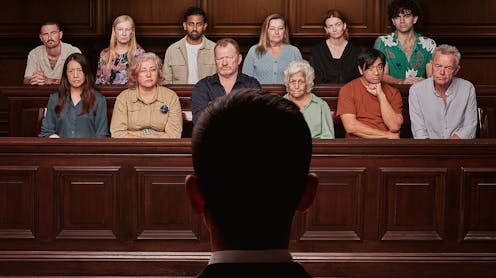
Juries are the bedrock of common law, and have been used for centuries to decide factual issues before the court.
Jury research has for years attempted to improve our understanding of how jurors reach a conclusion, both individually and as a collective. But we have very little understanding of how each specific case is decided: in Australia, jurors are banned from discussing their deliberations outside of the jury room.
Predicting the jury’s decision in criminal matters is impossible: the whole system remains totally opaque. This has been evident in a very high-profile case just this year, when a very surprising decision was handed down; I would love to be able to pick that one apart.
A new show by SBS attempts to demystify the process. The Jury: Death on the Staircase follows the deliberations of 12 jurors as they listen to nine days’ worth of evidence in a real, concluded manslaughter case.
Observing the trial, and the jury
The names, dates, locations and images from the original case have been changed to make sure the jurors could not look up the result, and to protect the individuals involved in the real trial. These changes could, of course, alter the jury’s decision-making process.
Actors are used to re-enact the trial, using transcripts of the original case to simulate the real trial as closely as possible. The jurors are everyday Australians who volunteered to take part in this experiment.
The case revolves around the death of a man who was found at the bottom of a staircase, in the home he shared with his male partner.
Other factors the jury attaches relevance to are the 20-year age gap between the deceased and the younger accused man, and the accused is Asian.
We hear the pre-trial thoughts and motivations of the jurors, and some of the biases and prejudices start to show early on.
As the trial unfolds, specific aspects of the accused’s personality impress different members of the jury – some finding points of commonality that encourage them to be very sympathetic, others highly sceptical of his innocence. This seems less based on the evidence being heard, and instead reflects directly the personality and life experience of the juror.
The jurors, like a real jury, come from all walks of life, educational backgrounds, sexualities and ancestral groups. There are some big, dominant voices, as well as others who are much quieter and more circumspect.
What surprised me while watching was that many of the impressions the jury discuss – and their interpretations of them – aren’t based on the evidence at all. They’re watching the accused, trying to get a read on his guilt or innocence from his body language, where he looks at certain times.
None of them are body language experts, but they seem to think they can reliably extrapolate how he is feeling from observing him.
Some of them also speculate wildly as to what could have happened, and why. If that’s what real jurors do, that’s worrying.
I have some questions
It’s hard to know how closely the producers mirrored the original case: was it a homosexual relationship, was there a large age gap, was the accused Asian?
These factors are important, because the jury puts weight on them and hypothesises with these in mind.
Another big question for me was how they chose the members of the jury. Was it random? If it was, they do not reflect the personalities of the original jurors and it is very clear that personality and life experience were heavily influential in each person’s response to the case.
The question was asked by one of the jurors: what if they reach a different conclusion than the original, genuine jury? What would that mean for the accused?
My sense was they were wondering if they found him not guilty of manslaughter, would that have any legal implication.
The answer is no.
It’s impossible to truly replicate a case. I would even suggest the same jury could reach a different conclusion at a different time, depending on what had happened in their lives recently and other external factors. Regardless of what result this jury reached, it could not hurt or help the real accused person.
But it is certainly an interesting program, and will give the viewer an insight into what factors most influence jurors.
It might also scare them slightly. We like to think juries make their decision based on the evidence put before them, but that does not appear to be the case, at least certainly not early on in the trial process.
The jurors focused on how the accused lived their life, and judged him accordingly – both positively and negatively. The scientist in me feels that it would be great to repeat this experience, to see if the same or a different result was achieved under these, somewhat controlled conditions.
I’d also love to see more access to real jurors, post decision: that is the only true way to gauge their thoughts and impressions as they work through a case. But as that is unlikely, this series is as close as we’ll get. It is worth a watch if you’re interested in how juries reach their – sometimes apparently inexplicable – decisions.
The Jury: Death on the Staircase is on SBS and SBS On Demand from today.


