

‘A woman is not a baby-making machine’: a brief history of South Korea’s 4B movement – and why it’s making waves in America
- Written by The Conversation
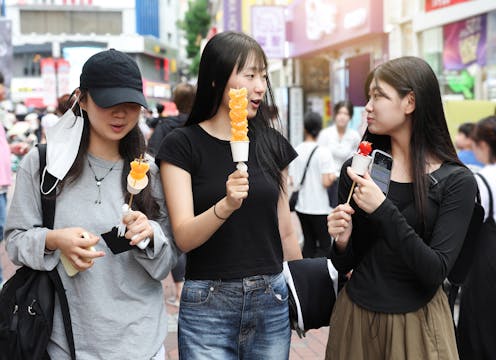
In South Korea, a growing number of young women are rejecting societal expectations of marriage, motherhood and heterosexual relationships, known as the “4B Movement” or the “4 Nos”.
The “B” is a homophone for the Korean word bi (비/非), meaning “no”, representing the movement’s four principles: bihon (no marriage), bichulsan (no childbirth), biyeonae (no dating) and bisekseu (no sex).
By refusing to marry, have children, engage in romance, or participate in sexual relationships with men, 4B feminists seek to redefine their lives outside the confines of traditional gender roles.
In the wake of the reelection of Donald Trump, there has been increased interest in the 4B movement from women in the United States.
But what is the 4B Movement, where did it come from, and how is it reshaping the feminist landscape in South Korea and beyond?
Challenges facing young women
The 4B Movement reflects a broader dissatisfaction among young South Korean women who face instability of housing, digital sexual violence, economic disparities and cultural pressures.
Read more: AI is fuelling a deepfake porn crisis in South Korea. What’s behind it – and how can it be fixed?
It emerged in the mid- to late-2010s, following a surge of interest in feminism in South Korea, and spread primarily through women’s online communities.
The roots of the 4B Movement lie in South Korea’s rapid economic transformation and the subsequent challenges it posed for younger generations of the 2000s.
For young women, economic insecurity is compounded by systemic gender inequality. South Korea consistently ranks worst in the OECD for the gender wage gap, and social mobility remains limited.
Against this backdrop, traditional life paths – marriage, childbearing and homemaking – have become less appealing.

Living an alternative life without men emerged as a radical strategy for young digital feminists to challenge the rigid patriarchy in South Korea.
The senseless killing in 2016 of a woman in a train station toilet by a man in Seoul shocked the nation and fuelled the movement. Online platforms became spaces where women could share their frustrations, critique patriarchal norms and organise protests.
During this period communities like radical feminist online groups gained traction. Among these was the Tal-Corset (escape the corset) movement, which encouraged women to reject societal beauty standards by foregoing makeup, cosmetic surgery and restrictive clothing.
The 4B Movement built on this momentum, targeting not only beauty standards but the very institutions that sustain patriarchy.
It collectively challenges the notion that women’s value lies in their ability to support men and sustain the family unit.
‘A woman is not a baby-making machine’
The birth rate in South Korea ranks among the lowest in the world. The government has long viewed this as a national crisis. Policies such as subsidised housing for newlyweds and tax incentives for families have sought to encourage marriage and childbearing.
In 2016, the government launched a national pink birth map visualising the number of women of reproductive age in each district. It sparked outrage. Women criticised it as reducing them to reproductive tools, proclaiming, “my womb is not national property” and “a woman is not a baby-making machine”.
 The birth rate in South Korea ranks among the lowest in the world.
bigshot01/Shutterstock
The birth rate in South Korea ranks among the lowest in the world.
bigshot01/Shutterstock
For many 4B feminists, these policies represent a stark example of how the state prioritises population growth over women’s autonomy. In response, the movement frames its rejection of marriage and motherhood as an act of political resistance.
As one protest slogan declared: “End population policies! Stop blaming women”.
Living on their own terms
Despite its growing influence, the 4B Movement faces significant challenges.
The radical principles have sparked backlash, with critics labelling participants as selfish or anti-social. Swearing off men as a form of protest against patriarchal structures and traditional marital norms is sometimes (mis)interpreted as implicitly favouring lesbianism, given its stance against heterosexual relationships.
The movement has also attracted negative political attention. Lee Seung-cheon, a 58-year-old Democratic Party candidate, pledged to introduce “measures to reject the 4B Movement” as part of his policy campaign in 2020.
Yet 4B feminists remain steadfast in their vision of a future where women can live on their own terms. Their rejection of traditional life paths is not a retreat into isolation but an attempt to create new ways of being free from patriarchal constraints.
As one participant noted, rejecting marriage allows women to envision futures beyond societal deadlines like “a woman’s age has an expiration date”.
An international movement
The 4B Movement’s radical critique of patriarchy has resonated internationally.
4B Movement ideas are starting to strike a chord in the US. The movement’s core principles align with broader feminist critiques of patriarchy and capitalism, which have intensified in response to political developments such as Trump’s rhetoric and debates over reproductive rights.
In the US, Trump’s presidency (and now his return) has been a flashpoint for feminist activism. Policies restricting access to abortion, coupled with an increase in conservative rhetoric around women’s rights, have galvanised movements that resist patriarchal structures.
For American feminists, the 4B Movement offers a framework for resistance that goes beyond economic precarity. It provides a roadmap for rejecting political conflicts, focusing on reclaiming agency by prioritising autonomy over their own bodies and rights.
6B4T is inspired by the 4B Movement and has gained particular attention in China. This version incorporates additional principles, including rejecting consumerism and fostering mutual aid among unmarried women.
The spread of 4B ideas across Asia and beyond highlights the universality of feminist struggles. As the movement continues to evolve, its impact extends beyond South Korea, sparking conversations about gender, autonomy and the future of feminism.
Whether embraced or contested, the 4B Movement forces society to confront uncomfortable truths about the cost of sustaining patriarchy – and perhaps the possibilities of living without it.
Correction: 6B4T is inspired by the 4B movement and gained attention in China; it did not originate in China.


