

Trump joins Putin, Xi and Modi as the ‘four horsemen’ of global authoritarianism
- Written by The Conversation
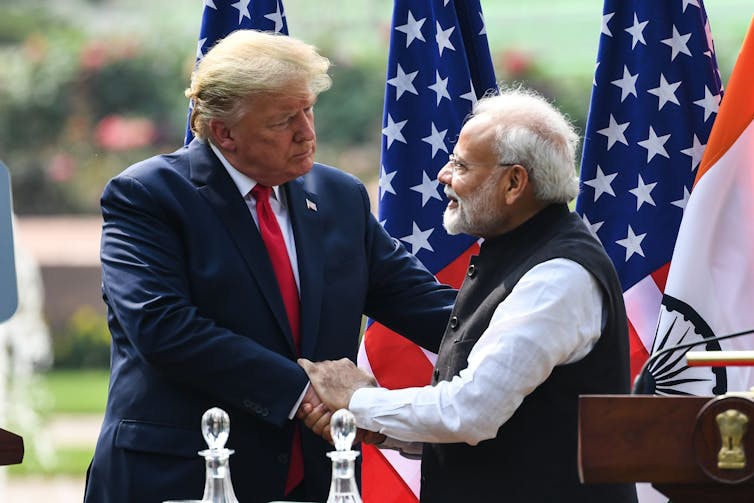
The election of Donald Trump for his second presidential term has led to widespread fears of an imminent authoritarian descent in the United States.
Quite how that might play out remains speculative, for now at least. But evidence from Trump’s first term, as well as his campaign policies and cabinet nominations since the election, suggest those fears are not without foundation.
Another way of looking at this, however, is that Trump’s return simply echoes realities within the international system’s other great powers – China, Russia and India have all displayed similar political pathologies for some time now.
Due to their collective power and influence in determining the nature of the world order, Trump’s victory thus marks the amplification of a deeply autocratic era in global politics.
The hallmarks of what we might call this nascent “Pax Autocratica” can be seen in a variety of ways, as these four horsemen of authoritarianism charge ahead with their policies and plans.
Strongman politics
Donald Trump and his counterparts – China’s Xi Jinping, Russia’s Vladimir Putin and India’s Narendra Modi – are all bombastic, divisive and confrontational leaders. They embody the archetype of strongman politics whereby power is focused on a single, would-be omnipotent individual.
As well as sharing similar alpha-male psychological characteristics and developing cults of personality around themselves, they seek to rule for long periods.
In 2018, Xi removed the presidential term limit from China’s constitution. In 2020, Putin amended the Russian constitution, allowing him to rule until 2036, leading to what’s been described as a “politics of eternity”.
In power since 2014, Modi has won the past three elections in India. Accused of having a god complex, his success has rested on mainstreaming Hindu-first nationalism, capturing the legal system and rewriting Indian history.
Trump, too, has flirted with ideas of a third term (impossible under current constitutional rules), saying, “we just have to figure that out”.
Constraining human rights
Each of these leaders has overseen governments that have sought to narrow and constrain human rights. This includes limiting freedoms of speech and expression within Russian media, attacking journalists and protesters in India, and purging opponents in China. In all three countries, this involves using legal mechanisms to stifle dissent.
Reports after Trump’s victory suggest he also wants to punish or suppress protest and dissent. The growing politicisation of the US Supreme Court matches similar trends in the other three countries.
This has been likened to a shift away from the rule of law (which underpins a free and open society) towards “rule by law” (whereby the law becomes a tool of control).
Globally, there have been warnings that reduced freedoms of speech, association and expression threaten the fundamental structures of civil society. The 2024 State of Civil Society Report by watchdog group Civicus estimates 72% of the world’s population now lives under authoritarian regimes.
Attacking minorities
The first Trump administration actively discriminated against minority ethnic groups, LGBTQ people, those with disabilities, and immigrants.
Trump’s 2017 travel ban closed the US border to Muslims, while the planned deportation of up to 13 million illegal migrants was a mainstay of his 2024 campaign.
In Russia, attacks against minorities and foreigners are commonplace, with racism in the country described as “out of control” by Amnesty International. Since 2014, violence and discrimination against India’s 200 million Muslims has significantly increased under Modi’s Hindu nationalist Bharatiya Janata Party (BJP).
The Modi government’s actions actively discriminate against Muslim employment, education, justice and housing, especially in Kashmir and Assam.
These chime with China’s actions in Xinjiang and Tibet where ethnic minorities are experiencing fundamental human rights violations. Beijing is also building a national social credit system designed to enhance public trust in the Chinese Communist Party (CCP) and create a society of “compliant subjects”.
Weakened electoral systems
While ostensibly democratic, there are glaring weaknesses in the US, Indian and Russian political and electoral systems, which undercut claims of electoral equality, fairness and plurality.
While not as blatantly authoritarian as China (under the one-party rule of the CCP since 1949, and which consistently silences its opponents), elections in Russia are essentially non-competitive and only a façade of democracy.
In the US, the gerrymandering of electoral regions, voter suppression, and vast corporate donations tilt the political landscape towards particular interests.
Much the same is true of India, which has shifted towards a form of “electoral autocracy”, and is described now as only a “partially free democracy” by monitoring group Freedom House. These trends are exacerbated by India’s persistent intergenerational political dynasties and powerful political donors.
Surveillance and security
All of these authoritarian trends are underpinned by modern surveillance structures, directed inward towards a country’s own citizens as much as outwards, and enabled by Big Tech and now AI.
What has been described as “algorithmic authoritarianism” takes different forms. The Chinese social credit system uses such technology to instil social control mainly through financial levers.
India’s Central Monitoring System allows government agencies to monitor all mobile phone, landline and internet communications with minimal legal restraints. The pervasive reach of Russia’s capabilities has resulted in a “cyber gulag” of “total digital surveillance”.
In the US, whistleblower Edward Snowden revealed the mass surveillance of telephone records in 2013, which was found to be illegal in 2020. Now, Trump’s alliance with Elon Musk has potential implications for his administration’s approach to AI and national security – including Musk continuing to use his social media platform to boost Trump’s political support.
Trump’s return has normalised and supercharged authoritarianism internationally, making it the rule rather than the exception. America’s autocratic drift is now part of a broader global pattern, one that threatens democratic forces everywhere.


