

At ACMI’s The Future Other Fictions, artists challenge us to imagine a more optimistic world
- Written by The Conversation
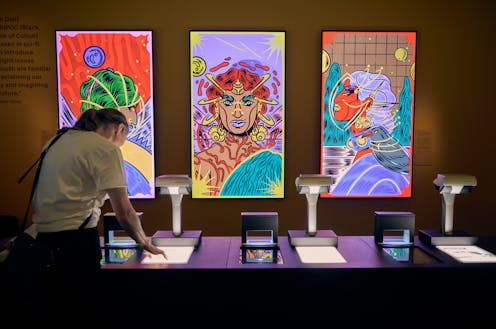
The Future & Other Fictions, ACMI’s flagship summer exhibition, explores where storytelling imagines and rethinks the future.
It is an original show co-curated by ACMI’s Amanda Haskard (Gunai/Kurnai) and Chelsey O’Brien, in collaboration with director, featured artist and futurist Liam Young.
Featuring the work of 19 creatives, it brings together an impressive 180 works, showcasing film, videogames, screen-based art, costumes, paraphernalia from movies, video essays, textiles, fashion activism and new commissioned works.
The future, according to Young, “rushes over us like water”. It doesn’t just “happen to us” – “we can all be active participants in shaping and defining it”.
At the opening he described the exhibition as a “call to arms”, challenging visitors to imagine or be empowered to shape a more optimistic world. Young’s analogy with water is present throughout the exhibition.
Moving through the maze
The first part of the exhibition has a video essay that offers a provocative history of future worlds as seen on screen. As you explore, you encounter popular items from Marvel Studios’ Black Panther: Wakanda Forever (2022) to a miniature from Blade Runner 2049 (2017).

As visitors move through, the set design wraps around us, directing us – a bit like a maze drawing one forward.
Birth of Dawn, by Queensland-based artist Hannah Brontë, uses the pregnant form and water to represent the embodiment of her Country.
This work is mesmerising and tranquil. The experience includes the smell of an earthy blue gum scent, which I identified as suggesting the earth sweating. The exhibition label for this work observes “there is nothing more science fiction than nature itself”.
Another commission, After the End, is designed and directed by Young and written and narrated by Ngarrindjeri, Narungga, Kaurna and Noongar actor Natasha Wanganeen.
It is described in the publicity as reimagining “a world in which fossil fuel production has ceased, and communities return to rebuild the landscape”.
Much of the work evokes the sensation of floating in water. I found it utterly hypnotic. Viewers can recline on bean bags and let the experience gently wash over them.
 After the End, designed and directed by Liam Young and written and narrated by Natasha Wanganeen.
Eugene Hyland/ACMI
After the End, designed and directed by Liam Young and written and narrated by Natasha Wanganeen.
Eugene Hyland/ACMI
Other works have this same imagining of speculative (hypothetical) futures, resistance and rebellion, including the idea Indigenous people reclaim sovereignty and Country.
Nigerian-born United States artist Olalekan Jeyifous’s Shanty Megastructures imagines “Anarchonauts”: an advanced and empowered African identity who turn neglected spaces into innovation and sustainability centres.
These works remind the viewer of Mad Max films, initially conjuring up dystopian ideas of society having gone wrong.
But Jeyifous’ vision feels utopian. We observe harmony realised by calm expressions, an image of a mother, child and technology (the latter creatively made wearable). The beaming face of a smiling child tells us that these shanty towns, usually places of extreme poverty, might be optimistic places of social ingenuity.
It flips the Max Max narrative. This society is resilient and thriving.
 A model from Blade Runner 2049 (2017), and Olalekan Jeyifous’ Shanty Megastructures.
Eugene Hyland/ACMI
A model from Blade Runner 2049 (2017), and Olalekan Jeyifous’ Shanty Megastructures.
Eugene Hyland/ACMI
Screen culture and the future
Screen culture (which is everything a screen community does, from production, to this article, and to exhibitions) has always engaged in futurism, from Fritz Lang’s Metropolis (1927) through to the new commissions described above.
As the exhibition’s introductory wall text offers, many of the innovations of today, from “driverless cars, smart phones, virtual reality – first appeared on screen”.
 Bjork’s The Gate, Music video by Andrew Thomas Huang.
ACMI
Bjork’s The Gate, Music video by Andrew Thomas Huang.
ACMI
From this perspective, this exhibition showcases a vision of the transformative power of screen culture for shaping the future. Throughout the exhibition, we are shown how screen productions of the past imagined the future, juxtaposed against contemporary creators speculating about futures they want to live in.
The environment and Indigenous cultures
Many of the works in the exhibition come from the Asia Pacific.
The fashion activist collective the Pacific Sisters celebrate Indigenous identities and mana wāhine (a concept from Māori culture in Aotearoa New Zealand that refers to the power, authority and prestige of women).
 K; Tauleolevai: Keeper of the Water (Tuna) from The Pacific Sisters.
Lisa French
K; Tauleolevai: Keeper of the Water (Tuna) from The Pacific Sisters.
Lisa French
Their aim is to preserve culture through costume design and speculative storytelling.
Artwork that dramatically represents their sustainable approach is seen in Kaitiaki with a K; Tauleolevai: Keeper of the Water (Tuna).
There are three imposing fashion artworks, one made from VHS video tape. Due to a lack of materials, they recycled the tape, removing it from cassettes and plaiting it using a technique usually applied to palm leaves for making kikau brooms.
Videotape has its own qualities, shimmering in the light as if it were alive. This is a metaphor; VHS is considered obsolete but, as the wall text reminds us, in Māori and Pacific cultures, “the past lives in the present”.
Interactivity
The exhibition is mentally and physically interactive. It poses thought-provoking questions about our future selves, exploring how artificial intelligence will reshape cinema and whether screen culture predicts the future or merely reflects the fantasies and social realities of the era in which it is created.
It also has lots of interactive features from making posters to using the barcode on the entry ticket to capture things and take them home.
 There are interactive experiences throughout the exhibition.
Eugene Hyland/ACMI
There are interactive experiences throughout the exhibition.
Eugene Hyland/ACMI
Visitors who’ve ever wondered what sci-fi renegades, afrofuturists, fashion activists, anarchonauts, Indigenous futurism, cyberpunks and screen culture have in common will be enlightened by the end of the show.
Each of these are woven into the story of the exhibition which has a positive message about how screen culture and environmental care can imagine and potentially create a future where human and nature thrive together.
It has something for audiences of all ages and will be a welcome cultural addition to the hot days of Melbourne’s forthcoming summer.
The Future & Other Fictions is at ACMI until April 27 2025.


