

The discovery of a rare new fossil sheds light on NZ’s extinct dolphin-like reptiles
- Written by The Conversation
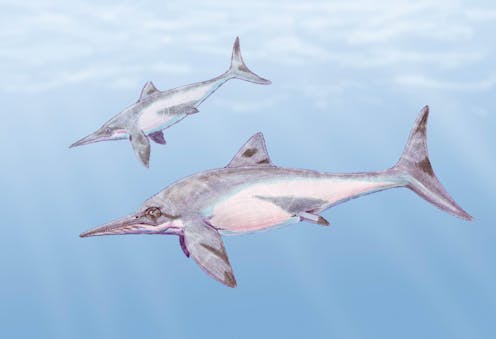
Ichthyosaurs were reptiles that swam in the seas during the time of the dinosaurs. They evolved separately around 250 million years ago, possibly from a crocodile-like ancestor, to resemble fish and modern dolphins.
Then, they went extinct around 94 million years ago.
In 2010, palaeontologist James Crampton discovered a partial ichthyosaur skeleton while working on Coverham Station in the Clarence Valley, inland North Canterbury. This specimen dates back to the Cenomanian stage during the Late Cretaceous epoch just under 100 million years ago.
The skeleton was encased within a hard concretion and was taken from Coverham to be stored and catalogued at GNS Science until 2021. It was identified as an ichthyosaur because of the characteristic hourglass shaped vertebrae.
Our detailed study now sheds further light on this specimen, which is more complete than any other known ichthyosaur skeleton from New Zealand.
Before this discovery, the only Cretaceous ichthyosaur material found in New Zealand was a small fragment of a jaw and a few vertebrae, all from different individuals, and all from the North Island. This find significantly advanced our understanding of these dolphin-like reptiles in Aotearoa New Zealand.
Medical scanner reveals bones within rocks
The ichthyosaurs of New Zealand have remained poorly understood due to the lack of well-preserved specimens. This fossil promises to change the narrative.
Expert fossil expert Al Mannering meticulously prepared the find so it could be scanned using a medical CT scanner to image the bones that were too difficult to prepare.
Each bone was then rendered in 3D to study its morphology using a technique known as virtual preparation. The fossils included a part of the base of the skull, parts of the shoulder and front flipper, as well as a complete left pelvis and most of a hind flipper. Many vertebrae and flipper bones were also present in the concretion.
This discovery is particularly exciting because the specimen is about 98 million years old. This is about four million years before the final extinction of ichthyosaurs, which makes it one of the youngest semi-complete ichthyosaur skeletons known.
The fossil is essential for understanding ichthyosaur diversity in New Zealand. These ancient reptiles have not been studied as comprehensively as in the northern hemisphere due to the fragmentary nature of most specimens.
The pelvis is also very rarely preserved in Cretaceous ichthyosaurs, especially this close to their final demise. This provides much needed additional data about what they looked like and how they differed from species around the world. We can see that it was different from the hip bones of other species.
Surprising evolutionary links
Although the specimen is too fragmentary to be formally named, it exhibits several distinctive features.
These include an extremely simplified base of the skull and a scapula (shoulder blade) with a prominently flared head and a strap-like shaft. There is also a distinct furrow on one of the pelvic bones, something not seen in any other species.
The well-preserved pelvis and hind fin of this specimen provide valuable information, contributing to our limited knowledge about Cretaceous ichthyosaurs.
Together, these characteristics indicate this specimen is part of the family Platypterygiidae and most closely related to the Australian species Platypterygius australis and various other European Cretaceous ichthyosaurs.
Interestingly, this specimen appears to be unrelated to the ichthyosaurs of Western Gondwana, in modern-day South America. This was unexpected, as 98 million years ago South America and New Zealand were certainly closer to each other than to Europe.
This suggests the species in New Zealand may have remained separate from those in South America, hinting at potential regionalism among the Gondwanan Cretaceous ichthyosaur populations.
This contradicts what is seen in the slightly younger fossils of other marine reptiles such as plesiosaurs and mosasaurs, which show evolutionary links between South America, Antarctica and New Zealand. It is possible these links began after ichthyosaurs became extinct.
This discovery enriches the known diversity of southern hemisphere and Australasian ichthyosaurs. It highlights the more regionalised distribution of these marine reptiles around the margins of Gondwana in the late Cretaceous.


