

Fake podcast clips are misleading millions of people on social media. Here’s how to spot them
- Written by The Conversation
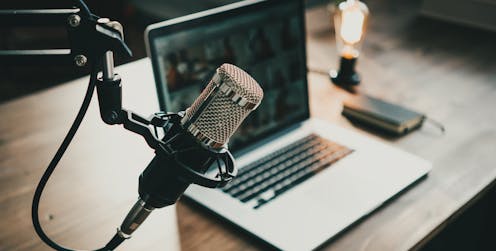
Podcasting is the medium of choice for millions of listeners looking for the latest commentary on almost any topic. In Australia, it’s estimated about 48% of people tune in to a podcast each month.
However, the rise of podcasts has also led to a new trend of “fake podcasts”. In some cases, these are a trivial marketing strategy. In others, they are a deceptive form of misinformation.
So what are fake podcasts?
Fake podcasts are short video clips designed to appear like snippets from real podcasts published on short-form content platforms such as TikTok.
These clips centre on one or sometimes two speakers, positioned behind high-quality broadcasting microphones, directing their conversation off camera. However, in reality no broader discussion is taking place.
These videos began gaining attention in late 2022 when social media users realised several viral clips showing commentators on seemingly high-profile podcasts were in fact “fake”. These clips weren’t from any real podcast episodes. In some instances the microphones hadn’t even been turned on.
The most noteworthy example came from fitness influencer and YouTuber Vincent Sant. To market his online brand, Sant created a video suggesting he had appeared on the Joe Rogan Experience.
Although the video showed him using the same microphone, headphones and red velvet curtain backdrop as Rogan, viewers quickly pointed out Sant had never appeared on the show. He removed the clip shortly after.
Since then, fake podcast clips have become a recognised marketing strategy employed by a range of brands. Some professional actors produce this content regularly, earning up to US$16,000 per month.
There are even explicit guides on LinkedIn for marketers wanting to produce their own fake podcasts, with the practice described as “the future of video marketing”.
Some fakes are more harmful than others
There are three main types of fake podcast, each one deceiving viewers to a different extent.
The first is the explicit ad. In this case, the podcast format is used to present an obvious sales pitch for a specific product. Examples include this ad from Junkee and Bank Australia:
While the ad uses a podcast format, it’s unlikely to fool many viewers, not least due to the “paid partnership” disclaimer.
The second category of fake podcasts uses the podcast aesthetic to market a personal brand, rather than a specific product. Several influencers including online entrepreneur Sebastian Ghiorghiu and Pearl Davis (the so-called “female Andrew Tate”), have garnered millions of followers through such clips, which intentionally leave the broader context ambiguous. They produce clips from both real and fake podcasts, with no means of differentiating the two.
These kinds of fake podcasts have three main purposes. The first is to gain consistent viewers. The second is to legitimise the creator’s, at times, conspiratorial political perspectives. And the third is to sell products.
The final and most intentionally deceptive form of fake podcast is what I call the “deep” fake podcast. These clips combine elements of the first two categories alongside manipulated audio and video – usually produced with the help of AI tools.
The purpose here is usually to convince viewers a certain prominent podcaster or personality has made certain claims and/or endorsed certain products. One recent example purports to show Joe Rogan and neuroscientist Andrew Huberman endorsing a “libido-boosting” supplement. This is the most deceptive form of the practice.
The psychology behind fake podcasts
Out of all the mediums to fake, why fake a podcast? Are online audiences so susceptible that they immediately associate anyone talking off camera into a microphone with expertise? Not quite.
Podcasting reflects what media researcher Henry Jenkins calls “convergence culture”. In this space, the distinctions between traditional, alternative and social media are increasingly blurred, as are the lines between producers, consumers, technical experts and “popular experts”.
Social media users usually recognise podcasters as popular experts. These individuals may not have recognised qualifications, yet they are often just as knowledgeable about a particular area of popular culture as a technical expert due to their experience and/or passion. Karen Kilgariff and Georgia Hardstark, hosts of the top podcast My Favourite Murder, are a good example, as is former YouTuber MatPat, whose channel The Game Theorists has close to 20 million subscribers.
Convergence culture has increasingly foregrounded popular experts in online spaces, helping to legitimise their blend of amateur and professional communication.
How to spot them
According to the Pew Research Centre, US adults who hear “news” discussed on podcasts are likely to view this information as more reliable than news gleaned from other sources such as social media. At the same time, podcasts are much easier and cheaper to fake than other forms of traditional media.
Spotting fake podcast clips may not always be easy, especially if you haven’t come across one before. If you see a suspicious clip, a good rule of thumb is to look for a clear link to the original video and recording. If this original is easily accessible, verifiable and lasts longer than sixty seconds, the clip itself is probably real.
Another way is to cross-reference the clip with other official channels. For instance, the next time you see a 20 second video of a renowned health expert spruiking a new supplement on Amazon, check that expert’s official social media page before clicking the purchase link.


