

Earth is bombarded with rocks from space – but who gets to keep these ultimate antiques?
- Written by The Conversation
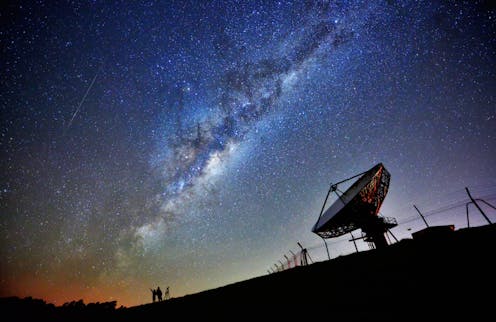
Every day, about 48.5 tonnes of space rock hurtle towards Earth. Meteorites that fall into the ocean are never recovered. But the ones that crash on land can spark debates about legal ownership.
Globally, meteorite hunting has become a lucrative business, with chunks of alien rock traded online and shipped between countries.
Meteorites hold the key to the mysteries of the universe, but increasingly, significant scientific finds are being lost to private collectors.
Last year, New Zealand formally recorded an apple-sized meteorite weighing 810g. It fell on Department of Conservation land in the central South Island, near Takapō. Recovered by Jack Weterings, a member of Fireballs Aotearoa (a citizen science group tracking meteorites), the meteorite has reignited discussion about the regulation of such finds.
Over the years, several meteorites have been recorded in New Zealand. Most notably, the 1.3kg Ellerslie meteorite crash-landed through the roof of the Archer family home in Auckland on June 12, 2004.
Bouncing off the sofa and eventually settling in the middle of the living room floor, the meteorite caused an international stir, with several individuals worldwide offering to purchase it.
The Archers, a retired couple, refused these offers, opting instead to sell it to the Auckland War Memorial Museum for public display.
The Takapō meteorite spent much of 2024 being pored over by geologists at the University of Otago. But the question of rightful ownership remains open because it was found on public land.
How New Zealand law deals with meteorites
Despite their interstellar origins, ownership of meteorites is determined by the law of the country where they are found. Approaches vary from country to country. Some allow private meteorite ownership while others require mandatory state ownership with no compensation of any kind.
New Zealand – along with Canada, France, the US and the UK – has adopted an approach that depends on where the meteorite crashes. If it lands on private property, the land owner is the rightful legal owner of the space rock.
With meteorites found on public property, as was the case with the Takapō meteorite, the “finders keepers” approach prevails and Fireballs Aotearoa, thanks to Jack Weterings, is the legal owner.
While the organisation professes to “have no commercial interest in meteorites” and pledges to donate all to museums, not all meteorite hunters are so willing to donate the spoils of their discoveries.
Commercial meteorite hunting appears to be on the rise internationally, especially in China, where it is a lucrative source of income. Some meteorites can fetch millions online. With collectors reportedly including Elon Musk, Steven Spielberg, Nicholas Cage and Uri Geller, the hobby is now seen as glamorous. The world’s fascination with the ultimate antique is expected to grow.
Trading meteorites
Several states have stepped in to regulate meteorite hunting within their borders. In New Zealand, the export of movable protected objects, including taonga tūturu (objects with Māori links), is heavily restricted.
Under the Protected Objects Act 1975, which incorporates both the 1970 UNESCO Convention on the prevention of illicit transfer of ownership of cultural property, and the 1995 UNIDROIT Convention on stolen cultural objects, permission must be obtained from the chief executive of the Ministry for Culture and Heritage before protected objects can be exported.
Meteorites are listed as protected objects under the legislation and as a result, the chief executive must consult two expert examiners in determining any export licence application.
Penalties for illegally exporting or attempting to export meteorites without a licence are hefty. They include automatic confiscation of the item to the Crown, a term of imprisonment of up to five years and a fine of up to NZ$100,000 for an individual and $200,000 for a body corporate.
If the export licence application is declined, for whatever reason, there is a right to appeal the decision directly to the minister for arts, culture and heritage. If the minister opts to uphold the decision, or if the applicant decides not to lodge an appeal, the object is automatically listed in the nationally significant objects register.
While New Zealand has adopted legislative measures to regulate meteorite exports, the relationship between finders and scientists could become increasingly tense. Perhaps meteorite collection should be strongly dissuaded unless it is strictly for scientific purposes? Time will tell whether an easy compromise can be found.


