

Here’s what ‘deep listening’ can tell us about the natural world and our place in it
- Written by The Conversation
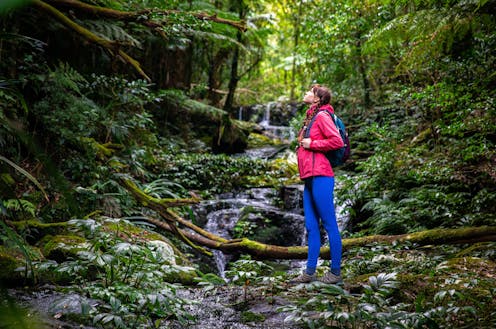
Have you ever taken the time to stop and listen to nature? Deeply, quietly and patiently?
If not, don’t worry, there’s still time to learn. Deep listening is a skill that can be developed.
There’s much more to it than simply recognising the call or song of a particular species. To listen deeply to nature is to become aware of behaviours, relationships and patterns of interaction between multiple species, and to learn from what we hear.
This is what Indigenous people have been doing for many thousands of years, in Australia and overseas.
Under the supervision and guidance of Indigenous knowledge holders of Karulkiyalu Country, my PhD research, explores ways to embed this Indigenous approach to deep listening in Australia’s education system.
The project builds on previous work showing positive results for student and teacher wellbeing, as well as an increased understanding of and desire to care for the natural world.

What is deep listening?
If you’d like to try deep listening, take some time to visit a natural place and find a quiet spot where you won’t be disturbed. Turn off your electronic devices.
Close your eyes, and extend your sense of hearing into the landscape around you. Try focusing your listening in each direction, then above and even below. How far you can hear?
At first you will hear the voices of individual creatures, perhaps one then another. After a while, you may begin to notice interactions and patterns of communication between them. Be curious. Does one respond to another? How, and why?
Hearing all the interconnected activity going on around you in that moment can help you comprehend the living system as a whole.

What can we learn from nature by listening?
People often simplify complex relationships down to perceptions of either cooperation or competition.
But listening to nature affirms that cooperative partnerships play a far greater role than meets the eye. Relationships between species that accommodate each other’s needs are ubiquitous throughout the biosphere.
For instance, multiple species of birds forage efficiently and safely in mixed flocks, by communicating and alerting each other to information about food and threats. This practice of foraging collectively is so worthwhile it’s encountered the world over.
Listening to the animated twittering of these flocks – which continually communicates and affirms each bird’s location – reminds us how beneficial cooperation can be. More importantly, cooperation is most advantageous when it embraces diversity.
Addressing the existential threats facing humanity will require cooperation and collaboration on a massive scale. Many of these threats are interlinked. They tend to resist independent solutions and need to be tackled together.
So there is an urgent need to embrace and celebrate our differences. Listening to mixed-species flocks reminds us that diversity can be a source of great strength.
Lessons about competition
Listening can also tell us about competitive interactions, particularly between members of the same species.
In the morning twilight of the breeding season, songbirds join the dawn chorus – singing with repertoire and behaviours not heard at other times of day or year. It’s also clear they are listening to each other.
At dawn, songbirds use formal vocal interactions to negotiate their most essential relationships. These include defining home ranges, establishing and maintaining pair bonds, acknowledging neighbours and affirming community identities.
In this way, the dawn chorus is a sonic expression of a widespread principle in nature: that while the potential for competition exists, life-threatening aggression is risky, inefficient and costly.
Many animals have developed specialised behaviours to sort out their relationships and status while minimising the risks of serious harm. For instance “boxing” kangaroos engage in scrapping or sparring rather than injurious fighting.
While these physical behaviours are found widely throughout the animal world, songbirds have evolved their own trick: they use song to negotiate their interactions. Listening to them singing at dawn reminds us that competitive behaviours and aggression are not advantageous. Negotiation, mutual acknowledgement and respect are more successful ways of living.
 Boxing kangaroos negotiate their status without causing injury.
victoriam, Shutterstock
Boxing kangaroos negotiate their status without causing injury.
victoriam, Shutterstock
Educational possibilities from listening
Learning through deep listening was integral to the education system in Australia for thousands of years. It allowed First Nations peoples to understand the ecological community around them and how to live with these groups of species.
In this education system, Country and Earth-Kin, (such as plants and animals) were both central knowledge holders and teachers. Humans (primarily grandparents) provided support for childrens’ learning from these knowledge holders. In this way children came to know, understand and care for land.
People and Country flourished through this way of learning. Australia became home to the longest continuing cultures in human history.
Research is demonstrating how this old teaching and learning method can work in modern schooling. More than 120 educators across the ACT are involved in the Country as Teacher project. Cultivating a practice of deep listening to Earth-Kin and Country helped teachers and students develop an improved sense of wellbeing, as well as knowledge and understanding of the places they live.
The research argues that teachers first need to cultivate their own practice of listening. Then they can embed this process in their approach to education. By slowing down, developing nuanced awareness, following curiosity, listening empathically to other beings and opening to being affected emotionally, teachers can cultivate their own deeper sense of care, appreciation and understanding. From their personal listening journey, educators can then facilitate these experiences for their students.
Deep listening to Earth-Kin or Country as Teacher offers an old and new pathway to return to a valuable and important way of being for our schools and society.
This path offers us the chance to come to appreciate and care for the ecological communities of the Earth. Through listening we can learn the ways in which species across the Earth adapt, survive and thrive, providing guidance for our own cultures as we confront increasing social and environmental uncertainty.
This article was written in collaboration with acoustic ecologist Andrew Skeoch.


