

This year, make a commitment to understanding your world better: practise the art of slow looking
- Written by The Conversation
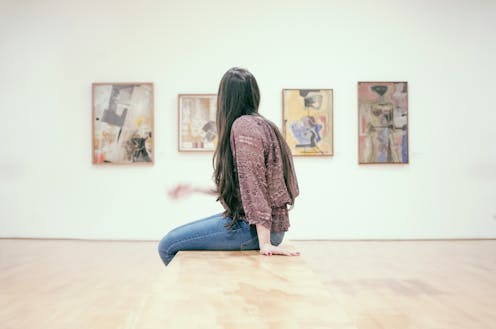
We are in a rapidly changing visual culture where it is increasingly inadequate to take images at face value.
There is an ever-increasing prevalence of image manipulation and AI imagery. And in the attention economy, our attention has become a precious, sought-after resource. Images participate in this redirection of our attention with an endless production line of new, stimulating content to maximise user engagement.
In this environment, there is an increasing demand to prioritise visual literacy with the same rigour as we do with writing and reading.
We need to look more closely at images – to practise slow looking.
What is it you’re looking at?
The act of slow looking involves taking a pause and thoroughly describing what you see.
Often, we jump to the image’s meaning by identifying its contents. But it is important to discern what the image actually “looks like” and how this influences its reading.
The aim of looking slowly is not just to verify what is real, fake or AI. After all, there will become a time when it is too difficult and time-consuming for the average person to determine every AI-generated image without a watermark or label.
While the ability to detect whether something is AI is one important skill, this should not be the only reason to practise slow looking. To only determine if it is fake or real can ignore what an AI image can also tell us about our cultural climate.
In December, Madonna shared a deepfake of her embracing the Pope from digital artist RickDick.
Satirical images of the pope have a long history. As early as the 16th century, artists depicted the head of the Catholic Church alongside the profane as a means of critique and provocation.
RickDick’s deepfakes, in their eerie sense of realness, prove a new means to continue to satirise and provoke viewers in the digital age. We can deduce on close inspection that these images of Madonna and the Pope are not real photographs, but we can look even further to also discern what nevertheless gives these AI images their potency.
Fake or not, the lifelike, intimate embrace of the two icons probes an old but ongoing friction between perceived acts of blasphemy in pop culture and the sacred authority of the church.

The act of slow looking develops visual literacy. It examines why certain images go viral, why some move us above others and what they say about our reality, values or beliefs.
Beginning to look slowly
To begin this practice, imagine you are trying to describe an image to a friend who cannot see it. What’s happening in the image? What is its scale? What colours are used? How is it made? Where and how are you viewing it – on your phone, a billboard or poster?
Adopt a questioning stance to spot possible biases or blind spots – your own, or of the creator of the image. What is possibly missing from the image? Whose perspective is it or isn’t it showing?
This process can be significantly enhanced through using your hands: draw or paint what you see. It doesn’t need to be expensive or time-consuming. Nor do you need to be “good” at it. Drawing on a scrap piece of paper with an old ballpoint pen you have on your desk for even just a few minutes can connect the mind and body into a deep awareness of your visual field.

Pick anything to draw from your immediate surroundings or screens. This is all about the process: it is not the goal to have a finished artwork.
Key details that weren’t apparent before will emerge through this creative practice and help you analyse how an image works, why it is or isn’t engaging and what are its multiple possible meanings.
Slowing down
That we should look more slowly in our fast-paced, oversaturated visual culture is not a new concept, especially in the art community.
Numerous galleries such as London’s Tate Gallery, the National Gallery of Australia , and most recently Ipswich Art Gallery’s 2024 Arriving Slowly exhibition host “slow looking” events to initiate this practice.
These events often take the form of a guided tour and provide prompts to build the viewer’s analytical skills, with the additional benefit of building a communal engagement to look slowly together.
We are all creators and consumers of images. It is important for all of us to reflect on where our attention is being directed, and why, in the constant flood of images.
We have a shared responsibility in how we examine images. Now, more than ever, our visual literacy would benefit from creative practices to slow us down. At both individual and collective levels, we should prioritise looking intently at how our images remember the past, define our present, and envision the future.


