

Unambitious and undermined: why NZ’s latest climate pledge lacks the crucial ‘good faith’ factor
- Written by The Conversation
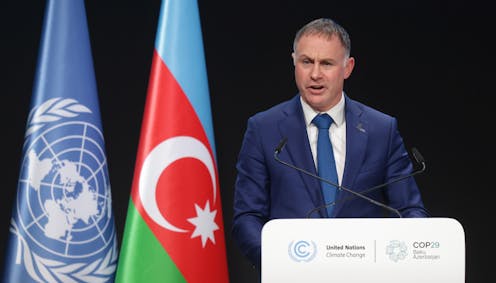
The announcement of New Zealand’s new climate pledge under the Paris Agreement was met with sharp criticism last week.
The agreement commits nations to provide a new pledge, known as a Nationally Determined Contribution (NDC) every five years. But it also requires each pledge to be a “progression beyond” the previous one.
Climate Change Minister Simon Watts announced New Zealand would commit to reducing emissions by 51-55% below 2005 levels by 2035, which is only 1-5% above the current NDC of a 50% cut by 2030.
Technically, the new NDC represents a progression, albeit the smallest possible one. It was criticised as underwhelming and unambitious to combat climate change, raising the question whether the coalition government has done enough to comply with its international obligations.
The commitments of each member nation should align with the Paris Agreement’s purpose to hold global average temperature rise well below 2°C above pre-industrial levels and to pursue efforts to keep it at 1.5°C.
But the agreement also requires that each country’s NDC reflects its “highest possible ambition, reflecting its common but differentiated responsibilities and respective capabilities, in light of different national circumstances”.
Does the government’s announcement to step up emissions cuts by as little as 1% really represent New Zealand’s highest possible ambition in present circumstances?
In October last year, looking specifically at New Zealand’s potential domestic contribution to the new NDC, the Climate Change Commission advised that emissions cuts of 66% could be achieved without shrinking the economy.
This excludes potential additional cuts achieved through offshore mitigation – paying for overseas carbon credits or funding other countries to reduce their greenhouse emissions.
Clearly, deeper cuts are possible and there is room for significantly greater ambition.
Bare minimum commitment
Even if the new NDC meets a minimal requirement for compliance, it is difficult to see how it adheres to the purpose of the Paris Agreement and the level of ambition required.
New Zealand’s NDC falls short of the commitments offered by other comparable countries and even some developing nations, including the oil and gas producer Brazil, which pledged to cut its emissions by 59-67% by 2035.
International law has long been guided by the principle of pacta sunt servanda, which translates to “agreements must be kept”. The principle reminds parties to any agreement or convention that all international obligations should be fulfilled in good faith.
Viewing New Zealand’s new NDC in the context of other recent decisions, it seems the coalition government may be pursuing policies that could undermine climate action while pledging the bare minimum internationally. This would be difficult to characterise as a party acting in good faith.
Immediately following the new NDC announcement, Resources Minister Shane Jones unveiled New Zealand’s national minerals strategy, along with a list of critical minerals. These documents support the government’s goal to double exports from the mineral sector by 2035.
Despite reassurance in the strategy that minerals production will not come at the expense of our environment, it includes plans to scale up exports of metallurgical coal. But mining more of this coal, then burning it (usually in the process of steelmaking), will add to greenhouse gas emissions.
Wider concerns about the likely environmental damage and biodiversity loss linked with fast-tracked mining operations continue to be raised.
Meeting trade obligations
Last year’s decision to postpone the entry of agriculture into New Zealand’s Emissions Trading Scheme without a robust alternative means that agricultural emissions continue to avoid effective regulation.
Even recent measures to allow increased road speed limits have been criticised for increasing greenhouse gas emissions as well as worsening air quality and reducing road safety.
Despite Prime Minister Christopher Luxon’s claim to be “all about yes” even on climate change, such decisions are difficult to square with a responsible party to the Paris Agreement acting in good faith.
The Paris Agreement is clear that emissions pledges are not imposed but are to be determined nationally. The agreement itself lacks an enforcement mechanism, but recently agreed trade deals with the European Union and with the United Kingdom both contain binding and enforceable commitments to the agreement.
This is a reminder that trading partners are already monitoring New Zealand’s climate actions. Consumer attitudes and trade obligations might become a more powerful lever for climate action in the future. No government should ignore this.
As the US administration begins to withdraw from the Paris Agreement, now more than ever is the time for other countries to stay focused on its purpose and to match national commitments accordingly.
Without an NDC in line with the Paris goal, New Zealand’s government is not sending the right message to New Zealanders or to our trading partners and neighbours. It is failing to show international and regional leadership at a time when many Pacific nations are on the frontline of climate-related risk and damage.


