

‘A house battery you can drive around’: how a handful of Australians are selling power from their cars back to the grid
- Written by The Conversation
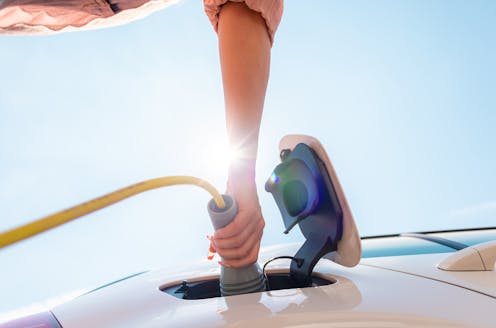
Our cars sit unused most of the time. If you have an electric vehicle, you might leave it charging at home or work after driving it. But there’s another step you could take. If you have a bidirectional charger, you can set it to sell power back to the grid when demand is high.
Fewer than ten people across Australia actually do this, because the technology – known as Vehicle-to-Grid (V2G) – is very new. To date, it only works with a single car model (Nissan LEAF) and a single charger (Wallbox Quasar 1). We’ve estimated the number of users based on sales of this charger. The chargers are expensive and there’s a thicket of regulations to navigate.
But that could soon change. Last year, Climate Change Minister Chris Bowen announced new Australian standards and communications protocols for bidirectional chargers in a bid to make it mainstream. Cheaper EVs and bidirectional chargers will make this more appealing.
If it takes off, V2G could become extremely useful to the power grid as a way to release power as required and stabilise the grid against fluctuations.
This week, Australia’s renewable energy agency released a V2G roadmap, which notes widespread uptake could “materially reduce electricity costs for consumers and accelerate national emissions reduction”.
To understand why people are using the technology and the challenges to do so, we interviewed five early adopters from New South Wales and South Australia. Our findings are released today.

Setting up V2G isn’t easy
Our interviewees reported a long, complex journey to set up V2G. These early adopters had no playbook to follow, so the process was one of trial and error.
Some relied on professional networks or social media groups to gather information. They spent significant time and energy finding electricians, installers and charger manufacturers to set up their systems. Strata approvals were required. They also had to negotiate with power retailers and distributors.
Delays were common, especially when seeking approval from the energy distributor. Some interviewees reported delays of months to years.
Most interviewees had experience in a technical field such as engineering or technology. Some reported a significant learning curve, while others using new software from their retailer reported a smoother “set and forget” process.
So why do it? Our interviewees had several reasons, ranging from getting the most out of expensive assets (solar and the EV) to offsetting power bills entirely.
Four out of five interviewees reported making a small profit of about A$1,000 annually instead of a bill. Many wanted to be able to reduce dependence on the grid and reduce their environmental impact.
As one told us:
you originally think of it as a car you can also use to power your house. [But actually] it’s a house battery you can drive around.
Maximising savings
Typically, our interviewees plugged their car in at home during the day to charge from their rooftop solar. In the evenings when power prices peaked, they used an app to sell power back to the grid. This maximised their cost savings for charging the car battery and their earnings from the grid.
For instance, a V2G user was alerted by their energy retailer that power prices had spiked to over $20 per kilowatt hour – far above normal rates of 25–45 cents. They immediately set their car and home battery to sell power back to the grid. In two hours, they sold 28 kilowatt hours of power to the grid and made more than $560. As they told us: “I look forward to more such events.”
Our interviewees often monitored energy prices, solar output and car battery levels to optimise their output. To avoid their EV battery getting too low, they set a lower limit – say 30% of charge – after which their car would stop exporting power.

Is there a downside?
One of the main reasons people are sceptical of V2G is due to concern about accelerated degradation of the battery.
This is a common concern. But to date, there’s no consensus showing V2G shortens the battery life of EVs significantly. One recent study shows it increases degradation by 0.3% a year. But another showed V2G might actually extend battery life in some scenarios.
Last year, we surveyed more than 1,300 members of a motoring organisation about their view of V2G technology. We found battery warranty was a bigger concern than battery life. This is because most EV manufacturers other than Nissan don’t mention V2G in their battery warranties, leading drivers to believe they might void their warranty by using V2G.
Awareness of V2G technology is growing. The survey also found almost 40% of respondents were very or somewhat familiar with V2G, a jump from the 17% who reported familiarity in 2022. Among EV owners, almost 90% reported knowledge of the concept.
Moving beyond early adopters
For V2G to go mainstream, the process must be much simpler, cheaper and easier to set up.
To accelerate uptake, reliable, accessible information is essential.
Expanding government incentive programs to include bidirectional chargers would cut the upfront cost and make it more accessible.
Even within the EV supply chain, knowledge of V2G is limited. Car dealerships will need to know which models work with V2G.
Electricians may need specific training to install and maintain these chargers.
EVs are falling in price as manufacturers vie for market share and cheaper options become available. V2G capabilities might help boost sales for competing car companies.
As more motorists switch to EVs, interest in V2G will increase. While V2G can boost the appeal of EVs, there are others, such as Vehicle-to-Home (using your car to power your home during blackouts or to save money) and Vehicle-to-Load (using your EV to run power tools or appliances).
Each of these can help consumers get more value from the vehicles parked in driveways and garages.


