

X has been used to represent love and kisses for centuries. But how did it start?
- Written by The Conversation
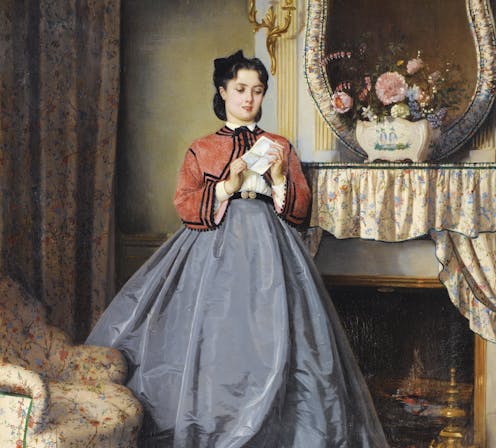
“1,000 Letters and 15,000 Kisses” screamed the headline in an 1898 edition of the English newspaper, the Halifax Evening Courier.
Harriet Ann McLean, a 32-year-old laundry maid, was suing Francis Charles Matthews, a green grocer, for reneging on the promise of marriage.
Over a decade-long courtship, Harriet had received 1,030 letters containing 15,000 crosses – kisses – from her “loving, precious, future husband Frank”.
By 1898, using a cross for a kiss was commonplace for British letter writers – particularly those of the more “ordinary” variety: the increasingly literate servants, tradesmen and shop workers whose love notes drew laughter when their imploding relationships brought them to court.
The symbol grew in popularity in the following decades, yet its origins have remained obscure.
X marks the spot (of the kiss)
Some three decades after Harriet won her suit, someone wrote a letter to Melbourne’s The Sun News asking if its readers knew the origins of using an X for a kiss.
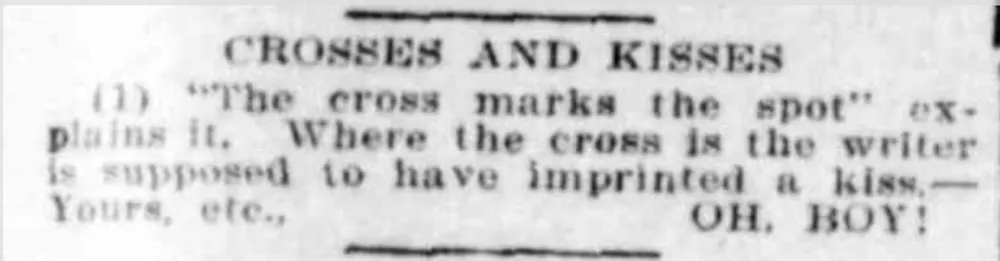
One correspondent proposed the X resembled the lips of two people kissing. Another thought “the cross marks the spot” where the author had imprinted a kiss for the recipient.
The following year, a more confidently penned and rapidly reprinted piece claimed the origins lay in the centuries-old practice of those with low literacy using an X in place of a signature. The article argued that, after marking a document with X, the signee kissed the page as a pledge of good faith, and so the X came to be associated with a kiss.
This account was to become popular, being rolled out by journalists many times over the following decades. And it may contain some truth. The laundry maids and green grocers who popularised the X as a kiss in their love notes were part of a newly literate community in the 19th century, for whom using an X as a signature was likely familiar.
However, their 17th and 18th century ancestors had not behaved similarly in their iconography of love. Marks of love on convict tokens, tattoos and the scrappy documents that survive tended to take the form of hearts, crossed Cupid’s arrows and interlinking initials. The cross as a kiss was nowhere to be found.

The kiss’s importance throughout history
The kiss had an important role in European culture. The holy kiss, once a mouth kiss shared by congregants in church, allowed for the mingling of spirits and the creation of a uniform Christian body.
Similarly, kisses of fealty (also on the mouth) formed part of a ritual that established a contract between superiors who held land, and their vassals who rented it. This tradition was carried well into the 16th century.
The lovers’ kiss also had many of the above meanings – a kiss of love, loyalty and unity of spirit.
As such, sending kisses in letters had been common among Europeans for centuries, but was usually done in written form. “I send you a thousand kiss’s”, wrote poet Judith Madan to her husband in 1728.
Kisses marked intimacy but could also be delivered to children and friends. As English letter writer Rebecca Cooper dispatched to her sister Catherine Elliott in 1764, “love to all friends not forgetting my sweet boy with fifty kisses”.
Wax dots and ink splots
Using a cross to symbolise a kiss was not unprecedented. Lovers had used ink splots, wax drippings, or drawings to send secret messages to a beloved from at least the 16th century. But at the time these signs were usually personalised and only interpretable by the intended recipient (or especially persistent historians).
Using specific marks to represent kisses became more fashionable and recognisable during the Victorian period, starting from around the mid-19th century.
The detective in an 1850 Charles Dicken’s short story tracked his suspect by a wax dot he left on his envelopes – a kiss for the recipient.
Similarly, in 1862 the jury for the “Hopley v. Hurst” breach of promise of marriage suit heard that the defendant’s letters to his future bride contained “spots of ink” at the bottom, each representing a kiss.
In 1871, William Steward of Montrose, Scotland, used “a number of crosses and small circles” at the bottom of a letter to his lover, according to the trial report in the Western Times.
 A letter from the early 20th century, with kisses marked at the bottom of the page. The text reads: ‘Darling, your visit was a wonderfully fragrant episode: I do love you, sweet, oh for June!’
Mitchell Library, State Library of New South Wales and Courtesy Percy Reginald Stephensen. The work has been digitized into the Library catalogue and the reference is FL9715738.
Becoming a universal symbol
The cross as a kiss – initially just one of many symbols used for this purpose – grew in use until it became the predominant choice by the 20th century.
During the second world war, the cross was even briefly banned by the military censors in Australia, the United Kingdom and United States, due to worries it could be used to send illicit information.
The cross was found across the United Kingdom, and particularly in Scotland in the early years of its use. It eventually spread to the rest of the Anglophone world, but made less headway on the European continent, where lovers continued to write their kisses out in full.
As the symbol’s popularity grew, so did the mythology and theories around it – its more mundane origin among working-class lovers forgotten.


