

Vibes are something we feel but can’t quite explain. Now researchers want to study them
- Written by The Conversation
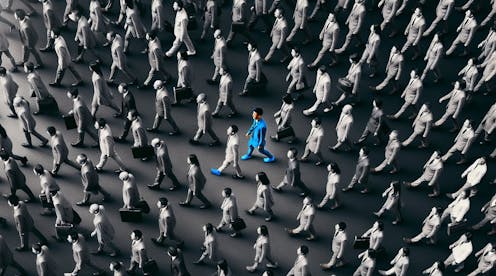
When we’re uncomfortable we say the “vibe is off”. When we’re having a good time we’re “vibing”. To assess the mood we do a “vibe check”. And when the atmosphere in the room changes we call it a “vibe shift”.
In a broad sense, a “vibe” is something akin to a mood, atmosphere or energy.
But this is an imperfect definition. Often, we’ll use this term to describe something we feel powerfully, but find hard to articulate.
As journalist and cultural critic Kyle Chayka described in 2021, a vibe is “a placeholder for an unplaceable feeling or impression, an atmosphere that you couldn’t or didn’t want to put into words”.
Being able to understand the subtleties of social interactions – that is, to “feel the vibes” – is extremely valuable, not just for our social interactions, but also for researchers who study people.
What’s behind the rise of vibes? And how can sociologists like myself unpack “vibe culture” to make sense of the world?
A history of vibes
The nuance and complexity of vibes makes them an interesting cultural trend. Vibes can be very specific, but can also totally resist specificity.
Australians (and fans of Australiana) will remember the iconic line from the beloved 1997 film The Castle: “It’s just the vibe of the thing… I rest my case.”
While it may seem like a recent cultural development, vibe isn’t the first example of cryptic language being used to express an ambiguous thing or situation. There are similar concepts with long histories, such as “quintessence” in Ancient Greek philosophy and “auras” in mysticism.
More recently, vibes rose in popularity through music including 1960s rock, epitomised by the Beach Boys (“pickin’ up good vibrations”) and Black American rap vernacular from the 1990s, such as in the song Vibes and Stuff by A Tribe Called Quest (“we got, we got, we got the vibes”).
While we don’t know when the term was first used as it is today, it seems to have taken hold in the 1970s.
I trawled the online archive of The New Yorker and found an early mention of vibes in a 1971 report about communes in New York City.
One interviewee spoke about the “vibration of togetherness” that drew them to the commune. Ending the day on the subway, the author Hendrik Hertzberg (now a senior editor at the magazine) “just sat there and soaked up the good vibes”.
New uses and meanings have emerged in the years since.
Vibes today
As vibe is used in more ways, its meaning becomes expanded and diffused. A person or situation can have good vibes, bad vibes, weird vibes, laid-back vibes, or any other adjective you can imagine.
Language is a central part of qualitative research. While new phrases and slang can be casual and superficial, they can also represent broader, more complex concepts. Vibe is a great example of this: a simple term that refers to something potent yet ephemeral, affecting yet ambiguous.
By paying attention to the words people use to describe their experiences, sociologists can identify patterns of social interactions and shifts in social attitudes.
Perhaps vibes work like a heuristic – a mental shortcut – but for feeling rather than thinking.
People use heuristics to make everyday decisions or draw conclusions based on their experiences. Heuristics are, in essence, our common sense. And “vibes” might be best described as our common feeling, as they speak to a subtle aspect of how we collectively relate and interact.
Sociologists have long studied complex common feelings. Ambivalence, for instance, has been a focus in research on digital privacy. Studying when and why people feel ambivalent about digital technology can help us understand their seemingly contradictory behaviour, such as when they say they are concerned about privacy, but do very little to protect their information.
Ambivalence reveals how people make decisions via small, everyday compromises – moments and feelings that may be overlooked in quantitative research. A qualitative approach can help us to align policies with people’s real-world behaviours.
Researchers react
Then again, it’s difficult to study something people find hard to articulate in the first place. Asking participants to rank the “vibes” of something in a survey doesn’t quite work.
So researchers are finding new ways to feel the vibe: to see what participants see, to feel what they feel and get a deeper understanding of their lived experiences.
For instance, such study could provide insight into how senior clinicians make important decisions amid uncertainty. We already know making decisions in complex situations involves more than logic and rationality.
In one Australian study published last year, researchers assessed how vibes have become part of online advertising algorithms. The researchers analysed the social media feeds of more than 200 young people, using the concept of vibes to show how advertising models attune to individuals and social groups.
Such approaches can complement, or even update, tried-and-tested research methods, expanding on what we know about human relationships and experiences.


