

This newly discovered neutron star might light the way for a whole new class of stellar object
- Written by The Conversation
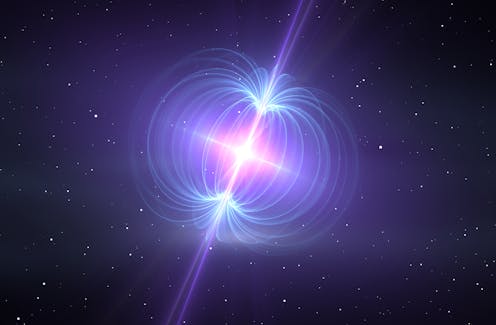
The discovery of a neutron star emitting unusual radio signals is rewriting our understanding of these unique star systems.
My colleagues and I (the MeerTRAP team) made the discovery when observing the Vela-X 1 region of the Milky Way about 1,300 light years away from Earth, using the MeerKAT radio telescope in South Africa. We spotted a strange-looking flash or “pulse” that lasted about 300 milliseconds.
The flash had some characteristics of a radio-emitting neutron star. But this wasn’t like anything we’d seen before.
Intrigued, we scoured through older data from the region in hopes of finding similar pulses. Interestingly, we did identify more such pulses which had previously been missed by our real-time pulse detection system (since we typically only search for pulses lasting some 20-30 milliseconds).
A quick analysis of the times of arrival of the pulses showed them to be repeating about every 76 seconds – whereas most neutron star pulses cycle through within a few seconds, or even milliseconds.
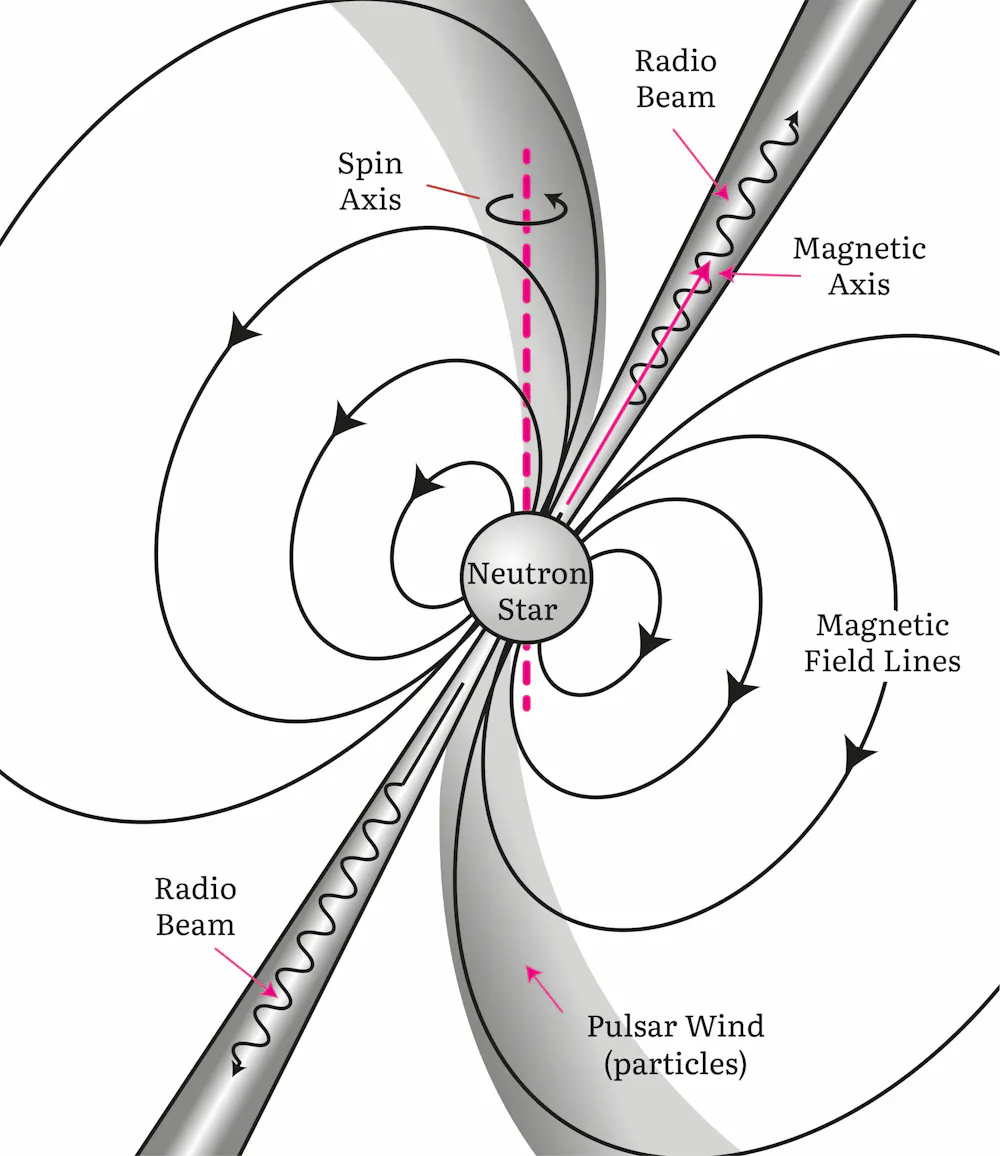
Our observation showed PSR J0941-4046 had some of the characteristics of a “pulsar” or even a “magnetar”. Pulsars are the extremely dense remnants of collapsed giant stars which usually emit radio waves from their poles. As they rotate, the radio pulses can be measured from Earth, a bit like how you’d see a lighthouse periodically flash in the distance.
However, the longest known rotation period for a pulsar before this was 23.5 seconds – which means we might have found a completely new class of radio-emitting object. Our findings are published today in Nature Astronomy.
Read more: A brief history: what we know so far about fast radio bursts across the universe
An anomaly among neutron stars?
Using all the data available to us from the MeerTRAP and ThunderKAT projects at MeerKAT, we managed to pinpoint the object’s position with excellent accuracy. After this we carried our more sensitive follow-up observations to study the source of the pulses.
The newly discovered object, named PSR J0941-4046, is a peculiar radio-emitting galactic neutron star which rotates extremely slowly compared to other pulsars. Pulsar pulse rates are incredibly consistent, and our follow-up observations allowed us to predict the arrival time of each pulse to a 100-millionth of a second.
Apart from the unexpected pulse rate, PSR J0941-4046 is also unique as it resides in the neutron star “graveyard”. This is a region of space where we don’t expect to detect any radio emissions at all, since it’s theorised the neutron stars here are at the end of their life cycle and therefore not active (or less active). PSR J0941-4046 challenges our understanding of how neutron stars are born and evolve.
It’s also fascinating as it appears to produce at least seven distinctly different pulse shapes, whereas most neutron stars don’t exhibit such variety. This diversity in pulse shape, and also pulse intensity, is likely related to the unknown physical emission mechanism of the object.
One particular type of pulse shows a strongly “quasi-periodic” structure, which suggests some kind of oscillation is driving the radio emission. These pulses may provide us with valuable information about the inner workings of PSR J0941-4046.
These quasi-periodic pulses bear some resemblance to enigmatic fast radio bursts, which are short radio bursts of unknown origin. However, it’s not yet clear whether PSR J0941-4046 emits the kind of energies observed in fast radio bursts. If we find it does, then it could be that PSR J0941-4046 is an “ultra-long period magnetar”.
Magnetars are neutron stars with very powerful magnetic fields, of which only a handful are known to emit in the radio part of the spectrum. While we’ve yet to actually identify an ultra-long period magnetar, they are theorised to be a possible source of fast radio bursts.
Brief encounters
It’s unclear how long PSR J0941-4046 has been active and emitting in the radio spectrum, since radio surveys typically don’t usually search for periods this long.
We don’t know how many of these sources might exist in the galaxy. Also, we can only detect radio emissions from PSR J0941-4046 for 0.5% of its rotation period – so it’s only visible to us for a fraction of a second. It’s pretty lucky we were able to spot it in the first place.
Detecting similar sources is challenging, which implies there may be a larger undetected population waiting to be discovered. Our finding also adds to the possibility of a new class of radio transient: the ultra-long period neutron star. Future searches for similar objects will be vital to our understanding of the neutron star population.
Read more: This object in space flashed brilliantly for 3 months, then disappeared. Astronomers are intrigued


