

Meet Maria Clementina Sobieska, the defiant queen who pulled off a jailbreak to secure the Jacobite legacy
- Written by The Conversation
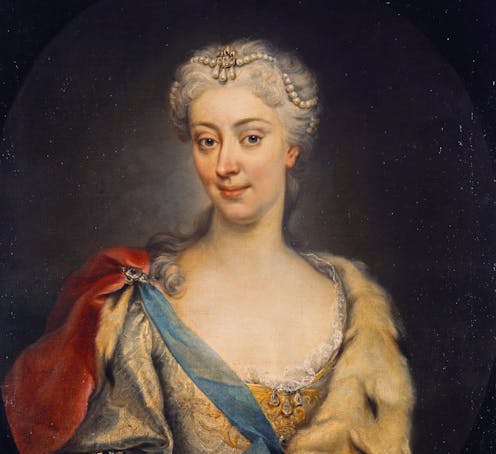
Maria Clementina Sobieski is one of only three women buried in the famous St Peter’s Basilica in Vatican City, alongside an estimated 100 or so popes. She lived a life of extraordinary defiance and determination.
Born in 1701 in Oława, Poland, Maria Clementina was the granddaughter of King John III Sobieski of Poland, who was famous for his victory in the 1683 Battle of Vienna against the forces of the Ottoman Empire.
While this ancestry provided Maria Clementina her status as a princess, it also came with significant challenges, by placing her at the centre of 18th century European dynastic politics.
At just 17 years old, she was betrothed to James Stuart, the Jacobite claimant to the British throne. This match, which held immense political and religious significance, was agreed to by her father, Jakub, after negotiations with Stuart.
But her journey to marriage wouldn’t simple. It required a daring escape from imprisonment in Innsbruck, where she was held by Emperor Charles VI in a bid to prevent her union with Stuart.
A high-stakes abduction
The marriage between Maria Clementina and James Stuart was a direct challenge to the Protestant king George I of Great Britain.
James Stuart, also known as the Old Pretender, was living in exile and sought to reclaim the British throne that was his by birthright. His marriage to Maria Clementina, which was endorsed by Pope Clement XI, would symbolise Catholic unity against growing Protestant dominance.
Recognising this political threat, George I asked Emperor Charles VI, his ally, to order Maria Clementina’s detention in Innsbruck while she was en route to her wedding.
Her confinement was intended to coerce her family into annulling the engagement. However, Maria Clementina, bolstered by her unwavering faith and determination, refused to capitulate.
The perilous escape
Maria Clementina’s imprisonment at the hands of Charles VI lasted six months. During this time, she kept her spirits high through correspondence with James Stuart and her father, Jakub. Meanwhile, plans for her escape were set in motion by Charles Wogan, an Irish Jacobite loyal to Stuart.
The princess disguised herself by switching clothes with the servant of one of her rescuers, Eleanor Misset. She then slipped past imperial guards with a small group posing as a travelling family.
The escape involved avoiding imperial agents and enduring significant physical hardship, including traversing the harsh and mountainous Brenner Pass in the Alps.
In one instance, after a carriage axle broke, Maria Clementina and Eleanor Misset were forced to walk a considerable distance to find shelter. Despite the gruelling journey, Maria Clementina demonstrated remarkable resolve, earning the admiration of her companions.
Reaching safety and marriage
After crossing into Italy, the group arrived in Bologna, where Maria Clementina rested and prepared for her new role as James Stuart’s wife. Her wedding took place on May 9 1719 in a modest ceremony.
Although James Stuart was absent (not unusual for high-profile dynastic alliances at the time), the marriage formalised their union and reinforced the Jacobite claim to the British throne.
Maria Clementina wore a white dress to symbolise mourning for James Stuart’s late mother, Maria Beatrice d’Este. The ceremony was attended by Jacobite activist Charles Wogan and other members of the escape team, including Eleanor Misset.
And so Maria Clementina became the titular Catholic queen of England, Scotland and Ireland.
Motherhood and family challenges
Maria Clementina’s bold actions ensured the continuity of the Jacobite line. On December 31 1720 she gave birth to her first son, Charles Edward Stuart, later known as Bonnie Prince Charlie.
He was baptised within the hour by Father Lawrence Mayes, the same bishop who officiated his parents’ wedding, and his birth was widely celebrated by Jacobite supporters.
Maria Clementina’s second son, Henry Benedict Stuart, was born on March 6 1725 and was later made Duke of York.
While the birth of her sons brought joy and hope to the Jacobite cause, Maria Clementina’s relationship with James Stuart grew strained.
As one household observer remarked:
their tempers are so very different that though in the greatest trifles they are never of the same opinion, the one won’t yield an inch to the other.
James neglected Maria Clementina. The pair also clashed over their sons’ education, further straining the marriage.
The later years
By the end of 1725, Maria Clementina’s frustrations with her marriage reached a breaking point. She left James and took up residence at the convent of St Cecilia in Trastevere, Rome, leaving her young sons behind.
For two years she embraced a devout lifestyle, focusing on her own welfare. Her return to James in 1728 was marked by a withdrawal from court life, and she spent much of her time in seclusion at Rome’s Palazzo Muti.

Despite her struggles, Maria Clementina’s legacy as a mother was significant. Charles Edward Stuart and Henry Benedict Stuart carried the Jacobite cause forward, their lives shaped by the resilience and determination demonstrated by their mother. Her commitment to their futures ensured the Jacobite line endured, even as political realities shifted.
Maria Clementina died on January 18 1735 at the age of 32. She was given a royal funeral in St Peter’s Basilica, where she was interred with honours befitting her status as queen. Her heart was enshrined separately in the church of the Twelve Holy Apostles in Rome.


