

Can playing games like Wordle help improve work and workplaces?
- Written by The Conversation
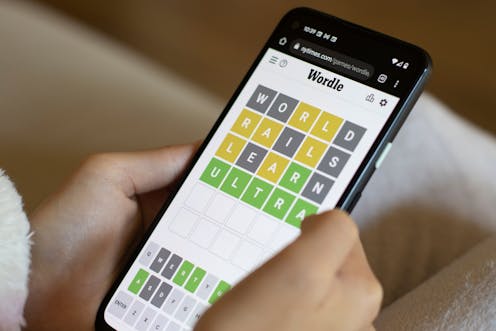
Do you ever find yourself taking a sneaky few minutes out of your work day to play a game on your phone?
You might try and solve the day’s Wordle – and you wouldn’t be alone. American players rack up a whopping three days a year of game time.
There are hundreds of ways we can distract ourselves from work, and not surprisingly, this can make us feel a bit guilty. Some games have become popular in part due to their low risk of being detected at work.
Managers have long surveilled employees in an effort to reduce distractions, and maximise productivity (as famously satirised in the 1999 cult cinema classic Office Space).
However, meetings, chat and email are now ironically contributing to “digital noise” that undermines productivity and wellbeing.
So, are there any benefits to taking a short break from the grind?
‘Exercising’ your brain
Over the last few decades, there has been a continued interest in whether engaging in brain-stimulating activities – even for short periods – may help “exercise” our brain. There have been claims that activities which engage our attention and memory could prevent cognitive decline in older age.
So, playing something like Wordle might seem a good way to warm our brains up, or help us improve at problem-solving. However, the purported benefits of “brain training” are hotly debated.
Much of this debate relates to what scientists refer to as ecological validity – the extent to which a study’s methods or findings relate to the “real world”. Simple cognitive tasks may have little relevance to the many kinds of cognitive skills we use at work, such as typing an email while in an online meeting.
To improve ecological validity, scientists often strive to create what is termed mundane realism: making the lab feel like the real world, like South Bank University’s “fake pub” in London, used to study drinking culture.
It is difficult to replicate office environments experimentally, and difficult to generalise from one work setting to another.
However, there are some ideas as to how taking breaks that involve games might impact our work and wellbeing in different ways.
Making room for recovery experiences
One way workplace breaks might benefit us is by creating opportunities for recovery experiences: activities that create a sense of detachment or relaxation, and tend to involve a feeling of mastery or control.
Recovery experiences tend to enhance wellbeing and productivity, primarily by reducing exhaustion, or increasing engagement.
Research has shown workplace breaks make people feel more energetic and enthusiastic, and less fatigued. And, video games appear to create recovery experiences.
Facilitating teamwork and enhancing culture
Another way to think about workplace breaks involving games is their potential to create team-building opportunities.
In a way, Wordle sparked a modern workplace watercooler conversation. These have long been thought to improve culture and collaboration.
Wordle workplace discussions have involved colleagues competing for the quickest solves, sharing hints and swapping strategies.
Games which require players to reach a solution may work well in generating conversation, or by simply incorporating fun in an otherwise humdrum work day.

Research has also shown that playing games with colleagues positively impacts team cohesion and performance, even on a subsequent task. This suggests playing games like Wordle with peers or team members might improve communication skills, and give people valuable experience in working together to solve problems.
This is especially relevant to modern workplaces where employees may not be working in the same location, or could be working on different components of an overarching project.
The de-intensification of work
Given the culture of busyness associated with modern work, we need to ensure employees can make the best use of breaks, including those used for games, to realise any productivity or wellbeing gains.
For example, one study showed that when employees were overstretched, those who engaged in breaks involving cognitive activities tended to feel worse at the end of the workday. So it is important to consider whether taking a break might be restorative, or counterproductive.
We also need to be realistic about our propensity to underestimate how long we are spending taking a break. Spending too much time on non-work related tasks might raise suspicions from colleagues and managers alike – and could create challenging workplace scenarios.
Although, we also need to keep in mind that many work breaks are nevertheless interrupted or cut short by work – which is not good for us either.
Approaches such as the Pomodoro Technique can help us manage work and breaks effectively. Organisations adopting a four-day working week are considering how the technique might get the best out of their employees.
So, taking a few minutes to crack the day’s Wordle as a means to engage in some friendly competition – or as a simple solo endeavour – might be exactly the kind of break we need to optimise work productivity, without undermining our health and wellbeing.
Read more https://theconversation.com/can-playing-games-like-wordle-help-improve-work-and-workplaces-247689


