

This Australian grasshopper gave up sex 250,000 years ago and it's doing fine
- Written by The Conversation
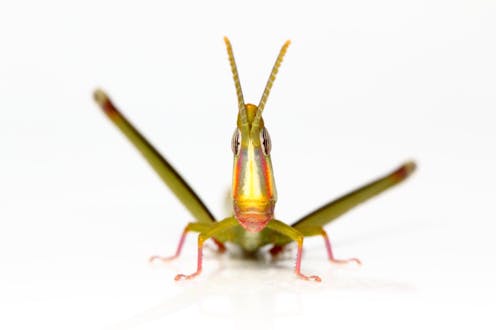
Most animals on Earth have two sexes, male and female, that combine and mix their genes when they reproduce. We are so accustomed to this state of affairs that the existence of all-female species that don’t have sex, but instead reproduce by cloning, comes as a great surprise.
The beautiful green grasshopper Warramaba virgo is one of these rare “parthenogenetic” species, in which an egg can develop into an embryo without being fertilised by a sperm. It lives in the southern parts of the Australian arid zone, where it feeds on mulga trees and other shrubs and bushes in the summertime.

We have studied these grasshoppers for the past 18 years to understand how they developed asexual reproduction, and how the change has affected their ability to survive and reproduce.
Our new research published in Science shows W. virgo arose about 250,000 years ago from a cross between two different sexually reproducing species of grasshopper, and giving up sex appears to have had no negative repercussions for them whatsoever.
The puzzle of parthenogenesis
Biologists studying evolution have often considered the rarity of parthenogenetic species like W. virgo as a major puzzle.
This is because sex imposes big costs on animal reproduction. First, there is the “two-fold cost of sex”: half a creature’s offspring (the males) are unable to produce their own offspring alone, so they are often seen as “evolutionary wastage”.
Moreover, finding a mate takes energy and mating animals are often at greater risk of attack by predators. Doing away with males also removes these drawbacks.
So why does sex exist at all? The main reason, biologists think, relates to the mixing or “recombination” of genes as a consequence of sex. This can speed up the rate of adaptation by bringing favourable combinations of genes together and also helps to purge a population of combinations of bad mutations.
Parthenogenetic species don’t have these processes: instead, all members of the species have virtually identical genes. This means they might be less able to adapt when the environment changes. What’s more, parthenogens could accumulate bad mutations that reduce their fitness.
But are these costs real? Do they result in the rapid extinction of any parthenogens that happen to form?
What’s the secret of W. virgo?
Over the past 18 years we have been investigating these questions in W. virgo.
This grasshopper was first studied in 1962 by the eminent evolutionary biologist and geneticist Michael White. White’s young son Nicholas first discovered them near the New South Wales town of Hillston, when he noted that only females of a particular species could be found.
White then went on to show that the same species was present 2,000 km away in Western Australia, along with a sexual species (recently named W. whitei).
W. virgo turned out to have a hybrid origin: a cross between W. whitei and another species, W. flavolineata, many thousands of years in the past.
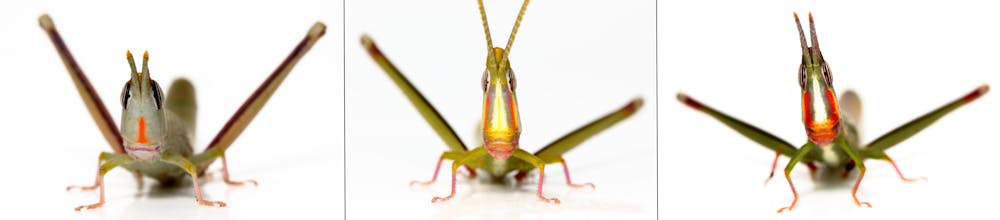 Warramaba virgo (middle) and its ‘parent species’, W. flavolineata (left) and W. whitei (right)
Michael Kearney, Author provided
A parthenogenetic species might have an advantage if its genetic diversity is boosted by repeated hybridisations between the two parent species, producing an army of different clones. Combining the genomes of the two species might also make the parthenogens more vigorous.
Such “hybrid vigour” does occur in some animals, such as mules (crosses between a horse and a donkey). The mule has much greater strength and endurance than its parent species.
Could it be that the hybrid origins of W. virgo generated a diverse clone army with special abilities compared to its sexual relatives, or a hybrid with high level of vigour?
Few benefits to giving up sex, but also no drawbacks
The answers to these questions were a resounding “No”!
We examined more than 1,500 genetic markers in W. virgo and found almost no variation in the parthenogens compared with the parent species.
This showed clearly that only one hybrid mating between W. whitei and W. flavolineata was responsible for producing W. virgo in the first place. Based on the number and nature of mutations that have occurred in W. virgo, we estimate the mating occurred some 250,000 years ago.
We also showed that the parthenogen had no advantage over its parent species in a range of physiological traits including tolerance to heat and cold, rate of metabolism, how many eggs they lay, the size of their eggs, how long they take to mature and how long they live.
Meanwhile, W. virgo naturally produced twice as many female offspring as the sexual species. It retained its two-fold advantage over sexual species despite 250,000 years for low fitness mutations to accumulate in this species.
The conclusion from our research then is that W. virgo has become parthenogenic but without costs. It has also successfully spread all the way from the west side of the country to the east side, unlike its parent species.
Why don’t more species give up on sex?
So why then do we see sexual species everywhere despite their two-fold reproductive cost? We suspect it must be very difficult to develop parthenogenesis in the first place.
Indeed, we have tried experimentally crossing the same sexual species that gave rise to W. virgo and only created a few hybrids, none of which were able to produce offspring. The hybrid state may disturb the normal processes of egg development sufficiently to make parthenogenesis an extremely uncommon phenomenon in animals more generally.
We think future research into the paradox of sexual reproduction should focus on barriers that prevent sex from being lost, rather than only focusing on the advantages of sex.


