

Top unis have imposed new restrictions on campus protests. What does this mean for students, staff and democracy?
- Written by The Conversation
A wave of restrictions on protesting has been rippling through Australia’s top universities.
Over the past year, all of Australia’s eight top research universities (the Group of Eight) have individually increased restrictions on campus protests.
The changes include bans on indoor protests and restrictions on banners, posters and student announcements. At some campuses, groups need to give notice or obtain university approval if they are going to protest.
Why has this happened and what does it mean for protests, free speech and democracy at Australian universities?
Why are university protests important?
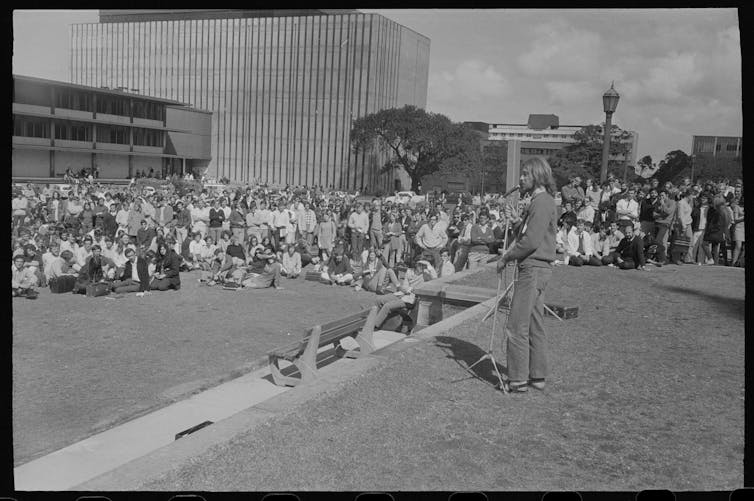
Over the past 60 years, campus protests have been a defining feature of Australian university life.
In the 1960s and ‘70s, they were a breeding ground for social protest, including rallies against apartheid and the Vietnam War, and in favour of women’s rights. In more recent years, students have protested on key social, political and environmental issues, from university fees to the invasion of Iraq and climate action.
This protest history feeds into the broader purposes of universities. Universities act as a modern-day “public square”. This means they are a place where ideas can be freely debated and difficult issues can be explored. In this way, they act as a key component of a free and healthy democracy.
As Victorian university legislation notes, universities should promote
critical and free enquiry, informed intellectual discourse and public debate within the University and in the wider society.
Restricting protests for campus safety
Since early 2024, there have been increasing restrictions on campus protests.
These come in the wake of the months-long encampments protesting the war in Gaza – and ensuing concerns over antisemitism at universities and campus safety.
They have also coincided with increased public scrutiny over university governance. This includes accusations vice-chancellors are running a “lawless sector,” pointing to underpayment of staff, high levels of executive pay and criticism of the way some universities managed the protests.
What have universities done?
In this heightened context, universities have increased restrictions on campus protests, arguing they are needed for safety.
Universities have taken various measures. For example, the University of Western Australia has restricted student announcements in class (or “lecture-bashing”).
To ensure safety and wellbeing, student announcements are not permitted at the commencement of lectures or other teaching and learning activities.
The University of Adelaide has banned student encampments and indoor protests.
The changes across the Group of Eight mean students announcing a rally for climate action in class now risk disciplinary action at some universities. Sit-ins calling on universities to divest from weapon companies are no longer permitted at others. At some campuses, union members going to stop-work meetings to protest staff cuts could be engaging in employee misconduct.
The legal basis of the restrictions
Australian universities are typically set up under state legislation and through this have broad powers to regulate campus protests.
They can impose obligations on students through university rules and direct their staff as employers. They can determine who is allowed to enter and remain on campus through their powers to manage land they either own or control.
Universities in South Australia and Victoria also have powers under state legislation to make university statutes and regulations.
The protest restrictions have relied on a mix of these powers.
Could these changes be challenged?
But these restrictions are also subject to enterprise agreements made under the federal Fair Work Act which protect academic and intellectual freedom. For example, the University of Sydney’s enterprise agreement entitles staff to:
express opinions about the operation of the university and higher education policy in general
express unpopular or controversial views, provided that in doing so staff must not engage in harassment, vilification or intimidation.
There is also the implied right of freedom of political communication under the Australian Constitution.
This means both the Fair Work Act and Constitution may provide grounds for a legal challenge to many of these new restrictions. The High Court has previously ruled restrictions on protest must be proportionate and necessary for preventing harm and damage.
The protest restrictions also implicate various human rights. Under international law, which Australia has ratified, staff and students have freedom of expression and freedom of peaceful assembly. As workers, staff have freedom of association through trade unions, including the right to organise.
Many of these measures would seem to restrict activities where there is no or little threat to safety. In some cases, there are arguably excessive and disproportionate means to ensure safety.
What will happen now?
Some university students, staff and unions have opposed these protest restrictions.
But there is a balancing to be struck here. Other students and staff have not felt safe on campus and in class and have called for more safety protections. This has particularly been the case for those from Jewish backgrounds.
Given the doubts over their legality, court challenges may be on the horizon. It is also possible some groups will actively test these restrictions.
But we may see a chilling effect on university activism and protests, when individuals would otherwise speak their minds on campus. Some staff may be worried they will lose their jobs. Students may be also worried about academic penalties or expulsion and the impact on their future careers.
This undermines universities as a place where people talk, debate and test ideas as a key part of the learning and research process – and a vital component of our democracy.


