

US-China trade war leaves NZ worse off, but still well placed to weather the storm – new modelling
- Written by The Conversation
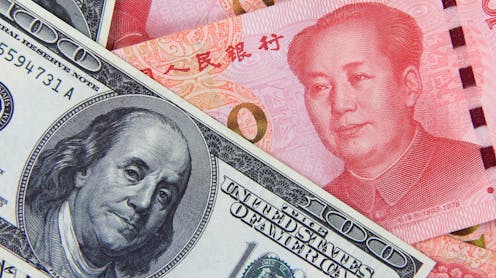
Forecasting the potential impact of Donald Trump’s turbulent tariff policies is a fraught business – and fraught for business. The United States president has changed, paused and exempted various categories of goods so often, the only certainty is uncertainty.
On “Liberation Day” (April 2) he famously announced far-reaching “reciprocal tariffs” on imports from most trading nations. Since then he has paused those tariffs, but kept 25% on imports of steel, aluminium and motor vehicles, and 10% “baseline” tariffs on all other imports.
The big exception is China, whose retaliation against the reciprocal US tariffs has resulted in an escalating trade war between the world’s two largest economies.
On April 9, the US raised tariffs on Chinese goods to 145%, but later scaled back duties on electronic goods such as laptops and smartphones to 20%. On April 12, China increased its tariff on US goods to 125%.
With China being New Zealand’s largest trade partner by far, and the US its third largest (just behind Australia), the impacts of this global standoff will be indirect but nevertheless significant.
GDP impacts of a trade war
To estimate the impacts of a US-China trade war, as well as other tariffs imposed by the US, I use the same global model of production, trade and consumption of goods and services employed to recently calculate the impacts of the Liberation Day tariffs.
As we can see, China and the US both lose from the tariff war. China’s GDP decreases by US$114 billion (0.58%), which equates to $236 per household per year on average. US GDP declines by $76 billion (0.25%) or $604 per household (all figures in US$).
The tariffs all but eliminate trade in goods between China and the US, except for electronic goods exported from China, which are subject to a lower tariff (for now).
Vietnam and India gain from the trade war because they produce many goods that substitute for Chinese products in the US market.
The trade war will affect New Zealand in at least three ways:
as the two nations buy less from each other, there is room for other nations to expand their exports to these markets
decreased incomes in China and the US will reduce global demand for all goods
and the tariffs will increase the costs of global supply chains.
The net effect is a 0.03% decrease in New Zealand’s GDP, equivalent to $70 million or $36 per household per year (roughly NZ$120 million and NZ$60 respectively).
Reshaping of the world economy
The simulations do not capture the impact of uncertainty caused by Trump’s frequent and abrupt changes in tariffs, carve-outs and clarifications (sometimes announced via social media).
The global US Trade Policy Uncertainty Index, last updated before the Liberation Day tariffs, is at a record high – 29 times higher than before the 2024 presidential election. This unprecedented uncertainty, coupled with the risk of high tariffs, is making exporters increasingly reluctant to commit to the US market.
The US currently accounts for 26.3% of global GDP. With higher future growth in many developing economies, especially in Asia, this is forecast to fall to 16.3% by 2050.
China is predicted to supplant the US as the world’s largest economy sometime in the 2030s, and by 2050 to account for 18.4% of global GDP (up from 16.9%).
India’s global GDP share is expected to increase significantly, from its current value of 3.7% to 9.7%. Indonesia and Philippines are also expected to grow rapidly.
New Zealand signed a free trade agreement with China in 2008 (and an upgrade to the agreement in 2022), has begun negotiations for one with India, and has regional agreements with many other rapidly developing Asian economies.
It remains to be seen whether Trump’s rollout of high tariffs signals a lasting policy shift or is merely a negotiating tactic to secure more favourable terms for US exporters. But New Zealand is well placed to pivot to alternative markets if needed.


